Dec 28, 2025 Written by 

Vocation Dynamics: Discovery and Dialogue

2. A vocation in the Church, from the human point of view, begins with a discovery, with finding the pearl of great price. You discover Jesus: his person, his message, his call. In the Gospel which we have heard today, we reflect on the call of Jesus to the first disciples. The first thing that Andrew did after meeting Jesus was to seek out his brother Simon and tell him: "We have found the Messiah!" Then Philip, in a similar way, sought out Nathanael and told him: "We have found the one Moses spoke of in the Law - the prophets too - Jesus, son of Joseph, from Nazareth" (Cfr. Io. 1, 35-51).

After the initial discovery, a dialogue in prayer ensues, a dialogue between Jesus and the one called, a dialogue which goes beyond words and expresses itself in love.

Questions are an important part of this dialogue. For example, in the Gospel account of the call of the disciples, we are told that "when Jesus turned around and noticed them following him, he asked them, ‘What are you looking for?’ They said to him, ‘Rabbi’ (which means teacher), where do you stay?’ ‘Come and see’, he answered” (Ibid. 1, 38-39).

What begins as a discovery of Jesus moves to a greater understanding and commitment through a prayerful process of questions and discernment. In this process, our motives are purified. We come face to face with pointed questions such as "What are you looking for?" And we even find ourselves asking questions of Jesus, as Nathanael did: "How do you know me?" (Io. 1, 48). It is only when we have reflected candidly and honestly in the silence of our hearts that we begin to be convinced that the Lord is truly calling us.

Yet, even then, the process of discernment is not over. Jesus says to us as he said to Nathanael: "You will see much greater things than that" (Ibid. 1, 50). Throughout our lives, after we have made a sacred and permanent commitment and after our active service of the Lord has begun, we still need the dialogue of prayer that will continually deepen our knowledge and love of our Lord Jesus Christ.

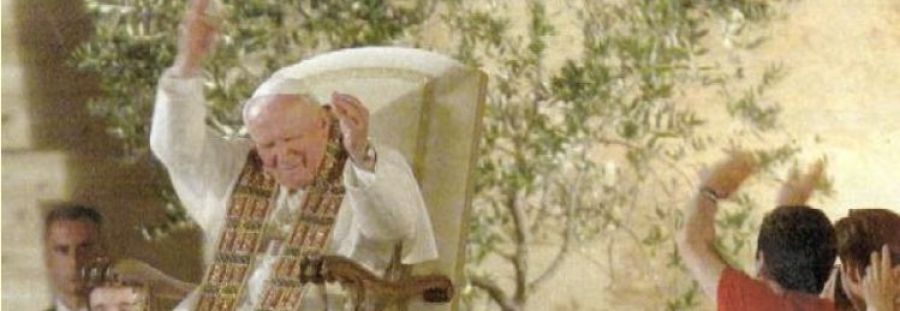
[Pope John Paul II, Address to American seminarians 13 September 1987]

50 Last modified on Sunday, 28 December 2025 05:42
don Giuseppe Nespeca

Giuseppe Nespeca è architetto e sacerdote. Cultore della Sacra scrittura è autore della raccolta "Due Fuochi due Vie - Religione e Fede, Vangeli e Tao"; coautore del libro "Dialogo e Solstizio".

Email This email address is being protected from spambots. You need JavaScript enabled to view it.
«The "blasphemy" [in question] does not really consist in offending the Holy Spirit with words; it consists, instead, in the refusal to accept the salvation that God offers to man through the Holy Spirit, and which works by virtue of the sacrifice of the cross [It] does not allow man to get out of his self-imprisonment and to open himself to the divine sources of purification» (John Paul II, General Audience July 25, 1990)
«La “bestemmia” [di cui si tratta] non consiste propriamente nell’offendere con le parole lo Spirito Santo; consiste, invece, nel rifiuto di accettare la salvezza che Dio offre all’uomo mediante lo Spirito Santo, e che opera in virtù del sacrificio della croce [Esso] non permette all’uomo di uscire dalla sua autoprigionia e di aprirsi alle fonti divine della purificazione» (Giovanni Paolo II, Udienza Generale 25 luglio 1990)
Seen from the capital Jerusalem, that land is geographically peripheral and religiously impure because it was full of pagans, having mixed with those who did not belong to Israel. Great things were not expected from Galilee for the history of salvation. Instead, right from there — precisely from there — radiated that “light” on which we meditated in recent Sundays: the light of Christ. It radiated right from the periphery (Pope Francis)
Vista dalla capitale Gerusalemme, quella terra è geograficamente periferica e religiosamente impura perché era piena di pagani, per la mescolanza con quanti non appartenevano a Israele. Dalla Galilea non si attendevano certo grandi cose per la storia della salvezza. Invece proprio da lì - proprio da lì - si diffonde quella “luce” sulla quale abbiamo meditato nelle scorse domeniche: la luce di Cristo. Si diffonde proprio dalla periferia (Papa Francesco)
Christ and his intimates tried to strengthen the sense of sharing, returning to the profound spirit of what once the clan, the family, the community were - expressions of God's love that manifests itself...
Cristo e i suoi intimi tentavano di rafforzare il senso di condivisione, tornando allo spirito profondo di ciò che un tempo erano appunto il clan, la famiglia, la comunità - espressioni dell’amore di Dio che si manifesta…
The Church was built on the foundation of the Apostles as a community of faith, hope and charity. Through the Apostles, we come to Jesus himself. Therefore, a slogan that was popular some years back:  "Jesus yes, Church no", is totally inconceivable with the intention of Christ (Pope Benedict)
La Chiesa è stata costituita sul fondamento degli Apostoli come comunità di fede, di speranza e di carità. Attraverso gli Apostoli, risaliamo a Gesù stesso. È pertanto del tutto inconciliabile con l'intenzione di Cristo uno slogan di moda alcuni anni fa: "Gesù sì, Chiesa no" (Papa Benedetto)
Intimidated by the nightmare of demons and concrete dangers, the crowds could not see the possibility of emancipation from an existence of obsessions - slavish, frightened, lost, overwhelmed...
Intimidite dall’incubo di demoni e pericoli concreti, le folle non riuscivano a vedere possibilità di emancipazione da un’esistenza di ossessioni - pedissequa, spaventata, smarrita, sopraffatta…
Justification incorporates us into the long history of salvation that demonstrates God’s justice: faced with our continual falls and inadequacies, he did not give up, but wanted to make us righteous (Pope Francis)
La giustificazione ci inserisce nella lunga storia della salvezza, che mostra la giustizia di Dio: di fronte alle nostre continue cadute e alle nostre insufficienze, Egli non si è rassegnato, ma ha voluto renderci giusti (Papa Francesco)

Due Fuochi due Vie - Vol. 1 Due Fuochi due Vie - Vol. 2 Due Fuochi due Vie - Vol. 3 Due Fuochi due Vie - Vol. 4 Due Fuochi due Vie - Vol. 5 Dialogo e Solstizio I fiammiferi di Maria

duevie.art

don Giuseppe Nespeca

Tel. 333-1329741


Disclaimer

Questo blog non rappresenta una testata giornalistica in quanto viene aggiornato senza alcuna periodicità. Non può pertanto considerarsi un prodotto editoriale ai sensi della legge N°62 del 07/03/2001.
Le immagini sono tratte da internet, ma se il loro uso violasse diritti d'autore, lo si comunichi all'autore del blog che provvederà alla loro pronta rimozione.
L'autore dichiara di non essere responsabile dei commenti lasciati nei post. Eventuali commenti dei lettori, lesivi dell'immagine o dell'onorabilità di persone terze, il cui contenuto fosse ritenuto non idoneo alla pubblicazione verranno insindacabilmente rimossi.






