Oct 3, 2026 Written by 

At the Banquet

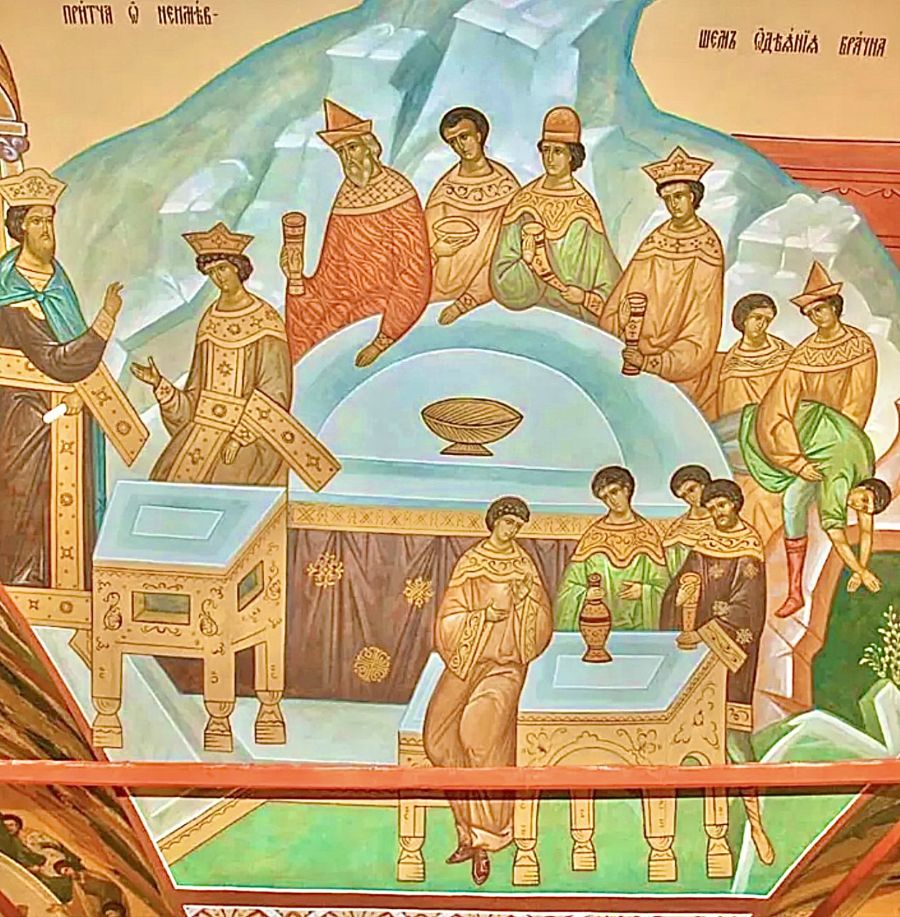
In today’s Gospel reading, Jesus presents the parable of the wedding banquet as a metaphor for the Kingdom of Heaven.

The invited guests show no interest in attending the king’s banquet, so the servants are sent out to gather whoever they find on the streets – but only those wearing wedding garments.

«For many are called, but few are chosen» (Mt 22:14).

Let us now consider how the Poverello lived out all this, according to the accounts in the Sources.

Enamoured of Lady Poverty, Francis of Assisi earnestly invited her to take a meal with the friars [cf. Sacrum Commercium Beati Francisci cum Domina Paupertate]:

“Then they led her to the place where the table had been set. When she arrived, she looked around and, seeing nothing but three or four loaves of barley and bran bread placed on the grass, was filled with great wonder” (FF 2020).

She then “ordered them all to gather together and addressed them with words of life, saying:

«May you be blessed, my sons, by the Lord God who created heaven and earth, for you have welcomed me into your home with such an abundance of charity that, being with you today, it has seemed to me as though I were in the Lord’s paradise […]

This is what I have sought so long; now I behold it […] for on earth I have been united with men who are for me a faithful image of Him who is my spouse in heaven.

May the Lord bless your courage and be pleased with the work of your hands»” (FF 2024).

Called and chosen in the company of Lady Poverty, to follow in the footsteps of the Son of God.

Clare herself, in her Spiritual Testament—a true Franciscan gem—addresses her present and future daughters, inviting them to guard the priceless treasure of their calling. We read in it:

«Among the other blessings we have received and continue to receive daily from our Giver, the Father of Mercies, for which we are deeply obliged to offer Him glorious and living thanksgiving, great is the blessing of our vocation. And the greater and more perfect it is, the more deeply we are bound to Him. Therefore, the Apostle admonishes: ‘Know well your vocation’» (FF 2823).

And again:

«The Son of God has become our Way; and this was shown and taught to us by word and example by our blessed father Francis, a true lover and imitator of Him» (FF 2824).

At this point, Clare recalls when the Saint, under divine inspiration, prophesied concerning them.

“Having climbed onto the wall of that church […] he addressed some poor people who were standing nearby:

«Come and help me with this work at the monastery of St Damian, for soon women will come to live there, and through the fame of the holiness of their lives, glory will be given to our heavenly Father throughout his holy Church».

We may, therefore, admire in this event the great goodness of God towards us: He deigned, in His overflowing mercy and charity, to inspire such words in His Saint concerning our vocation and election» (FF 2827–2828).


28th Sunday in Ordinary Time (year A)  (Mt 22:1–14)

276 Last modified on Saturday, 03 October 2026 03:54
Teresa Girolami

Teresa Girolami è laureata in Materie letterarie e Teologia. Ha pubblicato vari testi, fra cui: "Pellegrinaggio del cuore" (Ed. Piemme); "I Fiammiferi di Maria - La Madre di Dio in prosa e poesia"; "Tenerezza Scalza - Natura di donna"; co-autrice di "Dialogo e Solstizio".

Email This email address is being protected from spambots. You need JavaScript enabled to view it.
The Sadducees, addressing Jesus for a purely theoretical "case", at the same time attack the Pharisees' primitive conception of life after the resurrection of the bodies; they in fact insinuate that faith in the resurrection of the bodies leads to admitting polyandry, contrary to the law of God (Pope John Paul II)
I Sadducei, rivolgendosi a Gesù per un "caso" puramente teorico, attaccano al tempo stesso la primitiva concezione dei Farisei sulla vita dopo la risurrezione dei corpi; insinuano infatti che la fede nella risurrezione dei corpi conduce ad ammettere la poliandria, contrastante con la legge di Dio (Papa Giovanni Paolo II)
Today, as yesterday, the Church needs you and turns to you. The Church tells you with our voice: don’t let such a fruitful alliance break! Do not refuse to put your talents at the service of divine truth! Do not close your spirit to the breath of the Holy Spirit! (Pope Paul VI)
Oggi come ieri la Chiesa ha bisogno di voi e si rivolge a voi. Essa vi dice con la nostra voce: non lasciate che si rompa un’alleanza tanto feconda! Non rifiutate di mettere il vostro talento al servizio della verità divina! Non chiudete il vostro spirito al soffio dello Spirito Santo! (Papa Paolo VI)
Sometimes we try to correct or convert a sinner by scolding him, by pointing out his mistakes and wrongful behaviour. Jesus’ attitude toward Zacchaeus shows us another way: that of showing those who err their value, the value that God continues to see in spite of everything (Pope Francis)
A volte noi cerchiamo di correggere o convertire un peccatore rimproverandolo, rinfacciandogli i suoi sbagli e il suo comportamento ingiusto. L’atteggiamento di Gesù con Zaccheo ci indica un’altra strada: quella di mostrare a chi sbaglia il suo valore, quel valore che Dio continua a vedere malgrado tutto (Papa Francesco)
Deus dilexit mundum! God observes the depths of the human heart, which, even under the surface of sin and disorder, still possesses a wonderful richness of love; Jesus with his gaze draws it out, makes it overflow from the oppressed soul. To Jesus, therefore, nothing escapes of what is in men, of their total reality, in which good and evil are (Pope Paul VI)
Deus dilexit mundum! Iddio osserva le profondità del cuore umano, che, anche sotto la superficie del peccato e del disordine, possiede ancora una ricchezza meravigliosa di amore; Gesù col suo sguardo la trae fuori, la fa straripare dall’anima oppressa. A Gesù, dunque, nulla sfugge di quanto è negli uomini, della loro totale realtà, in cui sono il bene e il male (Papa Paolo VI)
The "talent" was an ancient Roman coin, of great value, and precisely because of this parable's popularity it became synonymous with personal gifts, which everyone is called to develop. In fact […] (Pope Benedict)
Il "talento" era un’antica moneta romana, di grande valore, e proprio a causa della popolarità di questa parabola è diventata sinonimo di dote personale, che ciascuno è chiamato a far fruttificare. In realtà […] (Papa Benedetto)
O Lord, let my faith be full, without reservations, and let penetrate into my thought, in my way of judging divine things and human things (Pope Paul VI)
O Signore, fa’ che la mia fede sia piena, senza riserve, e che essa penetri nel mio pensiero, nel mio modo di giudicare le cose divine e le cose umane (Papa Paolo VI)
The Judgment surprises and makes friends with the journey of each one who notices
Il Giudizio sorprende e fa amicizia con il viaggio di ciascuno che si accorge

Due Fuochi due Vie - Vol. 1 Due Fuochi due Vie - Vol. 2 Due Fuochi due Vie - Vol. 3 Due Fuochi due Vie - Vol. 4 Due Fuochi due Vie - Vol. 5 Dialogo e Solstizio I fiammiferi di Maria

duevie.art

don Giuseppe Nespeca

Tel. 333-1329741


Disclaimer

Questo blog non rappresenta una testata giornalistica in quanto viene aggiornato senza alcuna periodicità. Non può pertanto considerarsi un prodotto editoriale ai sensi della legge N°62 del 07/03/2001.
Le immagini sono tratte da internet, ma se il loro uso violasse diritti d'autore, lo si comunichi all'autore del blog che provvederà alla loro pronta rimozione.
L'autore dichiara di non essere responsabile dei commenti lasciati nei post. Eventuali commenti dei lettori, lesivi dell'immagine o dell'onorabilità di persone terze, il cui contenuto fosse ritenuto non idoneo alla pubblicazione verranno insindacabilmente rimossi.