Oct 21, 2026 Written by 

Not understanding Peace

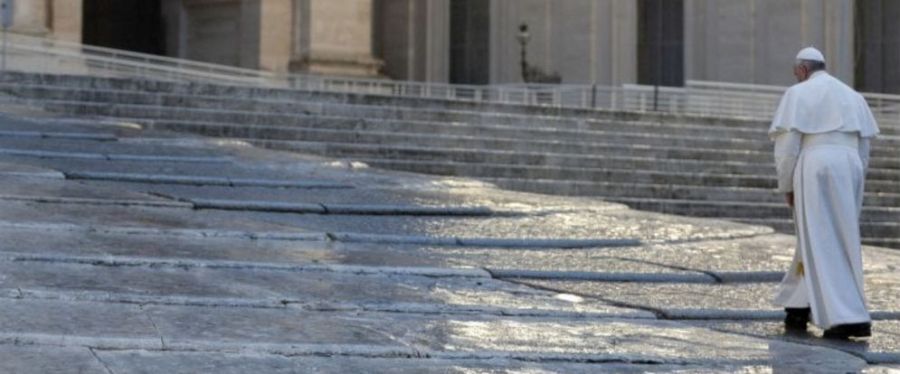
Today God continues to weep - with fatherly and motherly tears - before calamities, wars unleashed to worship the god of money, so many innocents killed by bombs, a humanity that does not seem to want peace. It is a strong invitation to conversion that Francis re-launched in the Mass celebrated on Thursday morning, 27 October, in the chapel of the Casa Santa Marta. An invitation that the Pontiff motivated by recalling that God became man precisely to weep with and for his children.

In the passage from Luke's Gospel (13:31-35) proposed by the liturgy, the Pope explained, "it seems that Jesus had lost his patience and also uses strong words: it is not an insult but it is not a compliment to say 'fox' to a person". To be precise he says to the Pharisees who told him about Herod: "Go and tell that fox". But already "on other occasions Jesus spoke harshly": for example, he said "perverse and adulterous generation". And he called the disciples 'hard-hearted' and 'foolish'. Luke reports the words in which Jesus makes a real 'summary of what is to come: "it is necessary for me to go on my way because it is not possible for a prophet to die outside Jerusalem"'. Basically, the Lord "says what will happen, he prepares to die".

But "then immediately Jesus changes tones," Francis pointed out. "After this loud outburst," in fact, "he changes his tone and looks at his people, he looks at the city of Jerusalem: 'Jerusalem, you who kill the prophets and stone those who were sent to you!'" He looks at "the closed Jerusalem, which has not always received the messengers of the Father". And "Jesus' heart begins to speak with tenderness: 'Jerusalem, how often have I wanted to gather your children like a hen her chicks!'". Here is "the tenderness of God, the tenderness of Jesus". That day he "wept over Jerusalem". But "that weeping of Jesus," the Pope explained, "is not the weeping of a friend before the tomb of Lazarus. That is the weeping of a friend before the death of another"; instead "this is the weeping of a father who weeps, it is God the Father who weeps here in the person of Jesus".

"Someone said that God became man so that he could weep for what his children had done," said the Pontiff. And so "the weeping before the tomb of Lazarus is the weeping of a friend". But what Luke recounts 'is the weeping of the Father'. In this regard, Francis also recalled the attitude of the 'father of the prodigal son, when his youngest son asked him for the inheritance money and went away'. And "that father is sure, he did not go to his neighbours and say: 'look what happened to me, but this poor wretch what he did to me, I curse this son! No, he did not do this'. Instead, said the Pope, "I am sure" that that father "went off crying alone".

True, the Gospel does not reveal this detail,' Francis continued, 'but it tells us that when the son returned he saw the father from afar: this means that the father continually went up to the terrace to watch the path to see if the son was coming back'. And 'a father who does this is a father who lives in weeping, waiting for his son to return'. Precisely this is "the weeping of God the Father; and with this weeping the Father recreates in his Son all creation".

"When Jesus went with the cross to Calvary," the Pontiff recalled, "the pious women wept and he said to them: 'No, do not weep over me, weep for your children'". It is the "weeping of a father and mother that God continues to do even today: even today in the face of calamities, of the wars that are waged to worship the god money, of so many innocents killed by the bombs that the worshippers of the idol money throw down". And so 'even today the Father weeps, even today he says: "Jerusalem, Jerusalem, my children, what are you doing?"'. And "he says this to the poor victims and also to the arms dealers and to all those who sell people's lives".

In conclusion Francis suggested that we "think that God became man in order to weep. And it will be good for us to think that our Father God weeps today: he weeps for this humanity that does not understand the peace he offers us, the peace of love".

[Pope Francis, homily at St Martha's, in L'Osservatore Romano 28/10/2016]

6 Last modified on Wednesday, 21 October 2026 02:59
don Giuseppe Nespeca

Giuseppe Nespeca è architetto e sacerdote. Cultore della Sacra scrittura è autore della raccolta "Due Fuochi due Vie - Religione e Fede, Vangeli e Tao"; coautore del libro "Dialogo e Solstizio".

Email This email address is being protected from spambots. You need JavaScript enabled to view it.
We find ourselves, so to speak, roped to Jesus Christ together with him on the ascent towards God's heights (Pope Benedict)
Ci troviamo, per così dire, in una cordata con Gesù Cristo – insieme con Lui nella salita verso le altezze di Dio (Papa Benedetto)
There are also serious, dangerous omissions and we have to recognize with healthy realism that in this way things are not all right, it is not all right when errors are made. However, we must also be certain at the same time that if, here and there, the Church is dying because of the sins of men and women, because of their non-belief, at the same time she is reborn (Pope Benedict)
Ci sono anche cadute gravi, pericolose, e dobbiamo riconoscere con sano realismo che così non va, non va dove si fanno cose sbagliate. Ma anche essere sicuri, allo stesso tempo, che se qua e là la Chiesa muore a causa dei peccati degli uomini, a causa della loro non credenza, nello stesso tempo, nasce di nuovo (Papa Benedetto)
The question makes apparent the concern, present in ancient Jewish tradition, over finding a unifying principle in the various formulations of God's will […] Emphasis is placed on the totality of this dedication to God, listing the three faculties that define man in his deep psychological structures: heart, soul and mind. The word mind, diánoia, contains the rational element (Pope Benedict)
La domanda lascia trasparire la preoccupazione, presente nell’antica tradizione giudaica, di trovare un principio unificatore delle varie formulazioni della volontà di Dio […] L’accento è posto sulla totalità di questa dedizione a Dio, elencando le tre facoltà che definiscono l’uomo nelle sue strutture psicologiche profonde: cuore, anima e mente. Il termine mente, diánoia, contiene l’elemento razionale (Papa Benedetto)
A “year” of grace: the period of Christ’s ministry, the time of the Church before his glorious return, an interval of our life (Pope Francis)
Un “anno” di grazia: il tempo del ministero di Cristo, il tempo della Chiesa prima del suo ritorno glorioso, il tempo della nostra vita (Papa Francesco)
The Church, having before her eyes the picture of the generation to which we belong, shares the uneasiness of so many of the people of our time (Dives in Misericordia n.12)
Avendo davanti agli occhi l'immagine della generazione a cui apparteniamo, la Chiesa condivide l'inquietudine di tanti uomini contemporanei (Dives in Misericordia n.12)
Addressing this state of mind, the Church testifies to her hope, based on the conviction that evil, the mysterium iniquitatis, does not have the final word in human affairs (Pope John Paul II)
Di fronte a questi stati d'animo la Chiesa desidera testimoniare la sua speranza, basata sulla convinzione che il male, il mysterium iniquitatis, non ha l'ultima parola nelle vicende umane (Papa Giovanni Paolo II)
Jesus reminds us today that the expectation of the eternal beatitude does not relieve us of the duty to render the world more just and more liveable (Pope Francis)
Let us look at them together, not only because they are always placed next to each other in the lists of the Twelve (cf. Mt 10: 3, 4; Mk 3: 18; Lk 6: 15; Acts 1: 13), but also because there is very little information about them, apart from the fact that the New Testament Canon preserves one Letter attributed to Jude Thaddaeus [Pope Benedict]

Due Fuochi due Vie - Vol. 1 Due Fuochi due Vie - Vol. 2 Due Fuochi due Vie - Vol. 3 Due Fuochi due Vie - Vol. 4 Due Fuochi due Vie - Vol. 5 Dialogo e Solstizio I fiammiferi di Maria

duevie.art

don Giuseppe Nespeca

Tel. 333-1329741


Disclaimer

Questo blog non rappresenta una testata giornalistica in quanto viene aggiornato senza alcuna periodicità. Non può pertanto considerarsi un prodotto editoriale ai sensi della legge N°62 del 07/03/2001.
Le immagini sono tratte da internet, ma se il loro uso violasse diritti d'autore, lo si comunichi all'autore del blog che provvederà alla loro pronta rimozione.
L'autore dichiara di non essere responsabile dei commenti lasciati nei post. Eventuali commenti dei lettori, lesivi dell'immagine o dell'onorabilità di persone terze, il cui contenuto fosse ritenuto non idoneo alla pubblicazione verranno insindacabilmente rimossi.