


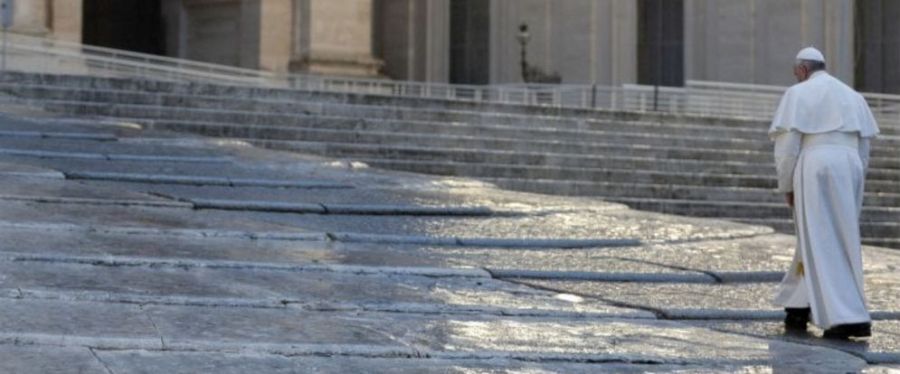
The Christian does not walk alone: he is embedded in a people, in a secular history and is called to put himself at the service of others. 'Memory' and 'service' are the key words of Pope Francis' reflection during the Mass celebrated at Santa Marta on Thursday 30 April. History - and therefore the memory one has of it - and service are, the Pontiff said, the "two traits of the Christian's identity" on which "today's liturgy" makes us reflect.
The reference is given by the passage from the Acts of the Apostles (13:13-25) in which we read that Paul, on arriving in Antioch, "as he usually did, went on the Sabbath to the synagogue" and there "was invited to speak". This was, in fact, "a custom of the Jews of that time" when a guest arrived. Having taken the floor, Paul 'began to preach Jesus Christ'. But, the Pope stressed, 'he did not say: "I preach Jesus Christ, the Saviour; he came from Heaven; God sent him; he saved us all and gave us this revelation. No, no, no'. To explain who Jesus is, the apostle "begins to tell the whole story of the people. We then read in Scripture: "Paul stood up and beckoned with his hand and said, 'Listen, the God of this people of Israel chose our fathers...'". And, starting with Abraham, Paul "tells the whole story".
It is not a random choice. In his reflection, Francis pointed out how the same thing was done by 'Peter in his speeches, after Pentecost', and also 'Stephen, before the Sanhedrin'. They, that is, "did not announce a Jesus without history", but "Jesus in the history of the people, a people that God has been making walk for centuries to arrive at this maturity, at the fullness of time, as Paul says". From this account we understand that "when this people arrives at the fullness of time, the Saviour comes, and the people continues to walk because this Saviour will return".
Here, then, the Pope reiterated, is one of the traits of Christian identity: 'it is to be a man and woman of history, to understand that history does not begin with me and ends with me'. Everything began, in fact, when the Lord entered history.
To comfort this, the Pontiff recalled the "very beautiful" psalm recited at the beginning of the Mass: "When you advanced Lord with your people and when you opened the way for them and dwelt with them - I remember that God walked with his people - the earth trembled, the heavens shouted. Admirable'. So 'the Christian is a man and woman of history, because he or she does not belong to himself or herself, he or she is part of a people, a walking people'. Hence the impossibility of thinking of 'a Christian egoism'. In other words, there is no perfect Christian, 'a laboratory spiritual man or woman', but always a spiritual man or woman inserted 'in a people, which has a long history and continues to walk until the Lord returns'.
Looking precisely at this concrete story that has unfolded over the centuries and continues to this day, the Pontiff added that if we assume "to be men and women of history", we also realise that this is "a story of God's grace, because God advanced with his people, opened the way, lived with them". But it is also 'history of sin'. And the Pope recalled: 'How many sinners, how many crimes...'. Also in the passage from the Acts of the Apostles, for example, 'Paul mentions King David, who was holy', but who 'before becoming holy was a great sinner'. And this, he emphasised, is true 'also today' when everyone's 'personal history' must take on 'their sin and the grace of the Lord who is with us'. For God accompanies us in sin 'to forgive', accompanies us 'in grace'.
It is therefore a very concrete reality that spans the centuries, the one recalled by Francis in his homily: "We," he said, "are not rootless", we have "deep roots" that we must never forget and that go from "our father Abraham to today".
Understanding, however, that we are not alone, that we are closely linked to a people that has been walking for centuries, also means understanding another characteristic trait of the Christian and that is "what Jesus teaches us in the Gospel: service". In the passage from John proposed by the liturgy on Thursday of the fourth week of Easter, "Jesus washes the disciples' feet. And after he had washed their feet, he said to them, 'Truly, truly I say to you, a servant is not greater than his master, nor is a sent one greater than he who sent him. Knowing these things, you are blessed if you put them into practice. I have done this with you, you do the same with others. I have come to you as a servant, you must make yourselves servants of one another, serve''.
It is clear, the Pontiff pointed out, that 'Christian identity is service, not selfishness'. Someone, he said, might retort: 'But Father, we are all selfish', but this 'is a sin, it is a habit from which we must detach ourselves'; we must then 'ask for forgiveness, may the Lord convert us'. Being a Christian, in fact, 'is not an appearance or even a social conduct, it is not a bit of making up one's soul, so that it may be a bit more beautiful'. To be a Christian, the Pope said decisively, "is to do what Jesus did: to serve. He came not to be served, but to serve'.
Hence some of the Pontiff's suggestions for the daily life of each of us. First of all, "think about these two things: do I have a sense of history? Do I feel part of a people walking from afar?". Useful might be 'to take the Bible, the Book of Deuteronomy, chapter 26, and read it'. Here, he said, one encounters "the memory, the memory of the righteous" and "how the Lord wants us to be 'mindful'", that is, to remember "the path our people walked". It is also good for us to think: "in my heart, what more do I do? Do I let others serve me, do I serve others, the community, the parish, my family, my friends, or do I serve, am I in service'?
"Memory and service", then, are the two attitudes of the Christian, those with which one also participates in the Eucharistic celebration "which is precisely memory of the service that Jesus did; real memory, with Him, of the service He rendered us: giving His life for us."
[Pope Francis, S. Marta homily in L'Osservatore Romano 01/05/2015]








