


Reputation: crossroads of the Cross
(Mt 16:24-28)
To lose one's life or to lose it? To save it or to find it? Christ desires to lead us to the homeland that corresponds deeply to us.
He offers this by sharing the pilgrim journey of exploration with us, together with Him and our brothers and sisters.
As we proceed, what we do is motivated by the search for fulfilment and happiness – even at the risk of losing ourselves.
We have become passionate about the journey in the Spirit for the same reason: to have an increase in life.
But in the Master's proposal, we see a disconcerting logic.
To protect ourselves from vain illusions (which degrade us), we must not rush to grab prestigious roles, possessions, or relationships that matter.
The most attractive and conspicuous things remain external and unfruitful. They do not regenerate.
Instead... waiting, listening, exercising passive virtues, bitterness and defeat call us to return to ourselves.
Setbacks are a call that prepares the most relevant and well-founded future developments, precisely in favour of a full existence.
Of course, those who do not fit into the rush for titles and the comedy of ceremonies of like-minded societies may immediately suffer the worst. But this is better than losing the quality and fruitfulness of life, dispersing them in misunderstanding.
Often, our 'leaving everything' to follow Christ is also for an expected and hoped-for gain. Even a 'good' gain: immediately relational, qualitative, and cultural, for example.
[The guides spoke to us in this sense of the vice of 'spiritual gluttony': the aim is to learn interesting things, have good and substantial company, increase knowledge, find well-founded ways to be praised, etc.].
The point is that the imagined positive outcome is always shaped by old intentions. Ultimately, it is to impose oneself, to shine and to command; not to "lose".
Not to 'give in'. Not to allow other energies and horizons to enter into situations and emerge - paradoxically - in us.
On this unattractive terrain - but one which in Christ will become overflowing with grace, fruitful and deeply educational - even those who do not fear sacrifice can waver, because the Way of the Crucified One seems to lead us straight to mockery and failure.
However, the profound and seemingly absurd reason for the new Magisterium emerges, without any ulterior motives.
Confrontation with the Word helps us to realise more and more that it is necessary to introduce a new frame of reference into the soul of each one of us: personal, social and communal.
The ancient, secure and triumphant context has helped to build an impressive scaffolding, but one that clashes with the meaning of the Good News of Salvation.
Life as saved people is for everyone. It is now a transparent proclamation of boundless Beatitudes in favour of the meek, the humiliated and neglected, those in need of everything.
Even for Jesus, the evangelisation of the Apostles and his 'neighbours' - all intent on softening and attenuating his immoderate Dreams - was no child's play.
Just like the Lord, even today, true proclaimers must already expect afflictions, traps, shoulder blows, mockery, and derision (the most surprising).
But they do not give up, partly because the embarrassment of those who suddenly find themselves not on a triumphal path is understandable. Not on a breathtaking path, dotted with honourable and exhilarating landings.
Rather, it is a path of truth and self-giving, discarded and rejected - no longer sweetened, superficial or smuggled.
It can be tolerated, after all, with a sense of realism, as Jesus did with his Peter. In short, even this strand can be part of the new balance that the Spirit is building.
Yes, the institutional and compromising [“Petrine”] aspect often wants to take the initiative and exorcise the Call of Jesus; to silence it in favour of the display of his superpowers.
Yet the Master does not allow himself to be taken hostage - indeed, it is He who has placed the head of the disciple in his place (vv. 22-23).
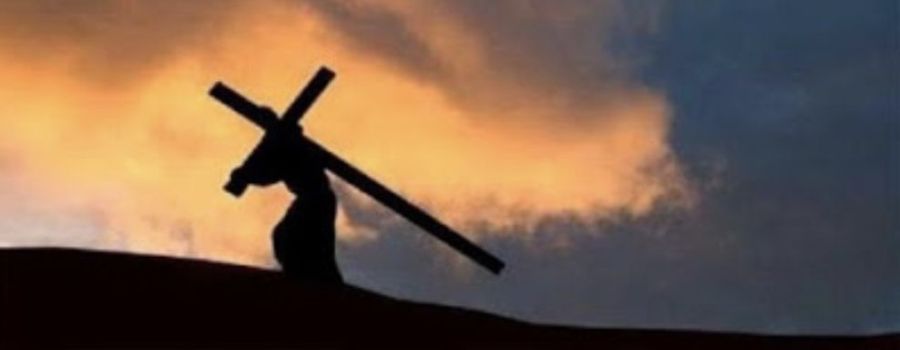
The cross was a death penalty and a perpetual disgrace reserved for rebellious slaves, bandits, subversives, misfits who refused their position of civil marginalisation.
This is what is at stake: agreeing to raise the horizontal arm of the public gallows behind Jesus still means today forgetting one's 'reputation', being shamed.
Not for asceticism or any particular perfectionism.
To impoverish oneself of superfluous goods, to lose prestige and roles, to be shamed, to let others pass ahead [even to manipulate us: so that sooner or later they will realise].
So that Providence has time to prepare us.
The life that is to come will call upon other energies, arranging events in ways that are more mysterious than obvious.
It will bring into play diverse personal and social virtues - convergent, cosmic and intimately humanising; acutely fascinating and inspiring.
We are experiencing this in a time of crisis and turmoil, for a 'rebirth' that requires new beginnings; which seems to have no desire to conform to the age that has passed.
In fact, in the storm, the passion of love has its preparatory stages, of higher significance, which sooner or later will bring forth authentic, eminent awareness. And the fraternal spirit nestled in the soul of all.
The perspective is personal in this sense, but not individualistic, rather that of the 'Son of Man': He who gives us a glimpse of the human condition, accessible and divinising.
But we need to realise this: let us help each other to grasp it in the Present (vv. 27-28)!
In fact, in the Gospels, the 'Son of God' is Christ who reveals the Father, unveiling God in the human condition. The 'Son of Man' is Jesus who reveals man in the divine condition.
The 'Son of Man' is the One who, having pushed himself to the utmost of love in the fullness of his Person, comes to reflect the divine condition, showing it and radiating it in eminent signs.
He does so without the narrow perspectives typical of religions; without even a legacy of 'right' and unchanging ideas, or forces of increasing and ever-performing power.
"Son of Man" is the successful Son: the Person who has taken the definitive step.
The Word made brother, who in us aspires to the fullness spread throughout history, to an indestructible quality within each of us who draws near (and encounters heartfelt divine figures, sublime traits of humanisation).
We therefore risk living 'with' and 'for' others, neglecting the search for esteem and losing credibility [not at all costs by seeking it].
We do this with determination, embracing our own unique calling, experiencing the Father who provides for us.
In this way, we will be able to positively lift up the flowered Cross, which fertilises the soul and the world around us.
It is an experience from which there is no turning back, so sublime is it and so endless are its goals, impossible to imagine or propose because of our sterile 'nature'.
On this ray of light and with a new Name, even in the great hardships of our time, we will be like the Friend-Guide: genuine, not conformist; lying on the core of our being, but standing upright on unexplored roads.
Simultaneously committed and serene. Less banal, through personal contact.
To internalise and live the message:
In what sense have you experienced life gained after having 'lost' it? By contacting what dormant energies? On what unexplored paths?








