


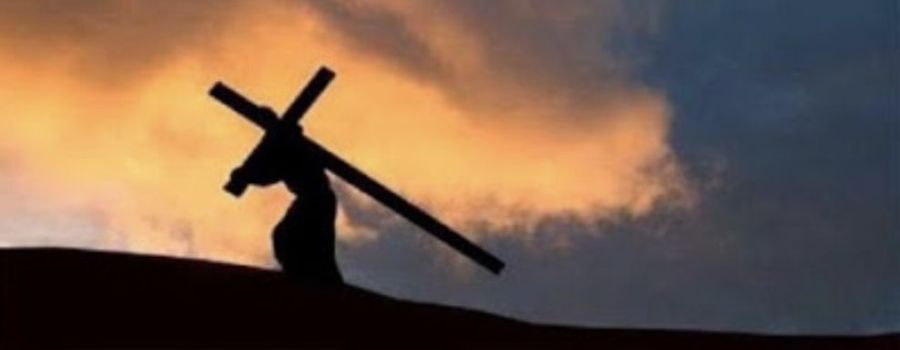
What is the Sign of the Mystery?
(Mt 12:38-42)
Jesus encounters unbelief. It comes from various forms of blindness and prejudice, or (especially in the disciples) arises from inattention.
The Lord distances himself from those who test him and from those who reject what is given by God, demanding to dictate how he should act.
The Son of Man respects every person who follows him, but he makes it clear that decisions and, even more so, a lack of acute perception prevent the Encounter and the redemption of life.
From this perspective, believers do not live to 'prove' anything. Christ himself does not wait for us in subliminal and amazing manifestations, but on the shore of an earthly spirituality.
Value does not need applause (a double-edged sword) - a mask for artificial proposals and inauthentic life.
Humanising correspondence does not grow with the multiplication of dizzying signals.
God does not coerce the unconvinced, nor does he overwhelm with proof; in this way, he gains a heritage of Love in growth.
His authentic Church, without clamour or persuasive positions - apparently insignificant - is gathered in intimate unity with his Firstborn: native, portentous and regenerating power - solid and real.
The queen of the south sought captivating solutions to enigmatic curiosities, but she could find them within her soul and in her life.
Incarnation: there are no other valid signs than events and new relationships - with oneself and with others - which present the very Person and unheard-of nature of the Risen One (the one without wrappings).
The Eternal One is no longer the pure transcendence of the Jews, nor the summit of the wisdom of the ancient world.
The sign of the Most High is the story of Jesus (alive in us). It opens the exciting path that leads to the Father.
Let us trust in Christ, therefore, and reject spiritual drugs that delude us with happiness.
This is the meaning of the new Creation: abandonment to the Spirit - but in a concrete way (not in a mannered way) - which proceeds by drawing along an alternative reality.
His Person is a unique sign that frees us from the many surrogates of the religion of fears, shackles and established roles.
These are those who would like to imprison him as an 'ally' who performs seductive and immediately decisive miracles.
Some would like to see him as a simple purifier of the temple or a character from a fairy tale - and so would we, if we allow ourselves to be manipulated.
In fact, the religious leaders to whom Jesus addresses himself are those returning to his communities!
They were Judaizers who wanted to fit the Messiah into the pattern of normal expectations to which they had always been accustomed.
Or they already understood and were fed up...
In these 'veterans' there was no sign of conversion to the idea of the Son of God as a Servant, trusting in dreams without prestige.
In them? There was no trace of a new idea - nor any change of pace that would mark the decline of the ostentatious, dehumanising - and even sacred - society of the outside world.
Popular leaders sometimes miss the meaning of the only living Sign: Jesus, the Bread of Life.
Because of them, not because of those who are far away, the Lord 'groans in spirit' (cf. Mk 8:12, Greek text) - even today, saddened by so much blindness.
Life is in fact precluded to those who cannot shift their gaze.
Immediately after Mt (16:6), he refers to the danger of the dominant ideology that caused even the leaders to lose their objective perception of events.
A coarse "leaven" but rooted in the painful experience of the people - which stimulated swelling even in the disciples, contaminating them.
To the top of the class, it might have seemed that Jesus was a leader like Moses, because he fed the hungry people in the desert (cf. Mt 14:13-21; 15:32-39).
But the rejection is clear: especially Mark (8:12) brings it to life by emphasising the Master's sense of suffering.
Then, as in Matthew and Luke in the episode of Jonah, there is his radical, peremptory refusal.
To save a people in need of everything, there is no other way than to start from within.
Then proceed towards a fullness of being that spreads, approves us, and, flowing out, allows us to break our lives in favour of our brothers and sisters.
There is no escape. Only communion with the hidden source of one's own eminent Self and respectful and active dialogue with others can save us from a closed group mentality.
In this way, no club is allowed - no club that claims exclusive monopoly over God and souls (Mt 9:38-40) with the explicit claim to discipline the multitudes.
The community of the Risen One abhors the competitive conception of religious life itself, if it is a sacred reflection of the imperial world and of a society that oppresses and embitters the existence of the little ones.
It would be a sick life in search of prestige, even if only apparent.
On the contrary, in fraternal realities, 'whoever humbles himself is the greatest in the kingdom of heaven' (Mt 18:4).Therefore, it is absolutely necessary to avoid a pyramidal mentality and a mentality of rejection creeping into the faithful.
A spirit of competition that inevitably ends up seeking refuge in hypocritical miracle-mongering, a substitute for the life of faith.
The Master does the same to educate members of the Church who remain - perhaps even today - affected by a sense of superiority towards crowds and strangers.
A feeling of being a chosen and privileged people (Lk 9:54-55) that was even infiltrating the early communities.
To those who do not want to open their eyes except to be captivated by phenomena that are yet to be discerned - because despite the official creed they profess, they remain tied to an ideology of power - the Lord never reserves impressive confirmations coming 'from heaven' (Mt 16:1) that would be their paradoxical validation.
The only sign is and will be his living Church: the 'victory' of the Risen One who pulsates in all those who take him seriously.
Without fixed hierarchies - under the infallible guidance of the Call and the Word - the children know how to reinterpret, even in new ways.
Such is the miracle, embodied in a thousand events (in history, in personal and community life); in recoveries, healings and impossible re-evaluations.
The authentic Messiah does not offer any cosmic display.
There are no festivals that force spectators to bow their heads in the presence of such overwhelming glory and condescension, as if he were a heavenly dictator.
And no lightning bolts as a shortcut.
Over the centuries, churches have often fallen into this 'apologetic' temptation, which is entirely internal to devotions with a dry impulse: seeking marvellous signs and trumpeting them to silence opponents.
These are stratagems for a banal attempt to silence those who ask not for parapsychological experiences, but for testimonies that are not withered and without tricks or gimmicks: for concrete disalienation.
Not bad, this activity of ours to liberate the least among us, which is holding its own, unclutched by the idea of a demagogue with triumphalist or consolatory airs.
We prefer the wave of Mystery.
We yearn to be guided by an unknown energy that has a non-artificial goal in store for us - led by the eminent but intimate and hidden Friend (exclusive to us).
We will be one humanity in the Master, on the right path that belongs to us. Even if we walk along interrupted and incomplete paths, even paths of confusion.
Commenting on the Tao Te Ching (i), Master Ho-shang Kung writes: 'The eternal Name wants to be like the infant who has not yet spoken, like the chick that has not yet hatched. The luminous pearl lies within the oyster, the beautiful gem lies in the middle of the rock: however much it shines within, on the outside it is foolish and insipid'.
All this may be considered "unconsciousness" and "inconclusiveness"... but it brings out what we are - expressing another way of seeing the world.
In ourselves and within the Call of the Gospels, we have a fresh power that approves of a path that is different from the immediately normal and the conspicuous.
An Appeal that is enchanting, delightful and splendid, because it activates us by challenging us.
A word that does not think according to patterns. A heartfelt plea that is not impressed by exceptional things, by performances that suffocate the soul in search of meaning and authenticity.
Genuine wonder, an indomitable impulse nestled in the dimension of human fullness, which does not give up: it wants to express itself in its transparency and become reality.
A sort of intimate Infante: he moves in a way that is considered 'abstruse', but he puts things right, inside and out.
His free and invigorating testimony, attentive and always personally brilliant, will be innate and unprecedented, biting, inventive without artifice, unpredictable and completely non-conformist.
It will give rise to and incessantly nourish an experience of Faith that is convinced, singular and incisive - even though it may appear losing and unsuccessful, dishonourable and unspectacular.
Much more than miracles, the supplications of our essence and reality will make us recognise God's call and action in human beings and in the fabric of history.
These invitations can give rise to other astonishing wonders of divine-human goodness, rather than paroxysmal visions tinged with neurosis and empty sentimentality or magic.
The only sign of salvation is Christ in us - without seams or great hysterical gestures.
He is the image and likeness of the new humanity; the manifestation of God's power on earth.
For authentic conversion: nothing external.
To internalise and live the message:
What kind of evidence are you looking for?
How does your Sign (which makes people believe) differ from gimmicks, acts of force, or what others would like you to spread?








