

1. Christ taught in parables, which were understandable to his listeners. Their content could be easily grasped by the imagination. At the same time, their message opened the hearts of those who heard them to another reality: the Kingdom of Heaven. The divine, supernatural reality. Mankind is called to this reality. It is called to the Kingdom of God, which begins here on earth, but which will find its definitive fulfilment in the eternal City of God, in heaven. The Kingdom of God also constitutes mankind’s eschatological future. Christ is its eyewitness: he sits on the Father’s throne, as the consubstantial and eternal Son.
In the parable of the ten virgins, which we have just heard, Jesus focuses his attention above all on the person invited to the heavenly banquet, called to share in the divine future.
2. The parable of the ten virgins remains as relevant as ever. Certainly, today the traditions associated with the celebration of marriage have taken on different outward forms. Nevertheless, the parable is always relevant. It can be said that what is recounted in it also happens in our own day. It happens here in Naples; it happens in the city and in each of its neighbourhoods; it happens in every parish, in every family, in every person.
What wedding are we talking about? Who is the bridegroom whom we are called to go and meet? The parable allows us to draw closer to the mystery of God, expressed through the image of a wedding. It is the wedding of Christ: He is the Bridegroom. He is the Bridegroom first and foremost as the Incarnate Word: the Son of God married humanity, our human nature, by becoming man in the womb of the Virgin Mary through the power of the Holy Spirit.
By virtue of this first wedding, Christ, the God-Man, marries all people: for he became Man for everyone, to redeem and save all. Christ is the Lamb of God who takes away the sins of the world. His Bride is the Church, which he established so that she might cooperate with him in the work of salvation. It is within her that the children of divine adoption are born and mature, called to share in the life of God in the likeness of the eternal and only-begotten Son.
6. Dearest brothers and sisters, today’s liturgy reminds us that our whole life is a watchful preparation for the encounter with the Bridegroom. ‘Watch and be ready’!
Here we must delve into the innermost being of every person. The Saviour shows us the way. What does this Gospel call to ‘watch’ consist of? What does the readiness of the wise virgins, of whom the parable speaks, consist of, if not precisely in what the Psalm proclaims? ‘O God, you are my God; at dawn I seek you; my soul thirsts for you; my flesh longs for you, like a parched and dry land without water’ (Ps 62:2).
Sensitivity to God; the awareness that he is present in the world, in this city, in each one of us. ‘For in him we live and move and have our being’ (Acts 17:28). We came forth from him when we were born. And our life is a path that can lead nowhere else but to him.
Are we aware that this is the path of our lives? Have we perhaps strayed onto rugged terrain? Or are we perhaps now beginning to stray from this main road? Are we, perhaps, like those virgins in the parable who dozed off and fell asleep? They continue to sleep and do not sense the coming of the bridegroom. Is there not a risk that not even the powerful shock of his death and resurrection will be able to rouse them?
Yes. Let us certainly admire the works of human genius, but let our eyes be wide open to recognise the works of divine Wisdom. Let our ears be wide open to hear the voice of the Bridegroom. Let us not allow our lamps to be extinguished, dimmed by a deluge of information leading to nothingness. Such information does not open up divine perspectives for us; on the contrary, it prevents us from perceiving the voice of the Bridegroom and stops us from hearing the Church crying out: ‘Go out to meet him!’
7. We cannot remain in ignorance. Nor can we remain in ignorance regarding those who die (cf. 1 Thess 4:13) . . . regarding those who have died in your families, in your parishes, in your town. November is the month in which we remember the dead! We cannot remain in ignorance. Hopeless grief is not enough.
Humanity today seems to underestimate the significance of death. When the meaning of death is devalued, when the meaning of human life is also devalued from the very first moment of conception, man falls into a dangerous slumber. He tries to doze off so as not to face the responsibilities arising from the greatness of his vocation and the dignity bestowed upon him by God. He tries not to hear the voice of the Bridegroom! November is the month of the dead who live in God.
‘For we believe that Jesus died and rose again; so too, through Jesus, God will bring with him those who have died’ (1 Thess 4:14). Be watchful! Remember that we live immersed in the Communion of Saints. Let us therefore remain ready – like the wise virgins of the parable – to enter with Christ into the wedding feast of the Kingdom of God.
The voice of the Church repeats: ‘Behold, the Bridegroom! Go out to meet him!’ Watch, therefore, and be ready. Amen!
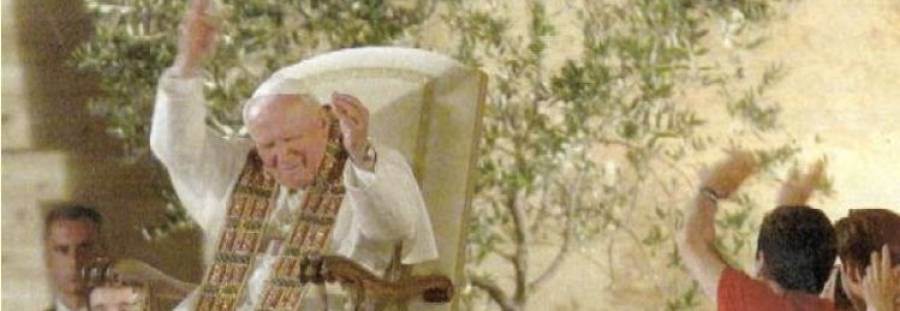
[Pope John Paul II, homily, Naples, 11 November 1990]
-
font size
decrease font size
 increase font size
Christ opened people’s hearts to another reality: how to draw near to the Mystery of God

don Giuseppe Nespeca
Giuseppe Nespeca è architetto e sacerdote. Cultore della Sacra scrittura è autore della raccolta "Due Fuochi due Vie - Religione e Fede, Vangeli e Tao"; coautore del libro "Dialogo e Solstizio".
Email This email address is being protected from spambots. You need JavaScript enabled to view it.Latest from don Giuseppe Nespeca
It is a happy image with which, however, Jesus teaches a truth that calls us into question […] If we remove God, we remove Christ and the world falls back into emptiness and darkness (Pope Benedict)
E’ un’immagine felice, con cui però Gesù insegna una verità che ci mette in discussione […] Se togliamo Dio, se togliamo Cristo, il mondo ripiomba nel vuoto e nel buio (Papa Benedetto)
We would also like to set an example ourself, even if the smallness of our means might prevent anyone from appreciating the practical and quantitative significance of it. We want to see our own charitable institutions undergo a new development in the struggle against hunger and toward meeting the main needs of the world. This is the way and the only way to build peace (Pope Paul VI)
Vorremmo anche Noi dare l'esempio, sebbene l'esiguità dei Nostri mezzi ci impedisca di farne apprezzare la rilevanza pratica e quantitativa: Noi vogliamo dare alle Nostre istituzioni caritative un nuovo sviluppo in favore della fame e dei bisogni del mondo: è in questo modo, e non altrimenti, che si costruisce la pace (Papa Paolo VI)
As St. Ambrose put it: You are not making a gift of what is yours to the poor man, but you are giving him back what is his (Pope Paul VI, Populorum Progressio n.23)
Non è del tuo avere, afferma sant’Ambrogio, che tu fai dono al povero; tu non fai che rendergli ciò che gli appartiene (Papa Paolo VI, Populorum Progressio n.23)
Here is the entire Gospel! Here! The whole Gospel, all of Christianity, is here! But make sure that it is not sentiment, it is not being a “do-gooder”! (Pope Francis)
Qui c’è tutto il Vangelo! Qui! Qui c’è tutto il Vangelo, c’è tutto il Cristianesimo! Ma guardate che non è sentimento, non è “buonismo”! (Papa Francesco)
Christianity cannot be, cannot be exempt from the cross; the Christian life cannot even suppose itself without the strong and great weight of duty [Pope Paul VI]
Il Cristianesimo non può essere, non può essere esonerato dalla croce; la vita cristiana non può nemmeno supporsi senza il peso forte e grande del dovere [Papa Paolo VI]
The horizon of friendship to which Jesus introduces us is the whole of humanity [Pope Benedict]
L’orizzonte dell’amicizia in cui Gesù ci introduce è l’umanità intera [Papa Benedetto]
The Church invites believers to regard the mystery of death not as the "last word" of human destiny but rather as a passage to eternal life (Pope John Paul II)
La Chiesa invita i credenti a guardare al mistero della morte non come all'ultima parola sulla sorte umana, ma come al passaggio verso la vita eterna (Papa Giovanni Paolo II)
The saints: they are our precursors, they are our brothers, they are our friends, they are our examples, they are our lawyers. Let us honour them, let us invoke them and try to imitate them a little (Pope Paul VI)
I santi: sono i precursori nostri, sono i fratelli, sono gli amici, sono gli esempi, sono gli avvocati nostri. Onoriamoli, invochiamoli e cerchiamo di imitarli un po’ (Papa Paolo VI)
Man rightly fears falling victim to an oppression that will deprive him of his interior freedom, of the possibility of expressing the truth of which he is convinced, of the faith that he professes, of the ability to obey the voice of conscience that tells him the right path to follow [Dives in Misericordia, n.11]
L'uomo ha giustamente paura di restar vittima di una oppressione che lo privi della libertà interiore, della possibilità di esternare la verità di cui è convinto [Dives in Misericordia, n.11]








duevie.art
don Giuseppe Nespeca
Tel. 333-1329741
Disclaimer
Questo blog non rappresenta una testata giornalistica in quanto viene aggiornato senza alcuna periodicità. Non può pertanto considerarsi un prodotto editoriale ai sensi della legge N°62 del 07/03/2001.
Le immagini sono tratte da internet, ma se il loro uso violasse diritti d'autore, lo si comunichi all'autore del blog che provvederà alla loro pronta rimozione.
L'autore dichiara di non essere responsabile dei commenti lasciati nei post. Eventuali commenti dei lettori, lesivi dell'immagine o dell'onorabilità di persone terze, il cui contenuto fosse ritenuto non idoneo alla pubblicazione verranno insindacabilmente rimossi.