1. Jesus’s incisive statement: ‘Render unto Caesar the things that are Caesar’s, and unto God the things that are God’s’ (Mt 22:21), addresses an issue that was much debated in his day and remains deeply felt today. What attitude should believers adopt towards civil authority and the laws of the state? What commitment should they undertake as citizens with regard to their social and political duties?
The occasion was presented to Jesus by a question that was much debated at the time concerning whether or not it was lawful to pay taxes to the Roman emperor. Opinions, in fact, were divided, and the reasons put forward to support the lawfulness or unlawfulness of the taxes imposed by the Romans were also varied.
In this context, the question put to Jesus by the Pharisees: ‘Is it lawful or not to pay tribute to Caesar?’ was a trap set for the Master, regarded by all as the One who taught the way of God in truth.
As sometimes happens in the Gospel, faced with the trap set for him by his enemies, Jesus, through his reply, rises above the immediate controversy and goes far beyond the particular and divergent positions.
On the one hand, by commanding that what belongs to Caesar be given to him, he declares that paying tax is not an act of idolatry, but a duty of honest citizens; on the other hand, by recalling God’s primacy in human life and in history, he asks that we give to him what is due to him as the one and true ‘Lord’.
2. With this statement, Jesus draws a clear distinction between the duties required of believers, both as citizens and as children of God. Yet he does not set them in opposition to one another. Thus, from a specific issue—such as the tax to be paid to Caesar—new horizons emerge for the mission of Christians in society.
By virtue of your faith, each one of you is called to transform history, to imbue the whole of human and social reality with the spirit of the Gospel. No one can or should withdraw from the duties required of them to work towards ensuring a more just and fraternal civil society. This task must, however, be carried out in full fidelity to the Gospel message, in docile submission to the Spirit, without ever shirking what is required by the laws of the State that serve this purpose. It must be carried out, above all, by giving primacy to what comes first: God, his plan of salvation, his law, and spiritual and transcendent values.
The profession of faith in Christ, membership of the Kingdom of God and the way of life that flows from it must be lived not ‘outside’ but ‘within’ history as a ‘service’ to be rendered to the human community and, therefore, to the common good and the integral promotion of every person.
Faith, lived out in its entirety, impels you to take on strong and specific responsibilities in that immense human endeavour aimed at promoting and safeguarding the fundamental human rights necessary for peaceful and supportive coexistence amongst all.
3. It is therefore a commitment linked to an authentic and active faith, which requires adequate formation, deep convictions and consistent witness. And so it also takes on the characteristics of a true service of charity towards all people.
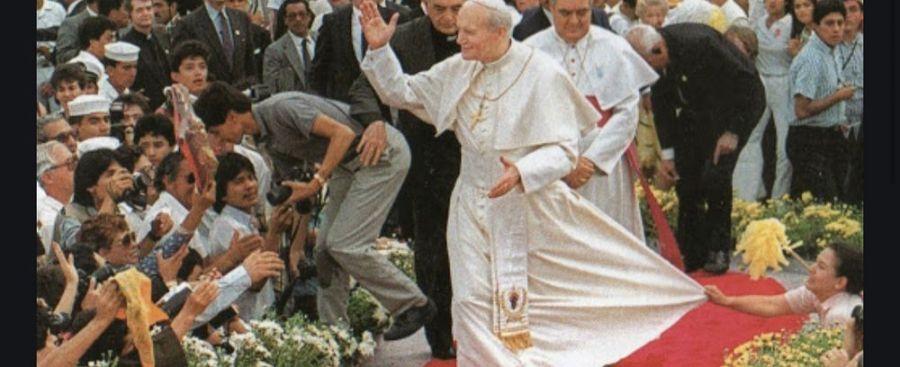
[Pope John Paul II, homily, 21 October 1990]