Aug 14, 2026 Written by 

Humble appearances, complete discipleship (against the ephemeral and dissipation)

1. With my gaze turned to the Shroud, I would like to extend a cordial greeting to you all, the faithful of the Church of Turin. I greet the pilgrims who have come from every part of the world at the time of this public exposition to look at one of the most unsettling signs of the Redeemer's suffering love. 

As I entered the cathedral, which still shows the scars of last year's terrible fire, I paused in adoration before the Eucharist, the sacrament which is the focus of the Church's attention and, under humble appearances, contains the true, real and substantial presence of Christ. In the light of Christ's presence in our midst, I then stopped before the Shroud, the precious Linen that can help us better to understand the mystery of the love of God's Son for us. Before the Shroud, the intense and agonizing image of an unspeakable torment, I wish to thank the Lord for this unique gift, which asks for the believer's loving attention and complete willingness to follow the Lord.

3. For the believer, what counts above all is that the Shroud is a mirror of the Gospel. In fact, if we reflect on the sacred Linen, we cannot escape the idea that the image it presents has such a profound relationship with what the Gospels tell of Jesus' passion and death, that every sensitive person feels inwardly touched and moved at beholding it. Whoever approaches it is also aware that the Shroud does not hold people's hearts to itself, but turns them to him, at whose service the Father's loving providence has put it. Therefore, it is right to foster an awareness of the precious value of this image, which everyone sees and no one at present can explain. For every thoughtful person it is a reason for deep reflection, which can even involve one's life. The Shroud is thus a truly unique sign that points to Jesus, the true Word of the Father, and invites us to pattern our lives on the life of the One who gave himself for us.

7. The Shroud is an image of silence. There is a tragic silence of incommunicability, which finds its greatest expression in death, and there is the silence of fruitfulness, which belongs to whoever refrains from being heard outwardly in order to delve to the roots of truth and life. The Shroud expresses not only the silence of death but also the courageous and fruitful silence of triumph over the transitory, through total immersion in God's eternal present. It thus offers a moving confirmation of the fact that the merciful omnipotence of our God is not restrained by any power of evil, but knows instead how to make the very power of evil contribute to good. Our age needs to rediscover the fruitfulness of silence, in order to overcome the dissipation of sounds, images and chatter that too often prevent the voice of God from being heard.

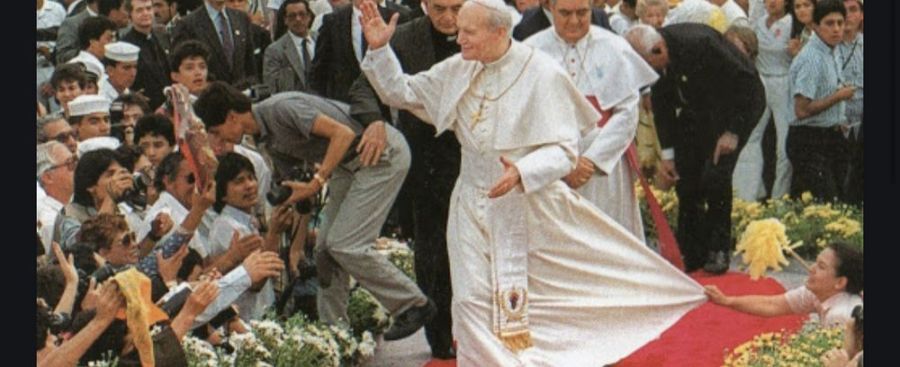
[Pope John Paul II, veneration of the Shroud, Turin, 24 May 1998]

11 Last modified on Friday, 14 August 2026 01:56
don Giuseppe Nespeca

Giuseppe Nespeca è architetto e sacerdote. Cultore della Sacra scrittura è autore della raccolta "Due Fuochi due Vie - Religione e Fede, Vangeli e Tao"; coautore del libro "Dialogo e Solstizio".

Email This email address is being protected from spambots. You need JavaScript enabled to view it.
More than 600 precepts are mentioned in the Law of Moses. How should the great commandment be distinguished among these? (Pope Francis)
Nella Legge di Mosè sono menzionati oltre seicento precetti. Come distinguere, tra tutti questi, il grande comandamento? (Papa Francesco)
The invitation has three characteristics: freely offered, breadth and universality. Many people were invited, but something surprising happened: none of the intended guests came to take part in the feast, saying they had other things to do; indeed, some were even indifferent, impertinent, even annoyed (Pope Francis)
L’invito ha tre caratteristiche: la gratuità, la larghezza, l’universalità. Gli invitati sono tanti, ma avviene qualcosa di sorprendente: nessuno dei prescelti accetta di prendere parte alla festa, dicono che hanno altro da fare; anzi alcuni mostrano indifferenza, estraneità, perfino fastidio (Papa Francesco)
Those who are considered the "last", if they accept, become the "first", whereas the "first" can risk becoming the "last" (Pope Benedict)
Proprio quelli che sono considerati "ultimi", se lo accettano, diventano "primi", mentre i "primi" possono rischiare di finire "ultimi" (Papa Benedetto)
The dialogue of Jesus with the rich young man, related in the nineteenth chapter of Saint Matthew's Gospel, can serve as a useful guide for listening once more in a lively and direct way to his moral teaching [Veritatis Splendor n.6]
Il dialogo di Gesù con il giovane ricco, riferito nel capitolo 19 del Vangelo di san Matteo, può costituire un'utile traccia per riascoltare in modo vivo e incisivo il suo insegnamento morale [Veritatis Splendor n.6]
St Augustine rightly commented: “Christ showed himself indifferent to her, not in order to refuse her his mercy but rather to inflame her desire for it” (Sermo 77, 1: PL 38, 483) [Pope Benedict]
Sant’Agostino commenta giustamente: “Cristo si mostrava indifferente verso di lei, non per rifiutarle la misericordia, ma per infiammarne il desiderio” (Sermo 77, 1: PL 38, 483) [Papa Benedetto]
In the divine attitude justice is pervaded with mercy, whereas the human attitude is limited to justice. Jesus exhorts us to open ourselves with courage to the strength of forgiveness, because in life not everything can be resolved with justice. We know this (Pope Francis)
Nell’atteggiamento divino la giustizia è pervasa dalla misericordia, mentre l’atteggiamento umano si limita alla giustizia. Gesù ci esorta ad aprirci con coraggio alla forza del perdono, perché nella vita non tutto si risolve con la giustizia; lo sappiamo (Papa Francesco)
The Second Vatican Council's Constitution on the Sacred Liturgy refers precisely to this Gospel passage to indicate one of the ways that Christ is present:  "He is present when the Church prays and sings, for he has promised "where two or three are gathered together in my name there am I in the midst of them' (Mt 18: 20)" [Sacrosanctum Concilium, n. 7]
The Lord Jesus presented himself to the world as a servant, completely stripping himself and lowering himself to give on the Cross the most eloquent lesson of humility and love (Pope Benedict)
Il Signore Gesù si è presentato al mondo come servo, spogliando totalmente se stesso e abbassandosi fino a dare sulla croce la più eloquente lezione di umiltà e di amore (Papa Benedetto)

Due Fuochi due Vie - Vol. 1 Due Fuochi due Vie - Vol. 2 Due Fuochi due Vie - Vol. 3 Due Fuochi due Vie - Vol. 4 Due Fuochi due Vie - Vol. 5 Dialogo e Solstizio I fiammiferi di Maria

duevie.art

don Giuseppe Nespeca

Tel. 333-1329741


Disclaimer

Questo blog non rappresenta una testata giornalistica in quanto viene aggiornato senza alcuna periodicità. Non può pertanto considerarsi un prodotto editoriale ai sensi della legge N°62 del 07/03/2001.
Le immagini sono tratte da internet, ma se il loro uso violasse diritti d'autore, lo si comunichi all'autore del blog che provvederà alla loro pronta rimozione.
L'autore dichiara di non essere responsabile dei commenti lasciati nei post. Eventuali commenti dei lettori, lesivi dell'immagine o dell'onorabilità di persone terze, il cui contenuto fosse ritenuto non idoneo alla pubblicazione verranno insindacabilmente rimossi.






