


1. These words were spoken by the Lord Jesus as he thought of his own death. He himself first of all is that “grain of wheat” which “falls on the ground and dies”. The Son of God, of the same substance as the Father, God from God and Light from Light, was made man. He entered into the life of ordinary men and women as the son of the Virgin Mary of Nazareth. And finally he accepted death on the Cross as the sacrifice for the sins of the world. Precisely in this way the grain of wheat dies and yields a rich harvest. It is the harvest of the Redemption of the world, the harvest of the salvation of souls, the power of truth and love as the beginning of eternal life in God.
In this way the parable of the grain of wheat helps us to understand the very mystery of Christ.
2. At the same time, the grain of wheat that “falls on the ground and dies” becomes the pledge of bread. A man harvests from his fields the heads of grain which have grown from the single grain and, transforming the collected grains into flour, he makes bread from it as food for his own body. In this way Christ’s parable about the grain of wheat helps us to understand the mystery of the Eucharist.
In fact, at the Last Supper, Christ took bread in his own hands, blessed it and said these words over it: “Take this, all of you, and eat it: this is my body which will be given up for you”. And the broken Bread which had become in a sacramental way his own Body he distributed to the Apostles.
In a similar way he brought about the transubstantiation of the wine into his own Blood, and distributing it to the Apostles, said: “Take this, all of you, and drink from it: this is the cup of my blood, the blood of the new and everlasting covenant. It will be shed for you and for all men so that sins may be forgiven”. And then he added: “Do this in memory of me”.
3. This is how the mystery of Christ remains among us through the Sacrament of the Eucharist. The mystery of the Redeemer of the world who gave himself up for us all, offering his Body and Blood in the Sacrifice of the Cross. Thanks to the Eucharist the words of our Redeemer are fulfilled: “I will not leave you orphans; I will come back to you” (Io. 14, 18).
In this Sacrament he is always coming to us. We are not orphans. He is with us!
In the Eucharist he also brings us his peace, and he helps us to overcome our weaknesses and fears. It is just as he had foretold: “Peace I bequeath to you, my own peace I give you, a peace the world cannot give, this is my gift to you. Do not let your hearts be troubled or afraid” (Io. 14, 27).
And hence, from the beginning, the disciples and witnesses of our Crucified and Risen Lord “remained faithful to the teaching of the apostles, to the brotherhood, to the breaking of bread and to the prayers” (Act. 2, 42).
They remained faithful “to the breaking of bread”. In other words, the Eucharist constituted the very centre of their life, the centre of the life of the Christian community, the centre of the life of the Church.
Thus it was at the beginning in Jerusalem. Thus it has been everywhere, wherever faith in the Gospel together with the teaching of the Apostles has been introduced. From generation to generation it has been so among different peoples and nations. Thus it has also been on the African continent since the Gospel first reached these lands through the missionaries, and since it produced its first fruits in a community assembled to celebrate the Eucharist […]
8. To feed and clothe and care for each child requires much sacrifice and hard work. In addition, parents have the duty of educating their children. As the Second Vatican Council says: “Their role as educators is so decisive that scarcely anything can compensate for their failure in it. For it devolves on parents to create a family atmosphere so animated with love and reverence for God and others that a well-rounded personal and social development will be fostered among the children. Hence, the family is the first school of those social virtues which every society needs” (Gravissimum Educationis, 3).
9. Prayer is essential to the life of every Christian, but family prayer has its own special character. Since it is a form of shared prayer, it has to be shaped and adapted according to the size and make-up of each family. Few activities influence a family more deeply than their prayer together. Prayer fosters reverence for God and respect for one another. It places joys and sorrows, hopes and disappointments, every event and circumstance, within the perspective of God’s mercy and providence. Family prayer opens the heart of each member to the Sacred Heart of Jesus and helps the family to be more united in itself, yet more ready to serve the Church and society.
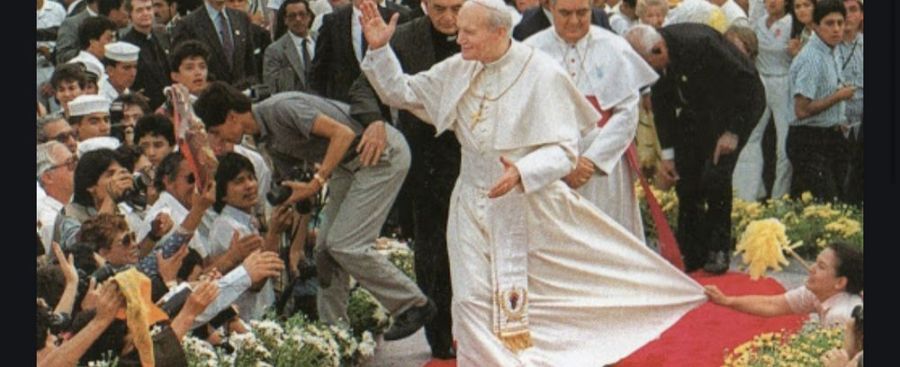
[Pope John Paul II, from homily in Nairobi, 18 August 1985]








