Jul 23, 2026 Written by 

Sign, Faith and Calling

The same link between the 'miracle-sign' and faith is confirmed by other negative facts. Let us recall some of them. In Mark's Gospel we read that Jesus in Nazareth "could perform no miracle, but only laid hands on a few sick people and healed them. And he marvelled at their unbelief" (Mk 6:5-6).

We know the gentle rebuke Jesus once addressed to Peter: "Man of little faith, why did you doubt?". This happened when Peter, who at first went boldly on the waves towards Jesus, then by the violence of the wind became afraid and began to sink" (cf. Mt 14:29-31).

5. Jesus emphasises more than once that the miracle he performed is linked to faith. "Your faith has healed you", he says to the woman who had been suffering from haemorrhaging for twelve years and who, when she came up behind him, touched the hem of his cloak and was healed (cf. Mt 9:20-22; Lk 8:48; Mk 5:34).

Similar words Jesus pronounced while healing blind Bartimaeus, who at the exit from Jericho insistently asked for his help, crying out: "Son of David, Jesus, have mercy on me!" (cf. Mk 10, 46-52). According to Mark: "Go, your faith has saved you", Jesus answers him. And Luke specifies the answer: "Have sight again! Your faith has saved you" (Lk 18:42).

He makes an identical statement to the Samaritan healed of leprosy (Lk 17:19). While to two other blind men pleading to regain their sight, Jesus asks: "Do you believe that I can do this?" "Yes, O Lord!" . "Let it be done to you according to your faith" (Mt 9:28-29).

6. Particularly touching is the episode of the Canaanite woman, who did not cease to ask Jesus' help for her daughter "cruelly tormented by a demon". When the Canaanite woman prostrated herself before Jesus to ask him for help, he replied: 'It is not good to take the bread of the children to throw it to the little dogs' (this was a reminder of the ethnic diversity between Israelites and Canaanites, which Jesus, son of David, could not ignore in his practical behaviour, but to which he alluded in a methodological function to provoke faith). And here the woman intuitively comes to an unusual act of faith and humility. She says: 'It is true, Lord . . . but even little dogs eat the crumbs that fall from their masters' table'. Faced with such a humble, gracious and confident word, Jesus replies: 'Woman, truly great is your faith! May it be done to you as you wish" (cf. Mt 15:21-28).

It is an event difficult to forget, especially when one thinks of the countless "Canaanites" of every time, country, colour and social condition, who reach out their hand to ask for understanding and help in their needs!

7. Note how in the Gospel narrative it is continually emphasised that Jesus, when he "sees faith", performs the miracle. This is clearly stated in the case of the paralytic lowered to his feet through the opening in the roof (cf. Mk 2:5; Mt 9:2; Lk 5:20). But the observation can be made in many other cases recorded by the evangelists. The factor of faith is indispensable; but as soon as it occurs, the heart of Jesus is outstretched to fulfil the requests of the needy who turn to him for help with his divine power.

8. Once again we see that, as we said at the beginning, the miracle is a "sign" of God's power and love that saves man in Christ. But because of this, it is at the same time a call to man to faith. It must lead both the one who is miraculously saved and the witnesses of the miracle to believe.

This applies to the apostles themselves, right from the first "sign" given by Jesus in Cana of Galilee: it was then that they "believed in him" (John 2: 11). Then, when the miraculous multiplication of the loaves took place near Capernaum, with which the heralding of the Eucharist is connected, the evangelist notes that "from then on, many of his disciples turned back and no longer went with him", not being able to accept a language that seemed too "harsh" to them. Jesus then asked the Twelve: "Perhaps you also want to leave?". Peter answered, "Lord, to whom shall we go? You have words to eternal life, we have believed and known that you are the Holy One of God" (cf. Jn 6:66-69). The principle of faith is thus fundamental in the relationship with Christ, both as a condition for obtaining the miracle and as the purpose for which it is performed. This is made very clear at the end of John's Gospel, where we read: "Many other signs did Jesus do in the presence of his disciples, but they were not written in this book. These have been written, so that you may believe that Jesus is the Christ, the Son of God, and so that, believing, you may have life in his name" (John 20: 30-31).

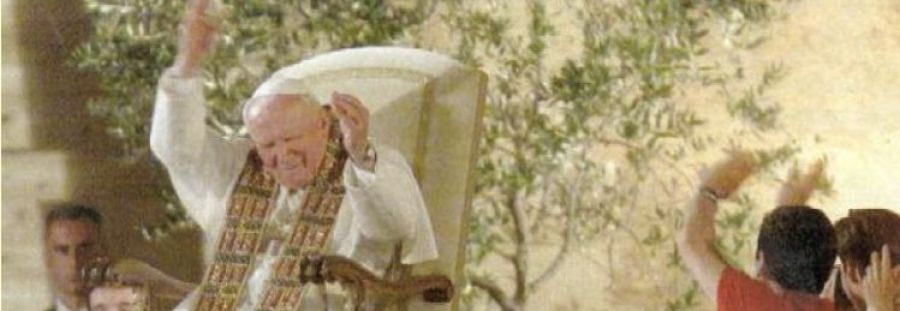
[Pope John Paul II, General Audience 16 December 1987]

91 Last modified on Thursday, 23 July 2026 02:25
don Giuseppe Nespeca

Giuseppe Nespeca è architetto e sacerdote. Cultore della Sacra scrittura è autore della raccolta "Due Fuochi due Vie - Religione e Fede, Vangeli e Tao"; coautore del libro "Dialogo e Solstizio".

Email This email address is being protected from spambots. You need JavaScript enabled to view it.
Faith is more than just empirical or historical facts; it is an ability to grasp the mystery of Christ’s person in all its depth [Pope Benedict]
La fede va al di là dei semplici dati empirici o storici, ed è capace di cogliere il mistero della persona di Cristo nella sua profondità [Papa Benedetto]
More than 600 precepts are mentioned in the Law of Moses. How should the great commandment be distinguished among these? (Pope Francis)
Nella Legge di Mosè sono menzionati oltre seicento precetti. Come distinguere, tra tutti questi, il grande comandamento? (Papa Francesco)
The invitation has three characteristics: freely offered, breadth and universality. Many people were invited, but something surprising happened: none of the intended guests came to take part in the feast, saying they had other things to do; indeed, some were even indifferent, impertinent, even annoyed (Pope Francis)
L’invito ha tre caratteristiche: la gratuità, la larghezza, l’universalità. Gli invitati sono tanti, ma avviene qualcosa di sorprendente: nessuno dei prescelti accetta di prendere parte alla festa, dicono che hanno altro da fare; anzi alcuni mostrano indifferenza, estraneità, perfino fastidio (Papa Francesco)
Those who are considered the "last", if they accept, become the "first", whereas the "first" can risk becoming the "last" (Pope Benedict)
Proprio quelli che sono considerati "ultimi", se lo accettano, diventano "primi", mentre i "primi" possono rischiare di finire "ultimi" (Papa Benedetto)
The dialogue of Jesus with the rich young man, related in the nineteenth chapter of Saint Matthew's Gospel, can serve as a useful guide for listening once more in a lively and direct way to his moral teaching [Veritatis Splendor n.6]
Il dialogo di Gesù con il giovane ricco, riferito nel capitolo 19 del Vangelo di san Matteo, può costituire un'utile traccia per riascoltare in modo vivo e incisivo il suo insegnamento morale [Veritatis Splendor n.6]
St Augustine rightly commented: “Christ showed himself indifferent to her, not in order to refuse her his mercy but rather to inflame her desire for it” (Sermo 77, 1: PL 38, 483) [Pope Benedict]
Sant’Agostino commenta giustamente: “Cristo si mostrava indifferente verso di lei, non per rifiutarle la misericordia, ma per infiammarne il desiderio” (Sermo 77, 1: PL 38, 483) [Papa Benedetto]
In the divine attitude justice is pervaded with mercy, whereas the human attitude is limited to justice. Jesus exhorts us to open ourselves with courage to the strength of forgiveness, because in life not everything can be resolved with justice. We know this (Pope Francis)
Nell’atteggiamento divino la giustizia è pervasa dalla misericordia, mentre l’atteggiamento umano si limita alla giustizia. Gesù ci esorta ad aprirci con coraggio alla forza del perdono, perché nella vita non tutto si risolve con la giustizia; lo sappiamo (Papa Francesco)
The Second Vatican Council's Constitution on the Sacred Liturgy refers precisely to this Gospel passage to indicate one of the ways that Christ is present:  "He is present when the Church prays and sings, for he has promised "where two or three are gathered together in my name there am I in the midst of them' (Mt 18: 20)" [Sacrosanctum Concilium, n. 7]
The Lord Jesus presented himself to the world as a servant, completely stripping himself and lowering himself to give on the Cross the most eloquent lesson of humility and love (Pope Benedict)

Due Fuochi due Vie - Vol. 1 Due Fuochi due Vie - Vol. 2 Due Fuochi due Vie - Vol. 3 Due Fuochi due Vie - Vol. 4 Due Fuochi due Vie - Vol. 5 Dialogo e Solstizio I fiammiferi di Maria

duevie.art

don Giuseppe Nespeca

Tel. 333-1329741


Disclaimer

Questo blog non rappresenta una testata giornalistica in quanto viene aggiornato senza alcuna periodicità. Non può pertanto considerarsi un prodotto editoriale ai sensi della legge N°62 del 07/03/2001.
Le immagini sono tratte da internet, ma se il loro uso violasse diritti d'autore, lo si comunichi all'autore del blog che provvederà alla loro pronta rimozione.
L'autore dichiara di non essere responsabile dei commenti lasciati nei post. Eventuali commenti dei lettori, lesivi dell'immagine o dell'onorabilità di persone terze, il cui contenuto fosse ritenuto non idoneo alla pubblicazione verranno insindacabilmente rimossi.






