Jun 14, 2026 Written by 

Blindness, beams, specks

In the liturgy of the word, Luke's Gospel presents us once again with Jesus' question: "Can a blind man guide a blind man?" (Lk 6:39). The Lord means that a guide cannot be blind; he must see well if he does not want to risk harming those entrusted to him. Jesus thus draws the attention of all those who have educational or leadership responsibilities: pastors of souls, rulers of peoples, legislators, teachers, parents, urging them to be aware, to feel responsibility, to ask themselves about the right path and to be the first to follow it themselves.

3. And the right path is the one traced by the divine Master. He said so himself with a Semitic expression that sounds like this: "The disciple is not above his master, but everyone who is well trained will be like his master" (Lk 6:40). With this, Jesus presents himself as a model and invites us to follow his conduct and his teachings. Only in this way can we be sure and wise guides. The Lord's teachings on moral life are contained mainly in the Sermon on the Mount, which we have been reading for the past three Sundays during the celebration of Holy Mass. In today's passage, we find another very significant phrase, which urges us not to be presumptuous and hypocritical. "Why do you look at the speck in your brother's eye and not notice the log in your own?" (Lk 6:41). How easy it is to see the faults and sins of others and not see our own! And how can we tell if our eye is clear or if it is impeded by a beam? The proof comes from our actions. It is Jesus himself who tells us: "Every tree is recognised by its fruit" (Lk 6:44). The fruit is our actions, but also our words. These too reveal the quality of the tree. In fact, those who are good bring out good from their hearts and mouths, and those who are evil bring out evil. This teaching of Jesus echoes the ancient words of wisdom from Sirach, which we heard in the first reading: 'The fruit shows how the tree is cultivated, so words reveal the feelings of a person' (Sir 27:6).

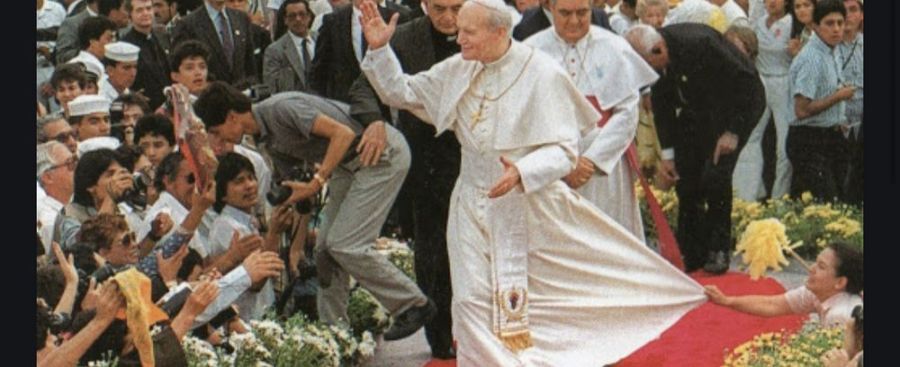
[Pope John Paul II, homily at Corviale, 1 March 1992]

7 Last modified on Sunday, 14 June 2026 03:32
don Giuseppe Nespeca

Giuseppe Nespeca è architetto e sacerdote. Cultore della Sacra scrittura è autore della raccolta "Due Fuochi due Vie - Religione e Fede, Vangeli e Tao"; coautore del libro "Dialogo e Solstizio".

Email This email address is being protected from spambots. You need JavaScript enabled to view it.
Paolo VI stated that the world today is suffering above all from a lack of brotherhood: “Human society is sorely ill. The cause is not so much the depletion of natural resources, nor their monopolistic control by a privileged few; it is rather the weakening of brotherly ties between individuals and nations” (Pope Benedict)
Paolo VI affermava che il mondo soffre oggi soprattutto di una mancanza di fraternità: «Il mondo è malato. Il suo male risiede meno nella dilapidazione delle risorse o nel loro accaparramento da parte di alcuni, che nella mancanza di fraternità tra gli uomini e tra i popoli» (Papa Benedetto)
Our commitment does not consist exclusively of activities or programmes of promotion and assistance; what the Holy Spirit mobilizes is not an unruly activism, but above all an attentiveness that considers the other in a certain sense as one with ourselves (Pope Francis)
Il nostro impegno non consiste esclusivamente in azioni o in programmi di promozione e assistenza; quello che lo Spirito mette in moto non è un eccesso di attivismo, ma prima di tutto un’attenzione rivolta all’altro considerandolo come un’unica cosa con se stesso (Papa Francesco)
The drama of prayer is fully revealed to us in the Word who became flesh and dwells among us. To seek to understand his prayer through what his witnesses proclaim to us in the Gospel is to approach the holy Lord Jesus as Moses approached the burning bush: first to contemplate him in prayer, then to hear how he teaches us to pray, in order to know how he hears our prayer (Catechism of the Catholic Church n.2598)
L’evento della preghiera ci viene pienamente rivelato nel Verbo che si è fatto carne e dimora in mezzo a noi. Cercare di comprendere la sua preghiera, attraverso ciò che i suoi testimoni ci dicono di essa nel Vangelo, è avvicinarci al santo Signore Gesù come al roveto ardente: dapprima contemplarlo mentre prega, poi ascoltare come ci insegna a pregare, infine conoscere come egli esaudisce la nostra preghiera (Catechismo della Chiesa Cattolica n.2598)
“Love is an excellent thing”, we read in the book the Imitation of Christ. “It makes every difficulty easy, and bears all wrongs with equanimity…. Love tends upward; it will not be held down by anything low… love is born of God and cannot rest except in God” (III, V, 3) [Pope Benedict]
«Grande cosa è l’amore – leggiamo nel libro dell’Imitazione di Cristo –, un bene che rende leggera ogni cosa pesante e sopporta tranquillamente ogni cosa difficile. L’amore aspira a salire in alto, senza essere trattenuto da alcunché di terreno. Nasce da Dio e soltanto in Dio può trovare riposo» (III, V, 3) [Papa Benedetto]
For Christians, non-violence is not merely tactical behaviour but a person's way of being (Pope Benedict)
La nonviolenza per i cristiani non è un mero comportamento tattico, bensì un modo di essere (Papa Benedetto)
The Angel does not enter our room visibly, but the Lord has a plan for each of us, he calls each one of us by name (Pope Benedict)
Nella nostra camera l’Angelo non entra in modo visibile, ma con ciascuno di noi il Signore ha un suo progetto, ciascuno viene da Lui chiamato per nome (Papa Benedetto)
A mysterious love, which in the texts of the New Testament is revealed to us as God’s boundless and passionate love for mankind. God does not lose heart in the face of ingratitude (Pope Benedict)
Un amore misterioso, che nei testi del Nuovo Testamento ci viene rivelato come incommensurabile passione di Dio per l'uomo. Egli non si arrende dinanzi all'ingratitudine (Papa Benedetto)

Due Fuochi due Vie - Vol. 1 Due Fuochi due Vie - Vol. 2 Due Fuochi due Vie - Vol. 3 Due Fuochi due Vie - Vol. 4 Due Fuochi due Vie - Vol. 5 Dialogo e Solstizio I fiammiferi di Maria

duevie.art

don Giuseppe Nespeca

Tel. 333-1329741


Disclaimer

Questo blog non rappresenta una testata giornalistica in quanto viene aggiornato senza alcuna periodicità. Non può pertanto considerarsi un prodotto editoriale ai sensi della legge N°62 del 07/03/2001.
Le immagini sono tratte da internet, ma se il loro uso violasse diritti d'autore, lo si comunichi all'autore del blog che provvederà alla loro pronta rimozione.
L'autore dichiara di non essere responsabile dei commenti lasciati nei post. Eventuali commenti dei lettori, lesivi dell'immagine o dell'onorabilità di persone terze, il cui contenuto fosse ritenuto non idoneo alla pubblicazione verranno insindacabilmente rimossi.






