Jan 28, 2026 Written by 

Integral Vocation, Announcement, and respect. Proposal to freedom

7. The urgency of missionary activity derives from the radical newness of life brought by Christ and lived by his followers. This new life is a gift from God, and people are asked to accept and develop it, if they wish to realize the fullness of their vocation in conformity to Christ. The whole New Testament is a hymn to the new life of those who believe in Christ and live in his Church. Salvation in Christ, as witnessed to and proclaimed by the Church, is God's self-communication: "It is love which not only creates the good, but also grants participation in the very life of God: Father, Son and Holy Spirit. For he who loves desires to give himself."

God offers mankind this newness of life. "Can one reject Christ and everything that he has brought about in the history of mankind? Of course one can. Man is free. He can say 'no' to God. He can say 'no' to Christ. But the fundamental question remains: Is it legitimate to do this? And what would make it legitimate?"

8. In the modern world there is a tendency to reduce man to his horizontal dimension alone. But without an openness to the Absolute, what does man become? The answer to this question is found in the experience of every individual, but it is also written in the history of humanity with the blood shed in the name of ideologies or by political regimes which have sought to build a "new humanity" without God.

Moreover, the Second Vatican Council replies to those concerned with safeguarding freedom of conscience: "The human person has a right to religious freedom.... All should have such immunity from coercion by individuals, or by groups, or by any human power, that no one should be forced to act against his conscience in religious matters, nor prevented from acting according to his conscience, whether in private or in public, whether alone or in association with others, within due limits."

Proclaiming Christ and bearing witness to him, when done in a way that respects consciences, does not violate freedom. Faith demands a free adherence on the part of man, but at the same time faith must also be offered to him, because the "multitudes have the right to know the riches of the mystery of Christ-riches in which we believe that the whole of humanity can find, in unsuspected fullness, everything that it is gropingly searching for concerning God, man and his destiny, life and death, and truth.... This is why the Church keeps her missionary spirit alive, and even wishes to intensify it in the moment of history in which we are living." But it must also be stated, again with the Council, that "in accordance with their dignity as persons, equipped with reason and free will and endowed with personal responsibility, all are impelled by their own nature and are bound by a moral obligation to seek truth, above all religious truth. They are further bound to hold to the truth once it is known, and to regulate their whole lives by its demands.".

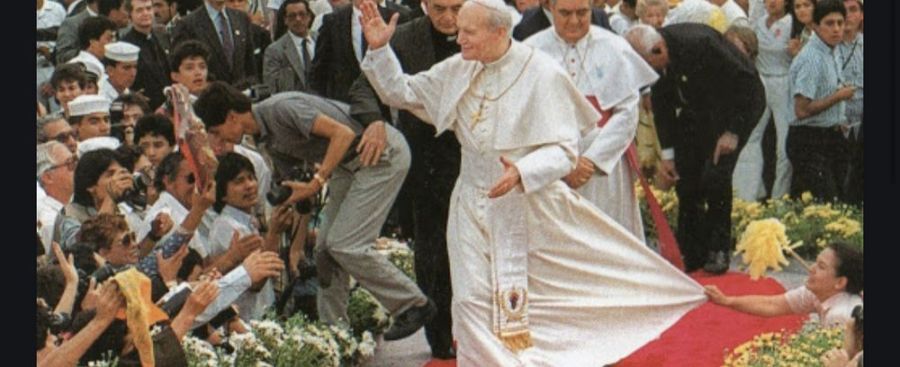
[Pope John Paul II, Redemptoris Missio]

64 Last modified on Wednesday, 28 January 2026 05:03
don Giuseppe Nespeca

Giuseppe Nespeca è architetto e sacerdote. Cultore della Sacra scrittura è autore della raccolta "Due Fuochi due Vie - Religione e Fede, Vangeli e Tao"; coautore del libro "Dialogo e Solstizio".

Email This email address is being protected from spambots. You need JavaScript enabled to view it.
In the crucified Jesus, a kind of transformation and concentration of the signs occurs: he himself is the “sign of God” (John Paul II)
In Gesù crocifisso avviene come una trasformazione e concentrazione dei segni: è Lui stesso il "segno di Dio" (Giovanni Paolo II)
Only through Christ can we converse with God the Father as children, otherwise it is not possible, but in communion with the Son we can also say, as he did, “Abba”. In communion with Christ we can know God as our true Father. For this reason Christian prayer consists in looking constantly at Christ and in an ever new way, speaking to him, being with him in silence, listening to him, acting and suffering with him (Pope Benedict)
Solo in Cristo possiamo dialogare con Dio Padre come figli, altrimenti non è possibile, ma in comunione col Figlio possiamo anche dire noi come ha detto Lui: «Abbà». In comunione con Cristo possiamo conoscere Dio come Padre vero. Per questo la preghiera cristiana consiste nel guardare costantemente e in maniera sempre nuova a Cristo, parlare con Lui, stare in silenzio con Lui, ascoltarlo, agire e soffrire con Lui (Papa Benedetto)
In today’s Gospel passage, Jesus identifies himself not only with the king-shepherd, but also with the lost sheep, we can speak of a “double identity”: the king-shepherd, Jesus identifies also with the sheep: that is, with the least and most needy of his brothers and sisters […] And let us return home only with this phrase: “I was present there. Thank you!”. Or: “You forgot about me” (Pope Francis)
Nella pagina evangelica di oggi, Gesù si identifica non solo col re-pastore, ma anche con le pecore perdute. Potremmo parlare come di una “doppia identità”: il re-pastore, Gesù, si identifica anche con le pecore, cioè con i fratelli più piccoli e bisognosi […] E torniamo a casa soltanto con questa frase: “Io ero presente lì. Grazie!” oppure: “Ti sei scordato di me” (Papa Francesco)
Thus, in the figure of Matthew, the Gospels present to us a true and proper paradox: those who seem to be the farthest from holiness can even become a model of the acceptance of God's mercy and offer a glimpse of its marvellous effects in their own lives (Pope Benedict))
Nella figura di Matteo, dunque, i Vangeli ci propongono un vero e proprio paradosso: chi è apparentemente più lontano dalla santità può diventare persino un modello di accoglienza della misericordia di Dio e lasciarne intravedere i meravigliosi effetti nella propria esistenza (Papa Benedetto)
Man is involved in penance in his totality of body and spirit: the man who has a body in need of food and rest and the man who thinks, plans and prays; the man who appropriates and feeds on things and the man who makes a gift of them; the man who tends to the possession and enjoyment of goods and the man who feels the need for solidarity that binds him to all other men [CEI pastoral note]
Nella penitenza è coinvolto l'uomo nella sua totalità di corpo e di spirito: l'uomo che ha un corpo bisognoso di cibo e di riposo e l'uomo che pensa, progetta e prega; l'uomo che si appropria e si nutre delle cose e l'uomo che fa dono di esse; l'uomo che tende al possesso e al godimento dei beni e l'uomo che avverte l'esigenza di solidarietà che lo lega a tutti gli altri uomini [nota pastorale CEI]
St John Chrysostom urged: “Embellish your house with modesty and humility with the practice of prayer. Make your dwelling place shine with the light of justice; adorn its walls with good works, like a lustre of pure gold, and replace walls and precious stones with faith and supernatural magnanimity, putting prayer above all other things, high up in the gables, to give the whole complex decorum. You will thus prepare a worthy dwelling place for the Lord, you will welcome him in a splendid palace. He will grant you to transform your soul into a temple of his presence” (Pope Benedict)

Due Fuochi due Vie - Vol. 1 Due Fuochi due Vie - Vol. 2 Due Fuochi due Vie - Vol. 3 Due Fuochi due Vie - Vol. 4 Due Fuochi due Vie - Vol. 5 Dialogo e Solstizio I fiammiferi di Maria

duevie.art

don Giuseppe Nespeca

Tel. 333-1329741


Disclaimer

Questo blog non rappresenta una testata giornalistica in quanto viene aggiornato senza alcuna periodicità. Non può pertanto considerarsi un prodotto editoriale ai sensi della legge N°62 del 07/03/2001.
Le immagini sono tratte da internet, ma se il loro uso violasse diritti d'autore, lo si comunichi all'autore del blog che provvederà alla loro pronta rimozione.
L'autore dichiara di non essere responsabile dei commenti lasciati nei post. Eventuali commenti dei lettori, lesivi dell'immagine o dell'onorabilità di persone terze, il cui contenuto fosse ritenuto non idoneo alla pubblicazione verranno insindacabilmente rimossi.






