Dec 26, 2025 Written by 

Free and eternal victim

"Heart of Jesus, victim of sins, have mercy on us".

1. Dear brothers and sisters, this invocation of the Litany of the Sacred Heart reminds us that Jesus, according to the words of the Apostle Paul, "was put to death for our sins" (Rom 4:25); although, in fact, he had committed no sin, "God treated him as sin for our sake" (2 Cor 5:21). On the Heart of Christ weighed, immense, the weight of the world's sin.

In him, the figure of the "Passover lamb" was perfectly fulfilled, the victim offered to God so that in the sign of his blood the first-born of the Hebrews might be spared (cf. Ex 12:21-27). Rightly, therefore, John the Baptist recognised in him the true "Lamb of God" (Jn 1:29): - innocent lamb, who had taken upon himself the sin of the world in order to immerse it in the healing waters of the Jordan (cf. Mt 3:3-16 et par.); - meek lamb, "led to the slaughter, as a sheep mute before her shearers" (Is 53:7), so that by his divine silence the proud word of unrighteous men might be confounded.

Jesus is a willing victim, because he offered himself "freely to his passion" (Missale Romanum, Prex euchar. II), as a victim of atonement for the sins of men (cf. Lev 1:4; Heb 10:5-10). which he consumed in the fire of his love.

2. Jesus is an eternal victim. Risen from the dead and glorified at the right hand of the Father, he preserves in his immortal body the marks of the wounds of the pierced hands and feet, of the pierced side (cf. Jn 20:27; Lk 24:39-40) and presents them to the Father in his unceasing prayer of intercession on our behalf (cf. Heb 7:25; Rom 8:34).

The admirable sequence of the Easter Mass, recalling this fact of our faith, exhorts:

"To the paschal victim, / let the sacrifice of praise rise today. / The lamb has redeemed his flock. / The innocent has reconciled us sinners with the Father" (Sequentia "Victimae Paschali", str. 1).

And the preface of that solemnity proclaims:

Christ is "the true Lamb who took away the sins of the world, / it is he who by dying destroyed death, / and by rising again gave us life".

3. Brothers and sisters, in this hour of the Marian prayer we have contemplated the Heart of Jesus, the victim of our sins; but first of all and more profoundly than all we contemplated his sorrowful Mother, of whom the liturgy sings: "For the sins of her people / she saw Jesus in the torments / of the harsh torment" (Sequentia "Stabat Mater", str 7).

As we approach the liturgical memorial of the Blessed Virgin Mary of Sorrows, let us remember this intrepid and interceding presence of Our Lady beneath the Cross of Calvary, and let us think with immense gratitude that, at that moment, the dying Christ, victim of the sins of the world, entrusted her to us as Mother: "Behold your Mother" (Jn 19:27).

To Mary we entrust our prayer, as we say to her Son Jesus:

Heart of Jesus,

victim of our sins,

receive our praise,

everlasting gratitude,

sincere repentance.
Have mercy on us,

today and always. Amen.


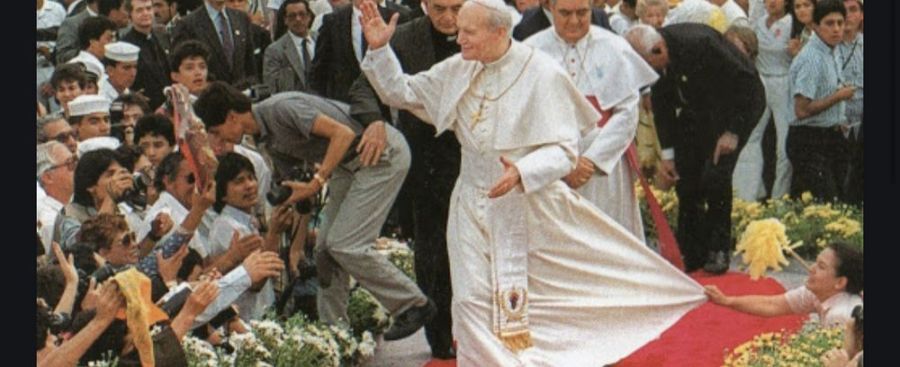
[Pope John Paul II, Angelus 10 September 1989]

124 Last modified on Friday, 26 December 2025 06:08
don Giuseppe Nespeca

Giuseppe Nespeca è architetto e sacerdote. Cultore della Sacra scrittura è autore della raccolta "Due Fuochi due Vie - Religione e Fede, Vangeli e Tao"; coautore del libro "Dialogo e Solstizio".

Email This email address is being protected from spambots. You need JavaScript enabled to view it.
For so long as we are sheep, we conquer: though ten thousand wolves prowl around, we overcome and prevail. But if we become wolves, we are worsted, for the help of our Shepherd departs from us (St John Chrysostom)
Finché saremo agnelli, vinceremo e, anche se saremo circondati da numerosi lupi, riusciremo a superarli. Ma se diventeremo lupi, saremo sconfitti, perché saremo privi dell’aiuto del Pastore (S. Giovanni Crisostomo)
Today, as on the day of our Baptism, we hear the words of Jesus addressed to us: “Ephphatha, be opened!” Open your ears. Jesus, I want to open myself to your Word; Jesus, open myself to listening to you; Jesus, heal my heart from being closed, heal my heart from haste, heal my heart from impatience (Pope Francis)
Sentiamo rivolta a noi oggi, come nel giorno del Battesimo, quella parola di Gesù: “Effatà, apriti”! Apriti le orecchie. Gesù, desidero aprirmi alla tua Parola; Gesù, aprirmi al tuo ascolto; Gesù, guarisci il mio cuore dalla chiusura, guarisci il mio cuore dalla fretta, guarisci il mio cuore dall’impazienza (Papa Francesco)
And this is the problem: when the People put down roots in the land and are the depository of the Law, they are tempted to place their security and joy in something that is no longer the Word of God: in possessions, in power, in other ‘gods’ that in reality are useless, they are idols. Of course, the Law of God remains but it is no longer the most important thing, the rule of life; rather, it becomes a camouflage, a cover-up, while life follows other paths, other rules, interests that are often forms of egoism, both individual and collective. Thus religion loses its authentic meaning, which is to live listening to God in order to do his will — that is the truth of our being — and thus we live well, in true freedom, and it is reduced to practising secondary customs which instead satisfy the human need to feel in God’s place. This is a serious threat to every religion which Jesus encountered in his time and which, unfortunately, is also to be found in Christianity. Jesus’ words against the scribes and Pharisees in today’s Gospel should therefore be food for thought for us as well (Pope Benedict)
Ed ecco il problema: quando il popolo si stabilisce nella terra, ed è depositario della Legge, è tentato di riporre la sua sicurezza e la sua gioia in qualcosa che non è più la Parola del Signore: nei beni, nel potere, in altre ‘divinità’ che in realtà sono vane, sono idoli. Certo, la Legge di Dio rimane, ma non è più la cosa più importante, la regola della vita; diventa piuttosto un rivestimento, una copertura, mentre la vita segue altre strade, altre regole, interessi spesso egoistici individuali e di gruppo. E così la religione smarrisce il suo senso autentico che è vivere in ascolto di Dio per fare la sua volontà - che è la verità del nostro essere - e così vivere bene, nella vera libertà, e si riduce a pratica di usanze secondarie, che soddisfano piuttosto il bisogno umano di sentirsi a posto con Dio. Ed è questo un grave rischio di ogni religione, che Gesù ha riscontrato nel suo tempo, ma che si può verificare, purtroppo, anche nella cristianità. Perciò le parole di Gesù nel Vangelo di oggi contro gli scribi e i farisei devono far pensare anche noi (Papa Benedetto)
Salt, in the cultures of the Middle East, calls to mind several values such as the Covenant, solidarity, life and wisdom. Light is the first work of God the Creator and is a source of life; the word of God is compared to light (Pope Benedict)
Il sale, nella cultura mediorientale, evoca diversi valori quali l’alleanza, la solidarietà, la vita e la sapienza. La luce è la prima opera di Dio Creatore ed è fonte della vita; la stessa Parola di Dio è paragonata alla luce (Papa Benedetto)

Due Fuochi due Vie - Vol. 1 Due Fuochi due Vie - Vol. 2 Due Fuochi due Vie - Vol. 3 Due Fuochi due Vie - Vol. 4 Due Fuochi due Vie - Vol. 5 Dialogo e Solstizio I fiammiferi di Maria

duevie.art

don Giuseppe Nespeca

Tel. 333-1329741


Disclaimer

Questo blog non rappresenta una testata giornalistica in quanto viene aggiornato senza alcuna periodicità. Non può pertanto considerarsi un prodotto editoriale ai sensi della legge N°62 del 07/03/2001.
Le immagini sono tratte da internet, ma se il loro uso violasse diritti d'autore, lo si comunichi all'autore del blog che provvederà alla loro pronta rimozione.
L'autore dichiara di non essere responsabile dei commenti lasciati nei post. Eventuali commenti dei lettori, lesivi dell'immagine o dell'onorabilità di persone terze, il cui contenuto fosse ritenuto non idoneo alla pubblicazione verranno insindacabilmente rimossi.






