Dec 1, 2025 Written by 

We are not "masses"

The Old Testament already usually speaks of God as the Shepherd of Israel, the people of the covenant, chosen by him to carry out the plan of salvation. Psalm 22 is a marvellous hymn to the Lord, the Shepherd of our soul:

"The Lord is my shepherd, I shall not want; / he makes me lie down in green pastures, / he leads me beside still waters, / he restores my soul. / He leads me in paths of righteousness... / Even though I walk through the valley of the shadow of death, / I fear no evil; / for thou art with me..." (Ps 22:1-3).

The prophets Isaiah, Jeremiah, and Ezekiel often return to the subject of the people as "the Lord's flock": "Behold your God!... He will feed his flock like a shepherd, he will gather the lambs in his arms..." (Is 40:11). Above all, they announce the Messiah as a Shepherd who will really feed his sheep and not let them go astray any more: "I will set up over them one shepherd, my servant David, and he shall feed them: he shall feed them and be their shepherd..." (Ez 34: 23).

This sweet and moving figure of the shepherd is a familiar one in the Gospel. Even if times have changed owing to industrialization and urbanism, it always keeps its fascination and effectiveness; and we all remember the touching and poetic parable of the Good Shepherd who goes in search of the lost sheep (Lk 15:3-7).

In the early times of the Church, Christian iconography used a great deal and developed this subject of the Good Shepherd, whose image often appears, painted or sculpted, in the catacombs, sarcophagi and baptismal fonts. This iconography, so interesting and reverent, testifies to us that, right from the early times of the Church, Jesus "the Good Shepherd" struck and moved the hearts of believers and non-believers, and was a cause of conversion, spiritual commitment and comfort. Well, Jesus "the Good Shepherd" is still alive and true today in our midst, in the midst of the whole of mankind, and he wants to let each of us hear his voice and feel his love.

1) What does it mean to be the Good Shepherd?

Jesus explains it to us with convincing clearness.

The shepherd knows his sheep and the sheep know him. How wonderful and consoling it is to know that Jesus knows us one by one; that for him we are not anonymous persons; that our namethat name which is agreed upon by loving parents and friendsis known to him! For Jesus we are not a "mass", a "multitude"! We are individual "persons" with an eternal value, both as creatures and as re-deemed persons! He knows us! He knows me, and loves me and gave himself for me! (Gal 2:20).

[...]

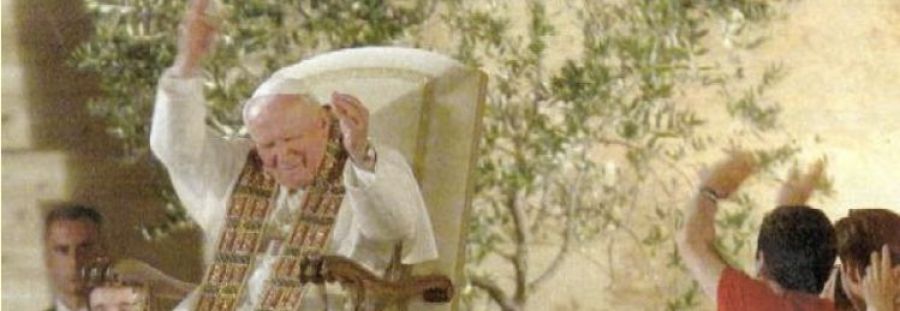
(Pope John Paul II, homily 6 May 1979)

2 Last modified on Monday, 01 December 2025 04:15
don Giuseppe Nespeca

Giuseppe Nespeca è architetto e sacerdote. Cultore della Sacra scrittura è autore della raccolta "Due Fuochi due Vie - Religione e Fede, Vangeli e Tao"; coautore del libro "Dialogo e Solstizio".

Email This email address is being protected from spambots. You need JavaScript enabled to view it.
The human race – every one of us – is the sheep lost in the desert which no longer knows the way. The Son of God will not let this happen; he cannot abandon humanity in so wretched a condition. He leaps to his feet and abandons the glory of heaven, in order to go in search of the sheep and pursue it, all the way to the Cross. He takes it upon his shoulders and carries our humanity (Pope Benedict)
L’umanità – noi tutti - è la pecora smarrita che, nel deserto, non trova più la strada. Il Figlio di Dio non tollera questo; Egli non può abbandonare l’umanità in una simile miserevole condizione. Balza in piedi, abbandona la gloria del cielo, per ritrovare la pecorella e inseguirla, fin sulla croce. La carica sulle sue spalle, porta la nostra umanità (Papa Benedetto)
"Too bad! What a pity!" “Sin! What a shame!” - it is said of a missed opportunity: it is the bending of the unicum that we are inside, which every day surrenders its exceptionality to the normalizing and prim outline of common opinion. Divine Appeal of every moment directed Mary's dreams and her innate knowledge - antechamber of her trust, elsewhere
“Peccato!” - si dice di una occasione persa: è la flessione dell’unicum che siamo dentro, che tutti i giorni cede la sua eccezionalità al contorno normalizzante e affettato dell’opinione comune. L’appello divino d’ogni istante orientava altrove i sogni di Maria e il suo sapere innato - anticamera della fiducia
It is a question of leaving behind the comfortable but misleading ways of the idols of this world: success at all costs; power to the detriment of the weak; the desire for wealth; pleasure at any price. And instead, preparing the way of the Lord: this does not take away our freedom (Pope Francis)
Si tratta di lasciare le strade, comode ma fuorvianti, degli idoli di questo mondo: il successo a tutti i costi, il potere a scapito dei più deboli, la sete di ricchezze, il piacere a qualsiasi prezzo. E di aprire invece la strada al Signore che viene: Egli non toglie la nostra libertà (Papa Francesco)
Inside each woman and man resides a volcano of potential energies which are not to be smothered and aligned. The Lord doesn’t level the character; he doesn’t wear out the creatures. He doesn't make them desolate. The Kingdom is Near: it reinstates the imbalances. It does not mortify them, it convert them and enhances them
Dentro ciascuna donna e uomo risiede un vulcano di energie potenziali che non devono essere soffocate e allineate. Il Signore non livella il carattere; non sfianca le creature. Non le rende desolate. Il Regno è Vicino: reintegra gli squilibri. Non li mortifica, li tramuta e valorizza
The Person of Christ opens up another panorama to the perception of the two short-sighted (because ambitious) disciples. But sometimes it is necessary to take a leap in the dark, to contact one's vocational Seed; heal the gaze of the soul, recognize himself, flourish; make true Communion
La Persona di Cristo spalanca alla percezione dei due discepoli miopi (perché ambiziosi) un altro panorama. Ma talora bisogna fare un salto nel buio, per contattare il proprio Seme vocazionale; guarire lo sguardo dell’anima, riconoscersi, fiorire; fare vera Comunione
«Too pure water has no fish». Accepting ourselves will complete us: it will make us recover the co-present, opposite and shadowed sides. It’s the leap of profound Faith. And seems incredible, but the Rock on which we build the way of being believers is Freedom
«L’acqua troppo pura non ha pesci». Accettarsi ci completerà: farà recuperare i lati compresenti, opposti e in ombra. È il balzo della Fede profonda. Sembra incredibile, ma la Roccia sulla quale edifichiamo il modo di essere credenti è la Libertà

Due Fuochi due Vie - Vol. 1 Due Fuochi due Vie - Vol. 2 Due Fuochi due Vie - Vol. 3 Due Fuochi due Vie - Vol. 4 Due Fuochi due Vie - Vol. 5 Dialogo e Solstizio I fiammiferi di Maria

duevie.art

don Giuseppe Nespeca

Tel. 333-1329741


Disclaimer

Questo blog non rappresenta una testata giornalistica in quanto viene aggiornato senza alcuna periodicità. Non può pertanto considerarsi un prodotto editoriale ai sensi della legge N°62 del 07/03/2001.
Le immagini sono tratte da internet, ma se il loro uso violasse diritti d'autore, lo si comunichi all'autore del blog che provvederà alla loro pronta rimozione.
L'autore dichiara di non essere responsabile dei commenti lasciati nei post. Eventuali commenti dei lettori, lesivi dell'immagine o dell'onorabilità di persone terze, il cui contenuto fosse ritenuto non idoneo alla pubblicazione verranno insindacabilmente rimossi.






