Nov 20, 2025 Written by 

Words that will not pass away

1. "Then they will see the Son of man coming in clouds with great power and glory" (Mk 13: 26). 

On this last Sunday of Ordinary Time, the liturgy speaks to us of Christ's second coming. The Lord will appear in clouds, clothed in power and glory. He is the same Son of man, merciful and compassionate, whom the disciples knew during his earthly journey. When the moment comes for his manifestation in glory, he will come to give human history its definitive fulfilment. 

Through the symbolism of cosmological upheavals, the Evangelist Mark recalls that God will pronounce his last judgement on human events in the Son, putting an end to a universe corrupted by falsehood and torn by violence and injustice.

3. Your daily experience brings you face to face with difficult and sometimes dramatic situations, which jeopardize human security. However the Gospel comforts us, presenting the victorious figure of Christ, the judge of history. With his presence, he brightens the darkness and even man's despair, and offers those who trust in him the comforting certainty of his constant assistance. 

In the Gospel just proclaimed we heard an important reference to the fig tree, whose branches, when their new leaves sprout, announce that springtime is near. With these words, Jesus encourages the Apostles not to give up before the difficulties and uncertainties of the present. 

Rather, he urges them to know how to wait and to prepare themselves to welcome him when he comes. Today, dear brothers and sisters, you too are invited by the liturgy to "read the signs of the times", an expression coined by my venerable predecessor, Pope John XXIII, who was recently beatified. 

However complex and difficult situations may be, do not lose trust. In the human heart, the seed of hope must never die. Indeed, always be attentive to discovering and encouraging every positive sign of personal and social renewal. Be prepared to further the courageous building of justice and peace with every possible means.

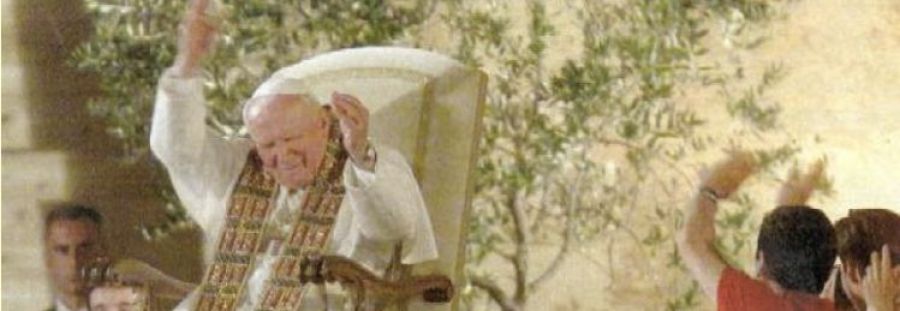
[Pope John Paul II, homily 19 November 2000]

131 Last modified on Thursday, 20 November 2025 03:29
don Giuseppe Nespeca

Giuseppe Nespeca è architetto e sacerdote. Cultore della Sacra scrittura è autore della raccolta "Due Fuochi due Vie - Religione e Fede, Vangeli e Tao"; coautore del libro "Dialogo e Solstizio".

Email This email address is being protected from spambots. You need JavaScript enabled to view it.
In one of his most celebrated sermons, Saint Bernard of Clairvaux “recreates”, as it were, the scene where God and humanity wait for Mary to say “yes”. Turning to her he begs: “[…] Arise, run, open up! Arise with faith, run with your devotion, open up with your consent!” [Pope Benedict]
San Bernardo di Chiaravalle, in uno dei suoi Sermoni più celebri, quasi «rappresenta» l’attesa da parte di Dio e dell’umanità del «sì» di Maria, rivolgendosi a lei con una supplica: «[…] Alzati, corri, apri! Alzati con la fede, affrettati con la tua offerta, apri con la tua adesione!» [Papa Benedetto]
«The "blasphemy" [in question] does not really consist in offending the Holy Spirit with words; it consists, instead, in the refusal to accept the salvation that God offers to man through the Holy Spirit, and which works by virtue of the sacrifice of the cross [It] does not allow man to get out of his self-imprisonment and to open himself to the divine sources of purification» (John Paul II, General Audience July 25, 1990)
«La “bestemmia” [di cui si tratta] non consiste propriamente nell’offendere con le parole lo Spirito Santo; consiste, invece, nel rifiuto di accettare la salvezza che Dio offre all’uomo mediante lo Spirito Santo, e che opera in virtù del sacrificio della croce [Esso] non permette all’uomo di uscire dalla sua autoprigionia e di aprirsi alle fonti divine della purificazione» (Giovanni Paolo II, Udienza Generale 25 luglio 1990)
Seen from the capital Jerusalem, that land is geographically peripheral and religiously impure because it was full of pagans, having mixed with those who did not belong to Israel. Great things were not expected from Galilee for the history of salvation. Instead, right from there — precisely from there — radiated that “light” on which we meditated in recent Sundays: the light of Christ. It radiated right from the periphery (Pope Francis)
Vista dalla capitale Gerusalemme, quella terra è geograficamente periferica e religiosamente impura perché era piena di pagani, per la mescolanza con quanti non appartenevano a Israele. Dalla Galilea non si attendevano certo grandi cose per la storia della salvezza. Invece proprio da lì - proprio da lì - si diffonde quella “luce” sulla quale abbiamo meditato nelle scorse domeniche: la luce di Cristo. Si diffonde proprio dalla periferia (Papa Francesco)
Christ and his intimates tried to strengthen the sense of sharing, returning to the profound spirit of what once the clan, the family, the community were - expressions of God's love that manifests itself...
Cristo e i suoi intimi tentavano di rafforzare il senso di condivisione, tornando allo spirito profondo di ciò che un tempo erano appunto il clan, la famiglia, la comunità - espressioni dell’amore di Dio che si manifesta…
The Church was built on the foundation of the Apostles as a community of faith, hope and charity. Through the Apostles, we come to Jesus himself. Therefore, a slogan that was popular some years back:  "Jesus yes, Church no", is totally inconceivable with the intention of Christ (Pope Benedict)
La Chiesa è stata costituita sul fondamento degli Apostoli come comunità di fede, di speranza e di carità. Attraverso gli Apostoli, risaliamo a Gesù stesso. È pertanto del tutto inconciliabile con l'intenzione di Cristo uno slogan di moda alcuni anni fa: "Gesù sì, Chiesa no" (Papa Benedetto)
Intimidated by the nightmare of demons and concrete dangers, the crowds could not see the possibility of emancipation from an existence of obsessions - slavish, frightened, lost, overwhelmed...

Due Fuochi due Vie - Vol. 1 Due Fuochi due Vie - Vol. 2 Due Fuochi due Vie - Vol. 3 Due Fuochi due Vie - Vol. 4 Due Fuochi due Vie - Vol. 5 Dialogo e Solstizio I fiammiferi di Maria

duevie.art

don Giuseppe Nespeca

Tel. 333-1329741


Disclaimer

Questo blog non rappresenta una testata giornalistica in quanto viene aggiornato senza alcuna periodicità. Non può pertanto considerarsi un prodotto editoriale ai sensi della legge N°62 del 07/03/2001.
Le immagini sono tratte da internet, ma se il loro uso violasse diritti d'autore, lo si comunichi all'autore del blog che provvederà alla loro pronta rimozione.
L'autore dichiara di non essere responsabile dei commenti lasciati nei post. Eventuali commenti dei lettori, lesivi dell'immagine o dell'onorabilità di persone terze, il cui contenuto fosse ritenuto non idoneo alla pubblicazione verranno insindacabilmente rimossi.






