Nov 19, 2026 Written by 

Free thinking

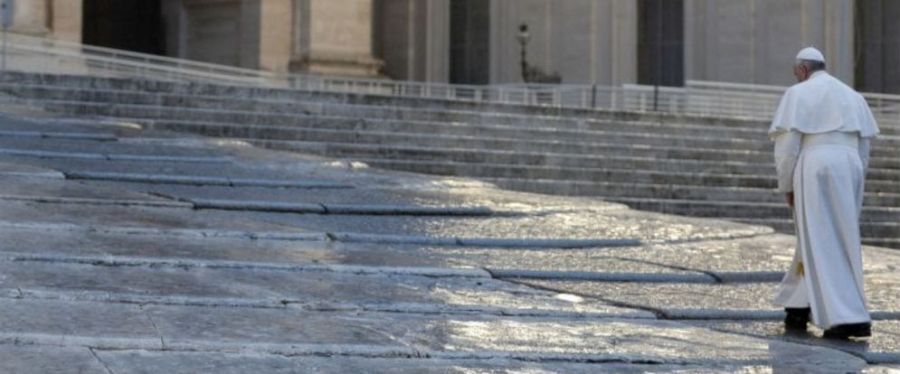
An invitation to "think in a Christian manner", because "a Christian does not think only with his head, he also thinks with his heart and with the spirit within", was addressed by Pope Francis this morning, Friday 29 November, during the Mass celebrated at Santa Marta. It is a particularly timely invitation in a social context where - the Pontiff pointed out - 'weak thinking, uniform thinking, ready-to-wear thinking' is increasingly creeping in.

The Bishop of Rome focused his reflection on the Gospel passage from Luke (21:29-33) proposed during the liturgy, in which the Lord "with simple examples teaches the disciples to understand what is happening". In this case, Jesus invites them to observe "the fig tree and all the trees", because when they sprout one understands that summer is near. In other contexts the Lord uses similar examples to rebuke those Pharisees who do not want to understand "the signs of the times"; those who do not see "the step of God in history", in the history of the people of Israel, in the history of the human heart, "in the history of humanity".

The teaching, according to the Holy Father, is that "Jesus with simple words encourages us to think in order to understand". And it is an encouragement to think "not only with the head", but also "with the heart, with the spirit", with our whole self. This is precisely 'thinking in a Christian manner', to be able to 'understand the signs of the times'. And those who do not understand, as in the case of the disciples of Emmaus, are defined by Christ as "foolish and slow of heart". Because - the Pope explained - he who "does not understand the things of God is such a person", foolish and hard of understanding, while "the Lord wants us to understand what is happening in our hearts, in our lives, in the world, in history"; and to understand "what is happening now". Indeed, it is in the answers to these questions that we can detect 'the signs of the times'.

Yet this is not always the case. There is an enemy lurking. It is 'the spirit of the world', which - the Holy Father recalled - 'makes other proposals to us'. Because 'it does not want us people, it wants us mass. Without thought and without freedom'. The spirit of the world, in essence, pushes us along "a road of uniformity, but without that spirit that makes up the body of a people", treating us "as if we did not have the ability to think, as people who are not free". And in this regard, Pope Francis expressly clarified the mechanisms of covert persuasion: there is a certain way of thinking that must be imposed, "this thinking is advertised" and "one must think" in this way. It is 'uniform thinking, equal thinking, weak thinking'; a thinking that is unfortunately 'so widespread', commented the bishop of Rome.

In practice, 'the spirit of the world does not want us to ask ourselves before God: but why is this happening? And to distract us from the essential questions, "it proposes to us a ready-made way of thinking, according to our tastes: I think as I like". This way of thinking "suits" the spirit of the world; while what he "does not want is what Jesus asks of us: free thinking, the thinking of a man and a woman who are part of the people of God". After all, 'salvation was precisely this: to make us people, God's people. To have freedom'. Because "Jesus asks us to think freely, to think in order to understand what is happening".

Of course, Pope Francis warned, "alone we cannot" do everything: "we need the Lord's help, we need the Holy Spirit to understand the signs of the times". In fact, it is precisely the Spirit who gives us "the intelligence to understand". It is a personal gift given to every man, thanks to which "I must understand why this is happening to me" and "what is the way the Lord wants" for my life. Hence the concluding exhortation to "ask the Lord Jesus for the grace to send us his spirit of intelligence", so that "we do not have a weak thought, a uniform thought, a thought according to our tastes", to have instead "only a thought according to God". And "with this thinking - of mind, heart and soul - which is a gift of the Spirit", try to be able to understand "what things mean, to understand well the signs of the times."

[Pope Francis, St. Martha, in L'Osservatore Romano 30/11/2013]

2 Last modified on Thursday, 19 November 2026 04:08
don Giuseppe Nespeca

Giuseppe Nespeca è architetto e sacerdote. Cultore della Sacra scrittura è autore della raccolta "Due Fuochi due Vie - Religione e Fede, Vangeli e Tao"; coautore del libro "Dialogo e Solstizio".

Email This email address is being protected from spambots. You need JavaScript enabled to view it.
"In aeternum, Domine, verbum tuum constitutum est in caelo... firmasti terram, et permanet". This refers to the solidity of the Word. It is solid, it is the true reality on which one must base one's life (Pope Benedict)
«In aeternum, Domine, verbum tuum constitutum est in caelo... firmasti terram, et permanet». Si parla della solidità della Parola. Essa è solida, è la vera realtà sulla quale basare la propria vita (Papa Benedetto)
«The morning Resurrection gets us the sustenance of the celestial help. The Resurrection has rejected the night, has brought us the day» (St Ambrosius)
«La Risurrezione mattutina ci procura il sostentamento dell’aiuto celeste, essa che ha respinto la notte, ci ha riportato il giorno» (S. Ambrogio)
It has made us come here the veneration of martyrdom, on which, from the beginning, the kingdom of God is built, proclaimed and begun in human history by Jesus Christ (Pope John Paul II)
Ci ha fatto venire qui la venerazione verso il martirio, sul quale, sin dall’inizio, si costruisce il regno di Dio, proclamato ed iniziato nella storia umana da Gesù Cristo (Papa Giovanni Paolo II)
The evangelization of the world involves the profound transformation of the human person (Pope John Paul II)
L'opera evangelizzatrice del mondo comporta la profonda trasformazione delle persone (Papa Giovanni Paolo II)
The Church, which is ceaselessly born from the Eucharist, from Jesus' gift of self, is the continuation of this gift, this superabundance which is expressed in poverty, in the all that is offered in the fragment (Pope Benedict)
La Chiesa, che incessantemente nasce dall’Eucaristia, dall’autodonazione di Gesù, è la continuazione di questo dono, di questa sovrabbondanza che si esprime nella povertà, del tutto che si offre nel frammento (Papa Benedetto)
How we treat them will be taken as the way we treat Jesus himself. We do not see here a simple literary device, or a simple metaphor [Pope Benedict]
Il comportamento che noi abbiamo nei loro confronti sarà dunque considerato come il comportamento che abbiamo nei confronti di Gesù stesso. Non vediamo in questo una semplice formula letteraria, una semplice immagine! [Papa Benedetto]
The Sadducees, addressing Jesus for a purely theoretical "case", at the same time attack the Pharisees' primitive conception of life after the resurrection of the bodies; they in fact insinuate that faith in the resurrection of the bodies leads to admitting polyandry, contrary to the law of God (Pope John Paul II)
I Sadducei, rivolgendosi a Gesù per un "caso" puramente teorico, attaccano al tempo stesso la primitiva concezione dei Farisei sulla vita dopo la risurrezione dei corpi; insinuano infatti che la fede nella risurrezione dei corpi conduce ad ammettere la poliandria, contrastante con la legge di Dio (Papa Giovanni Paolo II)
Today, as yesterday, the Church needs you and turns to you. The Church tells you with our voice: don’t let such a fruitful alliance break! Do not refuse to put your talents at the service of divine truth! Do not close your spirit to the breath of the Holy Spirit! (Pope Paul VI)
Oggi come ieri la Chiesa ha bisogno di voi e si rivolge a voi. Essa vi dice con la nostra voce: non lasciate che si rompa un’alleanza tanto feconda! Non rifiutate di mettere il vostro talento al servizio della verità divina! Non chiudete il vostro spirito al soffio dello Spirito Santo! (Papa Paolo VI)

Due Fuochi due Vie - Vol. 1 Due Fuochi due Vie - Vol. 2 Due Fuochi due Vie - Vol. 3 Due Fuochi due Vie - Vol. 4 Due Fuochi due Vie - Vol. 5 Dialogo e Solstizio I fiammiferi di Maria

duevie.art

don Giuseppe Nespeca

Tel. 333-1329741


Disclaimer

Questo blog non rappresenta una testata giornalistica in quanto viene aggiornato senza alcuna periodicità. Non può pertanto considerarsi un prodotto editoriale ai sensi della legge N°62 del 07/03/2001.
Le immagini sono tratte da internet, ma se il loro uso violasse diritti d'autore, lo si comunichi all'autore del blog che provvederà alla loro pronta rimozione.
L'autore dichiara di non essere responsabile dei commenti lasciati nei post. Eventuali commenti dei lettori, lesivi dell'immagine o dell'onorabilità di persone terze, il cui contenuto fosse ritenuto non idoneo alla pubblicazione verranno insindacabilmente rimossi.