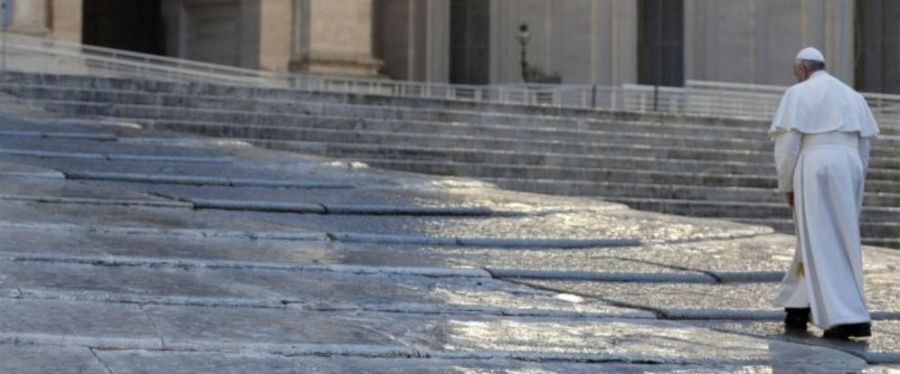
"Religion of make-up" or "path of humility"? In the homily of the Mass celebrated at Santa Marta on Tuesday 11 October, Pope Francis pointed out a decisive choice for the life of every Christian: even in "doing good", in fact, one can run into a dangerous misunderstanding, which is that of putting ourselves forward and not "the redemption that Jesus gave us". The objective is to affirm "our inner freedom" by showing the world how we really are in our hearts, without easy or cunning operations of external "make-up".
The Pontiff's reflection started precisely from the concept of freedom. The starting point came from the first reading of the day (Galatians, 5, 1-6), in which the Apostle Paul invites us to "stand firm and not allow the yoke of slavery to be imposed on us again, that is, to be free: free in religion, free in the worship of God". Here is the first teaching: "never lose your freedom". But what freedom? "Christian freedom," the Pope explained, "only comes from the grace of Jesus Christ, not from our works, not from our so-called 'righteousness', but from the righteousness that the Lord Jesus Christ has given us and with which he has recreated us". A righteousness, he added, "that comes precisely from the Cross".
The Gospel passage proposed by the liturgy (Luke, 11, 37-41) also insists on this subject. Here we read of Jesus rebuking a Pharisee, a doctor of the law. He rebukes him because, the Pope recalled, "this Pharisee invites Jesus to lunch and Jesus does not do ablutions, that is, he does not wash his hands": he therefore does not perform those practices "that were customary in the ancient law". Faced with certain remonstrances, the Lord says: "You Pharisees clean the outside of the glass and the plate but your inside is full of greed and wickedness". A concept, Francis noted, that Jesus "repeats many times in the Gospel" warning certain people with clear words: "Your inside is wicked, it is not right, it is not free. You are slaves because you have not accepted the justice that comes from God". Which is then 'the righteousness that Jesus gave us'.
In another passage we read that Jesus, after exhorting prayer, also teaches how it should be done: "In your room, let no one see you, so only your Father sees you". The invitation, therefore, is "not to pray in order to appear", in order to be seen, as did that Pharisee who - the Gospel goes on to say - before the altar in the temple said: "God, thank you, Lord, for I am not a sinner". Those who acted in this way, the Pontiff commented, were really "stubborn faces" and "had no shame".
Against certain attitudes, there is the suggestion given by Jesus himself and which the Pope summarised as follows: 'When you do good and give alms, do not do it to be admired. Let your right hand not know what your left hand is doing. Do it secretly. And when you do penance, fast, please beware of melancholy, do not be melancholic so that the whole world knows you are doing penance'. In essence: what matters "is the freedom that gave us redemption, that gave us love, that gave us the re-creation of the Father. It is an inner freedom, which leads one to do 'good in secret, without blowing the trumpet': in fact, 'the path of true religion is the same as the path of Jesus: humility, humiliation'. So much so that Jesus - recalled the Pontiff quoting Paul's letter to the Philippians - "humbled himself, emptied himself". He added: "It is the only way to remove from us selfishness, greed, pride, vanity, worldliness".
Faced with this model we find instead the attitude of those whom Jesus rebukes: "people who follow the religion of make-up: appearance, appearing, pretending to appear, but inside...". For them, the Pope stressed, Jesus uses "a very strong image: 'You are whitened sepulchres, beautiful on the outside but inside full of dead bones and rot'". On the contrary, "Jesus calls us, invites us to do good with humility", because otherwise we fall into a dangerous misunderstanding: "You can do all the good that you want, but if you do not do it humbly, as Jesus teaches us, this good is of no use, because a good that comes from yourself, from your security, not from the redemption that Jesus has given us". A redemption that, Francis said, comes through "the path of humility and humiliations": in fact "one never arrives at humility without humiliations". So much so that "we see Jesus humiliated on the cross".
Here then is the exhortation that concluded the homily: "We ask the Lord not to make us tired of going down this road, not to make us tired of rejecting this religion of appearing, of seeming, of pretending to...". The commitment must instead be to proceed "silently, doing good, gratuitously as we gratuitously received our inner freedom."
[Pope Francis, s. Marta, in L'Osservatore Romano 12/10/2016]