


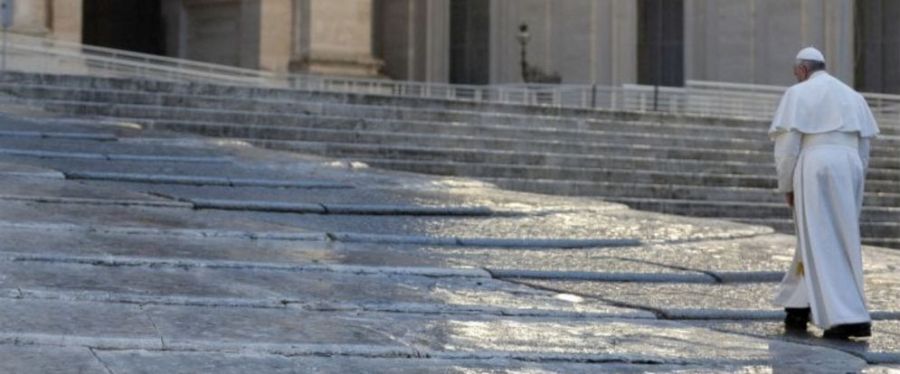
A man, John, and a road, which is that of Jesus, indicated by the Baptist, but is also ours, in which we are all called at the moment of trial.
It starts from the figure of John, "the great John: in the words of Jesus "the greatest man born of a woman"" the reflection of Pope Francis in the Mass celebrated at Santa Marta on Friday 6 February. The Gospel of Mark (6:14-29) recounts the imprisonment and martyrdom of this "man faithful to his mission; the man who suffered many temptations" and who "never, never betrayed his vocation". A man 'faithful' and 'of great authority, respected by all: the great of that time'.
Pope Francis paused to analyse his figure: 'What came out of his mouth was right. His heart was just'. He was so great that "Jesus will also say of him that 'it is Elijah who has returned, to clean the house, to prepare the way'". And John "was conscious that his duty was only to proclaim: to announce the proximity of the Messiah. He was conscious, as St Augustine makes us reflect, that he was the voice only, the Word was another'. Even when "he was tempted to "rob" this truth, he remained just: "I am not, behind me comes, but I am not: I am the servant; I am the servant; I am the one who opens the doors, so that he may come".
At this point the Pontiff introduced the concept of the way, because, he recalled, 'John is the forerunner: forerunner not only of the Lord's entry into public life, but of the Lord's entire life'. The Baptist 'goes forward in the Lord's way; he bears witness to the Lord not only by showing him - "This is it!" - but also by bringing life to the end as the Lord has brought it'. And by ending his life "with martyrdom" he was "a forerunner of the life and death of Jesus Christ".
The Pope went on to reflect on these parallel paths along which "the great" suffers "many trials and becomes small, small, small to the point of contempt". John, like Jesus, "annihilates himself, he knows the road of annihilation. John, with all that authority, thinking about his life, comparing it with that of Jesus, tells people who he is, what his life will be like: 'It is better for him to grow, I instead must diminish'". This, the Pope stressed, is "the life of John: to diminish before Christ, so that Christ may grow". It is "the life of the servant who makes room, makes way for the Lord to come".
John's life "was not easy": in fact, "when Jesus began his public life", he was "close to the Essenes, that is, to the observants of the law, but also of prayers, of penances". Thus, at a certain point, during the time he was in prison, 'he suffered the ordeal of darkness, of the night in his soul'. And that scene, Francis commented, 'moves one: the great, the greatest sends two disciples to Jesus to ask him: "But John asks you: is it you, or have I made a mistake and must we wait for another?" Along John's path therefore came 'the darkness of error, the darkness of a life burnt in error. And this was a cross for him".
To John's question "Jesus answers with the words of Isaiah": the Baptist "understands, but his heart remains in darkness". Nevertheless he lends himself to the demands of the king, 'who liked to hear him, who liked to lead an adulterous life', and 'almost became a court preacher, of this perplexed king'. But "he humbled himself" because "he thought he was converting this man".
Finally, the Pope said, 'after this purification, after this continual descent into annihilation, making way for the annihilation of Jesus, his life ends'. That king from being perplexed 'becomes capable of a decision, but not because his heart has been converted'; rather 'because the wine gives him courage'.
And so John ends his life 'under the authority of a mediocre, drunken and corrupt king, at the whim of a dancer and the vengeful hatred of an adulteress'. Thus 'ends the great, the greatest man born of woman', commented Francis, who confessed: 'When I read this passage, I am moved'. And he added a useful consideration for the spiritual life of every Christian: "I think of two things: first, I think of our martyrs, the martyrs of our days, those men, women, children who are persecuted, hated, driven from their homes, tortured, massacred". And this, he stressed, 'is not a thing of the past: this happens today. Our martyrs, who end their lives under the corrupt authority of people who hate Jesus Christ'. Therefore, "it is good for us to think about our martyrs. Today we think of Paul Miki, but that was in the 1600s. Let us think of those of today, of 2015".
The Pontiff went on to add that this passage also prompts him to reflect on himself: 'I too will end. All of us will end. No one's life is 'bought'. We too, willingly or unwillingly, go down the road of the existential annihilation of life'. And this, he said, prompts him "to pray that this annihilation resembles Jesus Christ, his annihilation, as much as possible".
This closes the circle of Francis' meditation: 'John, the great, who continually diminishes to nothingness; the martyrs, who diminish today, in our Church of today, to nothingness; and we, who are on this road and going towards the earth, where we will all end'. In this sense the Pope's final prayer: "May the Lord enlighten us, make us understand this road of John, the forerunner of the road of Jesus; and the road of Jesus, who teaches us how ours should be."
[Pope Francis, St. Martha, in L'Osservatore Romano 07.02.2015]








