Oct 26, 2026 Written by 

«Force them in»

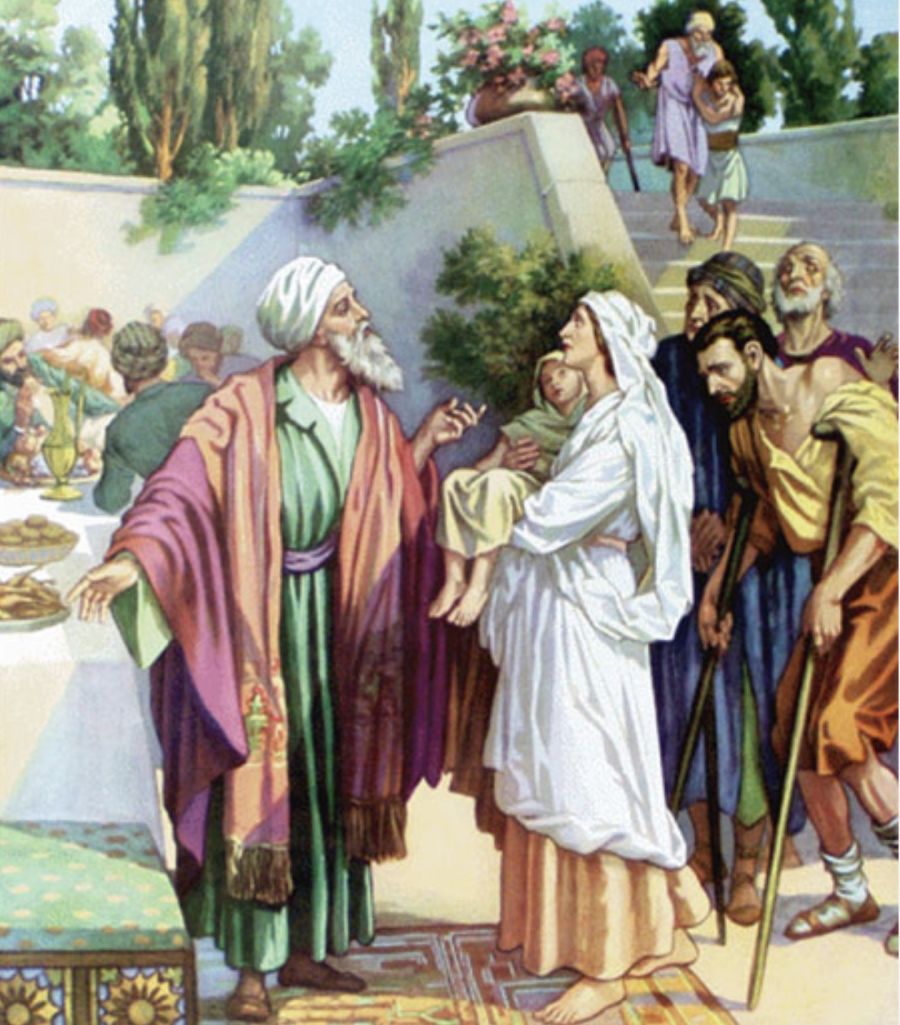
Luke tells the parable of the great banquet, of those who, having been invited to a wedding, do not prove worthy of the opportunity they have received.

Hence the host's choice to welcome to dinner the poor, the crippled, the blind and the lame found at the crossroads.


Significantly, we find in the Sources that Francis, in love with Our Lady Poverty, insistently invited her to take food with the brothers [cf. Sacrum Commercium Beati Francisci cum Domina Paupertate].

The Saint had well understood that the Queen of the table was the one who shone in a special way in the derelict, in those who were forced to the margins of society, but sensitive to the invitation.

We read in fact:

"Then they led her to the place where the table was prepared. As she arrived, she looked around and, seeing nothing but three or four loaves of barley bread and bran placed on the grass, she was seized with great admiration" (FF 2020).

Then "he commanded them all to be together and spoke words of life to them, saying:

«Be blessed, my children, by the Lord God who created the heavens and the earth, for you have welcomed me into your home with such fullness of charity, that today, being with you, it seemed to me that I was in the paradise of the Lord [...].

Here is what I have sought so much, now I contemplate it [...] because on earth I have united myself with men who are for me the faithful image of Him who is my spouse in heaven.

May the Lord bless your courage and praise the work of your hands» (FF 2024).

Called and elected [in the company of Our Lady Poverty] to follow in the footsteps of the Son of God.

Clare herself, in her Spiritual Testament, a true Franciscan pearl, addresses her present and future daughters, inviting them to guard the priceless treasure of election.

We read:

"Among the other benefits we have received and daily receive from our Donor, the Father of Mercies, for which we are greatly obliged to render to Him glorious living acts of grace, great is that of our vocation. And the greater and more perfect it is, the more we are obliged to him.

Therefore the Apostle admonishes: «Know your vocation well»" (FF 2823).

Again:

"The Son of God became our Way; and this by word and example our blessed father Francis, a true lover and imitator of Him, showed and taught us" (FF 2824).

At this point Clare recalls when the Saint, under divine inspiration, prophesied about them. 

"Having climbed over the wall of the said church [...] he addressed some poor people who were standing nearby:

«Come and help me in this work of the monastery of St Damian, for soon women will come to inhabit it, and by the fame of the holiness of their lives glory will be rendered to our heavenly Father throughout his holy Church».

We can, therefore, admire in this fact the great goodness of God towards us: he has deigned, in his superabundant mercy and charity, to inspire such words to his Saint concerning our vocation and election" (FF 2827-2828).


«Go out early into the squares and alleys of the city and bring in the poor and crippled and blind and lame» (Lk 14:21b)


Tuesday 31st wk. in O.T.  (Lk 14:15-24)

225 Last modified on Wednesday, 04 November 2026 04:15
Teresa Girolami

Teresa Girolami è laureata in Materie letterarie e Teologia. Ha pubblicato vari testi, fra cui: "Pellegrinaggio del cuore" (Ed. Piemme); "I Fiammiferi di Maria - La Madre di Dio in prosa e poesia"; "Tenerezza Scalza - Natura di donna"; co-autrice di "Dialogo e Solstizio".

Email This email address is being protected from spambots. You need JavaScript enabled to view it.
The Church, which is ceaselessly born from the Eucharist, from Jesus' gift of self, is the continuation of this gift, this superabundance which is expressed in poverty, in the all that is offered in the fragment (Pope Benedict)
La Chiesa, che incessantemente nasce dall’Eucaristia, dall’autodonazione di Gesù, è la continuazione di questo dono, di questa sovrabbondanza che si esprime nella povertà, del tutto che si offre nel frammento (Papa Benedetto)
How we treat them will be taken as the way we treat Jesus himself. We do not see here a simple literary device, or a simple metaphor [Pope Benedict]
Il comportamento che noi abbiamo nei loro confronti sarà dunque considerato come il comportamento che abbiamo nei confronti di Gesù stesso. Non vediamo in questo una semplice formula letteraria, una semplice immagine! [Papa Benedetto]
The Sadducees, addressing Jesus for a purely theoretical "case", at the same time attack the Pharisees' primitive conception of life after the resurrection of the bodies; they in fact insinuate that faith in the resurrection of the bodies leads to admitting polyandry, contrary to the law of God (Pope John Paul II)
I Sadducei, rivolgendosi a Gesù per un "caso" puramente teorico, attaccano al tempo stesso la primitiva concezione dei Farisei sulla vita dopo la risurrezione dei corpi; insinuano infatti che la fede nella risurrezione dei corpi conduce ad ammettere la poliandria, contrastante con la legge di Dio (Papa Giovanni Paolo II)
Today, as yesterday, the Church needs you and turns to you. The Church tells you with our voice: don’t let such a fruitful alliance break! Do not refuse to put your talents at the service of divine truth! Do not close your spirit to the breath of the Holy Spirit! (Pope Paul VI)
Oggi come ieri la Chiesa ha bisogno di voi e si rivolge a voi. Essa vi dice con la nostra voce: non lasciate che si rompa un’alleanza tanto feconda! Non rifiutate di mettere il vostro talento al servizio della verità divina! Non chiudete il vostro spirito al soffio dello Spirito Santo! (Papa Paolo VI)
Sometimes we try to correct or convert a sinner by scolding him, by pointing out his mistakes and wrongful behaviour. Jesus’ attitude toward Zacchaeus shows us another way: that of showing those who err their value, the value that God continues to see in spite of everything (Pope Francis)
A volte noi cerchiamo di correggere o convertire un peccatore rimproverandolo, rinfacciandogli i suoi sbagli e il suo comportamento ingiusto. L’atteggiamento di Gesù con Zaccheo ci indica un’altra strada: quella di mostrare a chi sbaglia il suo valore, quel valore che Dio continua a vedere malgrado tutto (Papa Francesco)
Deus dilexit mundum! God observes the depths of the human heart, which, even under the surface of sin and disorder, still possesses a wonderful richness of love; Jesus with his gaze draws it out, makes it overflow from the oppressed soul. To Jesus, therefore, nothing escapes of what is in men, of their total reality, in which good and evil are (Pope Paul VI)
Deus dilexit mundum! Iddio osserva le profondità del cuore umano, che, anche sotto la superficie del peccato e del disordine, possiede ancora una ricchezza meravigliosa di amore; Gesù col suo sguardo la trae fuori, la fa straripare dall’anima oppressa. A Gesù, dunque, nulla sfugge di quanto è negli uomini, della loro totale realtà, in cui sono il bene e il male (Papa Paolo VI)

Due Fuochi due Vie - Vol. 1 Due Fuochi due Vie - Vol. 2 Due Fuochi due Vie - Vol. 3 Due Fuochi due Vie - Vol. 4 Due Fuochi due Vie - Vol. 5 Dialogo e Solstizio I fiammiferi di Maria

duevie.art

don Giuseppe Nespeca

Tel. 333-1329741


Disclaimer

Questo blog non rappresenta una testata giornalistica in quanto viene aggiornato senza alcuna periodicità. Non può pertanto considerarsi un prodotto editoriale ai sensi della legge N°62 del 07/03/2001.
Le immagini sono tratte da internet, ma se il loro uso violasse diritti d'autore, lo si comunichi all'autore del blog che provvederà alla loro pronta rimozione.
L'autore dichiara di non essere responsabile dei commenti lasciati nei post. Eventuali commenti dei lettori, lesivi dell'immagine o dell'onorabilità di persone terze, il cui contenuto fosse ritenuto non idoneo alla pubblicazione verranno insindacabilmente rimossi.