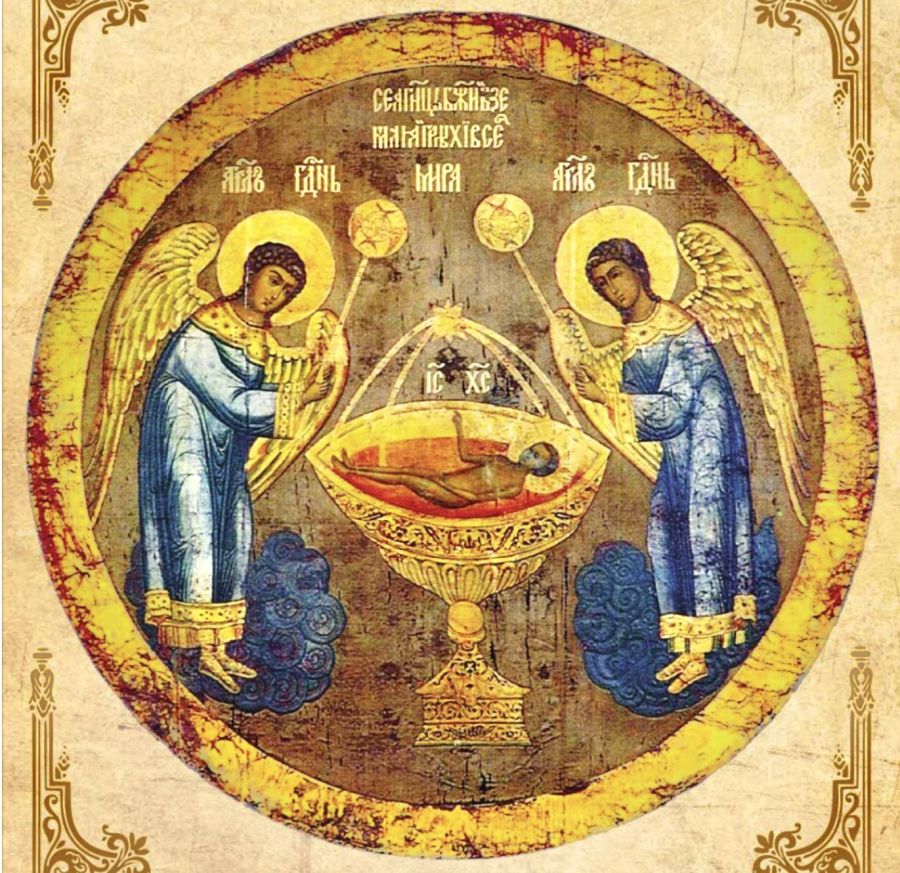
On this solemn Sunday of Corpus Christi, the liturgy presents a passage from John in which Jesus, addressing the Jews, says:
«I am the living bread that came down from heaven. Whoever eats this bread will live for ever, and the bread that I will give is my flesh for the life of the world» (Jn 6:51).
Francis was enamoured of France not because his mother, Monna Pica, came from those lands, but because of the flourishing of Eucharistic devotion, of which he had been informed by James of Vitry, a staunch advocate.
When he went into the woods or was in a particularly cheerful mood, he often sang the Lauds in French.
The Sources inform us of his deep devotion to the Body of Christ.
In Celano’s Second Life we read:
“He burned with love in every fibre of his being for the sacrament of the Lord’s Body, overcome with wonder beyond measure at such benevolent condescension and most generous charity.
He considered it a grave sign of contempt not to receive the Eucharist, even just once, if time permitted.
He received Communion frequently and with such devotion that he inspired devotion in others as well.
Indeed, being filled with reverence for this venerable sacrament, he offered the sacrifice of all his limbs, and when he received the slain Lamb, he offered up his spirit in that fire which always burned upon the altar of his heart.
For this reason he loved France, a land devoted to the Body of the Lord, and wished to die there because of the veneration he had for the sacred mysteries.
One day he wished to send the friars out into the world with precious ciboria, so that they might place the price of redemption in the most worthy place possible, wherever they saw it kept with little decorum” (FF 789).
“He wished great respect to be shown to the hands of the priest, for to them has been conferred the divine power to consecrate this sacrament.
«If it should happen to me,’ he often said, ‘to meet both a saint coming from heaven and a poor little priest, I would greet the priest first and run to kiss his hands.
For I would say: ‘Oh! Wait, Saint Lawrence*, for this man’s hands touch the Word of life and possess a superhuman power»” (FF 790).
And Saint Clare, faced with a shortage of bread in the monastery, obtained by Grace the power to multiply it.
“There was only one loaf of bread in the monastery, and the hour of supper was drawing near, and hunger was setting in.
Having summoned the stewardess, the Saint ordered her to divide the bread and send one portion to the friars, keeping the other inside for the sisters.
From this second half that had been set aside, she ordered fifty slices to be cut—the number of the women—and for them to be placed before them on the table of poverty.
And to the devout daughter, who replied:
«The ancient miracles of Christ would be needed to cut such a small amount of bread into fifty slices», the Mother replied, saying to her:
«Be certain of what I tell you, daughter!».
The daughter therefore hastens to carry out her Mother’s command; and the Mother hastens to offer pious sighs to her Christ, for her daughters.
And by divine grace that scant substance grows in the hands of the one who breaks it, so that there is an abundant portion for each member of the community” (FF 3189).
Francis and Clare’s love for the Body and Blood of Christ made them direct participants in that Holy Mystery.
* Saint Lawrence was only a deacon, like Francis.
Corpus Christi Sunday A (Jn 6:51–58)