
29th Sunday in Ordinary Time (year A) [18 October 2026]
First Reading from the Book of the Prophet Isaiah 45:1–6
When Isaiah wrote this text, the Jews had been in exile in Babylon for almost fifty years. In 587 BC, Nebuchadnezzar’s armies had conquered Jerusalem, destroyed and plundered the Temple, and deported the survivors. Now, however, news is arriving of the conquests of Cyrus, King of Persia, the new ruler of the world. For the Jews, this news offers a glimmer of hope, for Cyrus is rapidly conquering the entire region. Cyrus stands out from other rulers because he adopts a more humanitarian policy: he does not kill the vanquished, nor does he destroy or plunder their cities, nor does he deport the populations. On the contrary, in the conquered territories he allows the exiles to return to their homeland, restores to them the property taken by previous conquerors, and even provides the means to rebuild the country. He probably realises that it is in an emperor’s interest to rule over happy peoples. In this context, Isaiah utters a prophecy that is above all a profession of faith and hope. He says: ‘Thus says the Lord to his anointed one, to Cyrus’. The message is probably not addressed directly to Cyrus—who would not have listened to a Jewish prophet—but to the exiled Jews, to restore their hope. This hope is based on two fundamental convictions. Firstly, God is faithful to his Covenant.
God has not abandoned his people: Israel remains his servant and his chosen people. Even though they have lost their freedom, their land, the Temple, their king and their political independence, God continues to be faithful to the Covenant with Jacob and Israel. This certainty is particularly important precisely at a time when the Jews might think that God has abandoned them. Secondly,
God is the Lord of history. God declares: ‘I am the Lord; there is no other.’ Even the mighty Cyrus is in his hands. The expressions relating to bestowing a title, taking by the hand and opening the gates recall the rites of the coronation of kings: the king received the title of Son of God, was anointed with oil and placed in God’s hands; the open gates also symbolised the conquest of enemy cities. Isaiah therefore applies to Cyrus imagery typical of the coronation of the kings of Israel, presenting him as a king chosen and consecrated by God, even though he is a pagan. This proves that it is always God who retains the initiative and control over events.
Responsorial Psalm (95/96)
There is a thrill, indeed an exultation, running through these few verses. One senses the faith that stirs this people; indeed, even better, the hope that is the joy of faith. It is hope that enables us to affirm with certainty what we do not yet possess, as the Letter to the Hebrews states (1:1). If we pause to read the final verses, we realise that this psalm already transports us to the end of the world, to that blessed day when all peoples, without exception, will recognise God as the one and only God. Joy in heaven! Let the earth rejoice! Let the depths of the sea roar; let the whole countryside be in celebration. Let the trees of the forests dance for joy before the Lord, for he is coming to judge the earth. He will judge the world with justice and the peoples according to his truth! Here, the blessed day we await is already being sung of. Let us imagine the scene: we are in Jerusalem; all peoples, nations and races are thronging around the Temple. The esplanade is teeming; the steps of the courtyard are black with people; crowds are pouring in from every corner of the world; the number of pilgrims stretches as far as the eye can see, and Jerusalem is not big enough to contain them all. Everyone is singing at the top of their voices, like a true symphony: ‘God reigns!’ It is an immense and colossal clamour, like the ovation given to every new king on the day of his coronation. This time, however, it is not the people of Israel acclaiming an earthly king; it is the whole of humanity acclaiming the King of the world: ‘Great is the Lord, highly praised, awesome’. And it is not just humanity; the earth itself trembles, and even the seas join in the symphony, whilst the countryside rejoices and the trees dance, for they recognise their Creator. Amidst so many idols and false gods, there is no room for error, and even the trees are not deceived. People, on the other hand, have long allowed themselves to be deceived, and it is incredible that it has taken them so long to recognise their Creator, their Father. This time, however, it has happened, and everyone is coming to Jerusalem to acclaim God because at last the good news resounds: ‘Day by day Israel has proclaimed its salvation… the ceaseless work of liberation… day by day Israel has borne witness that God first delivered it from Egypt, then from every kind of slavery; and the most terrible form of slavery is to place one’s trust in false values, false gods that can only disappoint. Israel is immensely fortunate to know and to be charged with proclaiming that our God is the one and only God, as declared in the Shema Israel: ‘Hear, O Israel: the Lord our God is one’ (Deut 6:4). This is the mystery of Israel’s vocation, as we read in Deuteronomy: ‘You have been granted to see all this, so that you may know that the Lord is God; there is no other’ (Deut 4:32). But the chosen people have never forgotten that if they have been granted to see, it is so that they may make it known; and whilst awaiting the fulfilment of this dream, Israel sings this psalm to renew its faith and hope.
Second Reading from the Letter of Saint Paul the Apostle to the Thessalonians (1:1–5)
This is the earliest Christian writing, even though we are accustomed to seeing the Gospels at the beginning of the New Testament, thus running the risk of forgetting that they were written after Paul’s letters. The First Letter to the Thessalonians dates back to just twenty years or so after the Resurrection of Christ, and so here we have the earliest statements of Christian preaching. It is the first time that an attempt has been made to set down in writing the mystery of Jesus Christ. It is around the year 50, and the Gospel has already been proclaimed far from Jerusalem, for Thessalonica is in Europe, in northern Greece, in the region known as Macedonia. Before reaching that far, Paul had already had time to establish communities throughout the south, the centre and even the west coast of Turkey. It is from the Acts of the Apostles that we know how events unfolded: Paul was on a mission on the west coast of Turkey when, one night, he had a vision of a Macedonian man imploring him: ‘Come over to Macedonia and help us’. And Luke, who was part of the journey, recounts: “Following this vision of Paul’s, we immediately set out for Macedonia, for we realised that God was calling us to bring the Good News there” (Acts 16:9–10). Paul, Luke and Silas arrived on the Greek coast in the city of Philippi, where they were initially well received, but were soon accused of disturbing the peace; they were beaten and thrown into prison. Thanks to a providential earthquake, they were set free and, having left the city, went on to Thessalonica. According to the Acts of the Apostles, Paul’s preaching was always the same: “For three Sabbaths he reasoned with them from the Scriptures, explaining and proving that the Christ had to suffer and rise from the dead, and he added: ‘This Jesus whom I am proclaiming to you is the Christ’”. The text adds: “Some of them (that is, the Jews he met in the synagogue) were persuaded and joined Paul and Silas, along with a large crowd of Greeks who worshipped God and a good number of prominent women” (Acts 17:2–4). But, as usual, Paul did not arouse only enthusiasm because, as we read in the Acts of the Apostles: “The Jews, driven by jealousy, gathered some troublemakers in the public square; having stirred up crowds, they were causing unrest in the city” (Acts 17:5), so much so that it seemed very prudent for Paul and Silas to leave the area. Paul therefore left this new community too hastily and remained somewhat troubled about it for a while. When he wrote this letter, which we begin to read today, he had just been reassured by Silas and Timothy, who had remained in Macedonia and were bringing him excellent news. This explains the particularly joyful tone at the beginning of the letter: “Paul, Silvanus (another name for Silas) and Timothy to the Church of the Thessalonians, which is in God the Father and in the Lord Jesus Christ. Grace and peace to you. At all times we give thanks to God for all of you.” Right from this first sentence, one is struck by the solemnity of the greeting: this community is very small, and he grandly calls it “the Church of Thessalonica which is in God the Father and in the Lord Jesus Christ”. This immense respect that Paul has for Christian communities, even modest ones, is characteristic of all his letters.
From the Gospel according to Saint Matthew (22:15–21)
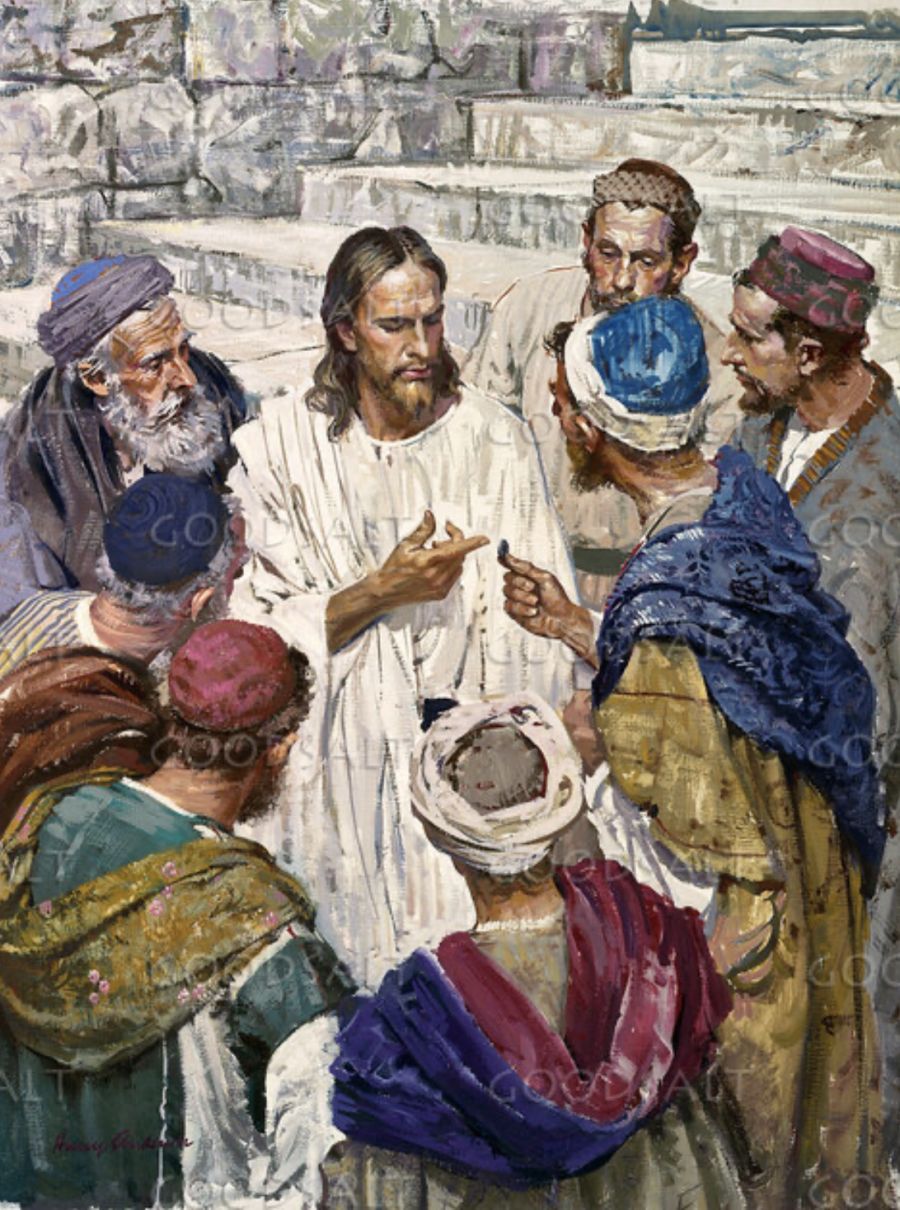
‘Is it lawful to pay the tribute to the emperor?’ Jesus replies by calling the questioners ‘hypocrites’! Why ‘hypocrites’? Because this is not a genuine question, and they are hypocrites for two reasons: first of all, because they have long since resolved this issue. Paying the tax to the Emperor – ‘Render unto Caesar the things that are Caesar’s’ – is something they do, and Jesus does not say they are wrong. Now they are setting a trap and trying to catch Jesus out… And the falsely respectful tone that precedes the question further emphasises this: ‘Teacher, we know that you are always truthful and teach the way of God in accordance with the truth’. All this politeness is nothing more than a preamble to a trick question designed to put Jesus in a difficult position. If Jesus urges his compatriots to refuse to pay the tax levied for the benefit of the Roman occupiers, it will be easy to denounce him to the authorities as a resistance fighter or even a revolutionary, and he will be condemned. If, on the other hand, he advises paying the tax, he could be discredited in the eyes of the people as a collaborator, losing any chance of being recognised as the Messiah; for the expected Messiah must be an independent and sovereign king on the throne of Jerusalem, which necessarily involves a revolt against the Roman occupiers. The trap is well laid, and in any case, whatever his answer, Jesus is doomed. In fact, they are seeking the first suitable opportunity to put him to death, for the Passion is already looming on the horizon, given that we are in the very final moments in Jerusalem. In his reply, Jesus clearly shows that he has understood: ‘Hypocrites! Why are you trying to test me?’ He is not naive in the face of the trap being set for him… Yet he does not seek to embarrass his interlocutors, for Jesus never did so and never sought to set a trap for anyone: this would be unworthy of the God whose light shines upon both the good and the wicked.
Jesus therefore does not respond to the trap with another trap, but takes the question seriously and answers it properly, setting out his argument in three points: ‘Give to Caesar what is Caesar’s… and give to God what is God’s. Firstly, ‘Render unto Caesar what is Caesar’s’, including by paying tax. By this he invites us to recognise that Caesar is the holder of power, and this has nothing to do with servile collaboration; on the contrary, it is accepting a de facto situation and, furthermore, from the Old Testament perspective, it was considered that all power comes from God. Jesus himself, during his Passion, will say to Pilate: ‘You would have no power over me unless it had been given to you from above’ (Jn 19:11). Moreover, Isaiah also recalled this in the first reading when speaking of King Cyrus: God can turn every human kingship to the good of his people. The Pharisees know the passage from Isaiah about Cyrus better than we do; they therefore know that all power, even pagan power, is in God’s hands. Let us note, however, in passing that the Caesar of the time was actually called ‘Tiberius’ and that the name ‘Caesar’ had become a title of the Roman emperor. Secondly, ‘Render unto Caesar only what is Caesar’s’: when Caesar – that is, the Roman emperor – demands tax, he is within his rights, but when he demands to be called ‘Lord’ and to be worshipped, he exposes you to idolatry, and here there must be no compromise. At the time when Matthew was writing his Gospel, this scenario was a reality. Many martyrs paid with their lives for this refusal to worship the Roman emperor. The invitation is therefore important: ‘Render unto God what is God’s’. That is the real issue: are you sure you are rendering unto God what is God’s? Why do you not recognise in Jesus the one who ‘is of God’? Without wishing to derive a theory of political power from this text – which Jesus certainly did not intend to do here – we can nevertheless draw from this Gospel passage, once again, a surprising lesson in freedom. Caesar is but Caesar, and the kings of the earth are but petty kings whose kingship is fleeting, whilst the kingdom of God is of an entirely different order: it is within the very heart of the kingdoms of the earth that every act of love and brotherhood causes the one true kingdom—the Kingdom of God—to grow.
+Giovanni D’Ercole
