
21st Sunday in Ordinary Time (year A) [23 August 2026]
First Reading from the Book of the Prophet Isaiah (22:19–23)
We are in Jerusalem around 700 BC, during the reign of Hezekiah. The steward of the royal palace, Shebna, holds a very important office: he is entrusted with the ‘keys of the house of David’, a symbol of the authority to control access to the king and to govern in his name. The prophet Isaiah accuses Shebna of two serious offences: 1. He supported an alliance with Egypt against the Assyrian empire, a choice that would have led to grave consequences for the kingdom: the offence, therefore, of giving bad advice. 2. Instead of serving the people, he was primarily concerned with his own prestige and power: the offence of pursuing his own interests. For this reason, Isaiah announces his dismissal and the appointment of Eliakim, described as a true servant of the people. He is entrusted with the keys to the kingdom with the words: ‘If he opens, no one will shut; if he shuts, no one will open.’ From this historical event, the sacred author draws several important messages: 1. God acts within concrete history, and political events too form part of the history of salvation. 2. Nothing escapes God’s plan of salvation, and everything contributes to its fulfilment. 3. In this context, the role of the prophets is to call rulers and those in power to justice and the common good. 4. We must constantly remember that all authority is a service: power exists for the good of the people, not for the personal interest of those who exercise it. 5 We must not forget that when the good of his people is threatened, God intervenes to raise up faithful leaders, for he never abandons his people or his plans for salvation.
Responsorial Psalm (137/138)
The prayer of the poor rises above the clouds. This short psalm (138 according to the Hebrew numbering, 137 in the Greek) is a prayer of thanksgiving that summarises the entire history of the Covenant between God and Israel. As is often the case in the psalms, the ‘I’ who speaks actually represents the whole people of Israel, chosen by God to know his love and bear witness to it before the nations. The psalm opens with a thanksgiving: ‘I give you thanks, Lord, with all my heart’. In the Greek version, the reason for this praise is specified: God has heard the prayer of his people. This is one of the fundamental convictions of the biblical faith. Ever since the experience of Moses at the burning bush, God has presented himself as the one who sees the suffering of his people, hears their cry and knows their anguish. He is not indifferent to human suffering, but sustains his children so that they may not be overwhelmed by evil. This is why the psalm states that the Lord, though he is most high, looks with care upon the humble. The same teaching is taken up by Ben Sira: ‘The prayer of the poor pierces the clouds’, that is, it reaches God. And Jesus, too, will express the same trust before Lazarus’s tomb: ‘I knew that you always hear me’ (John 11:41–42). This is a universal psalm which, in some parts, lends itself to various possible interpretations due to differences between the Hebrew and Greek texts. The phrase ‘I will sing to you in the presence of the angels’ in the Hebrew text could be translated as ‘before the gods’ (the Elohîm). The two readings are not mutually exclusive: ‘Before the angels’ evokes the heavenly liturgy, in which the heavenly beings continually praise God with the song ‘Holy, Holy, Holy’, as in the vision of the prophet Isaiah (Isaiah 6:3). ‘Before the gods’ is a profession of faith: the God of Israel is the one true God, whilst the idols of the nations have no power whatsoever. A Syriac translation, on the other hand, proposes: ‘I sing to you before the kings’. In this case, Israel’s mission to bear witness to the Lord before all the peoples of the earth comes to the fore. Rather than contradicting one another, the three interpretations complement one another. The psalm sings of God’s love and faithfulness. In the Bible, ‘love and faithfulness’ is a phrase that denotes God’s unshakeable faithfulness to the Covenant. For Israel, remembering God’s love and faithfulness means remembering that the Lord never abandons his people, even when they prove unfaithful. The conclusion is trust in God’s work. Indeed, the psalm ends with a plea: ‘Do not forsake the work of your hands’. This is not a request born of fear, but of trust. The believer knows that God’s love is eternal and that, despite human frailty, the Lord will continue to carry out his plan of salvation. The final message is therefore simple and profound: God always hears the cry of the lowly and the poor; his faithfulness never fails and his work in history continues. For this reason, the believer can praise him with gratitude and entrust themselves to him with complete confidence.
Second Reading from the Letter of Saint Paul the Apostle to the Romans (11:33–36)
This passage concludes Paul’s reflection on the rift within the Jewish people following the emergence of the Christian community. For centuries, the Jews had been certain that they were the people chosen by God to bear witness to the one true God before the world, and his Covenant had been confirmed throughout history. The prophets had recalled this vocation, proclaiming that Israel would be a light to the nations and an instrument of salvation for all peoples. The emergence of Christianity triggered a profound crisis, and a group of Jews arose who recognised Jesus as the long-awaited Messiah. Paul, who was Jewish and became a Christian, experienced this rift first-hand. On the one hand, he adhered to Christ; on the other, he suffered at the sight of the majority of his people rejecting the Gospel. This gave rise to his question: has God perhaps rejected Israel? Has the Covenant been annulled and replaced by a new people? Paul finds an initial answer in the Scriptures: the Covenant, founded on God’s gratuitous love and not on the people’s abilities or merits, cannot be revoked because God is faithful to his promises and cannot deny himself. For this reason, Paul affirms that ‘God’s gifts and his call are irrevocable’ (Rom 11:29). The second reason for hope is the conviction that the relationship between God and Israel – described by the prophets as a spousal love – will be maintained even in times of suffering, which are transformed into opportunities for salvation. A portion of Israel—the so-called ‘faithful remnant’ spoken of by the prophets—has accepted Christ, and Paul is convinced that this process will lead to full salvation: he cannot explain how, but he is certain of it. Having reached this point, Paul offers no further theoretical explanations, but contemplates the mystery of God: ‘Oh, the depth of the riches and wisdom and knowledge of God! How unsearchable are his judgements and his ways beyond our understanding!’ The final message, which draws on words from Isaiah, Job and the wisdom tradition, is an invitation to Christians to cultivate an attitude of humble trust: God’s plans are beyond human understanding, but his faithfulness is certain.
From the Gospel according to Matthew (16:13–20)
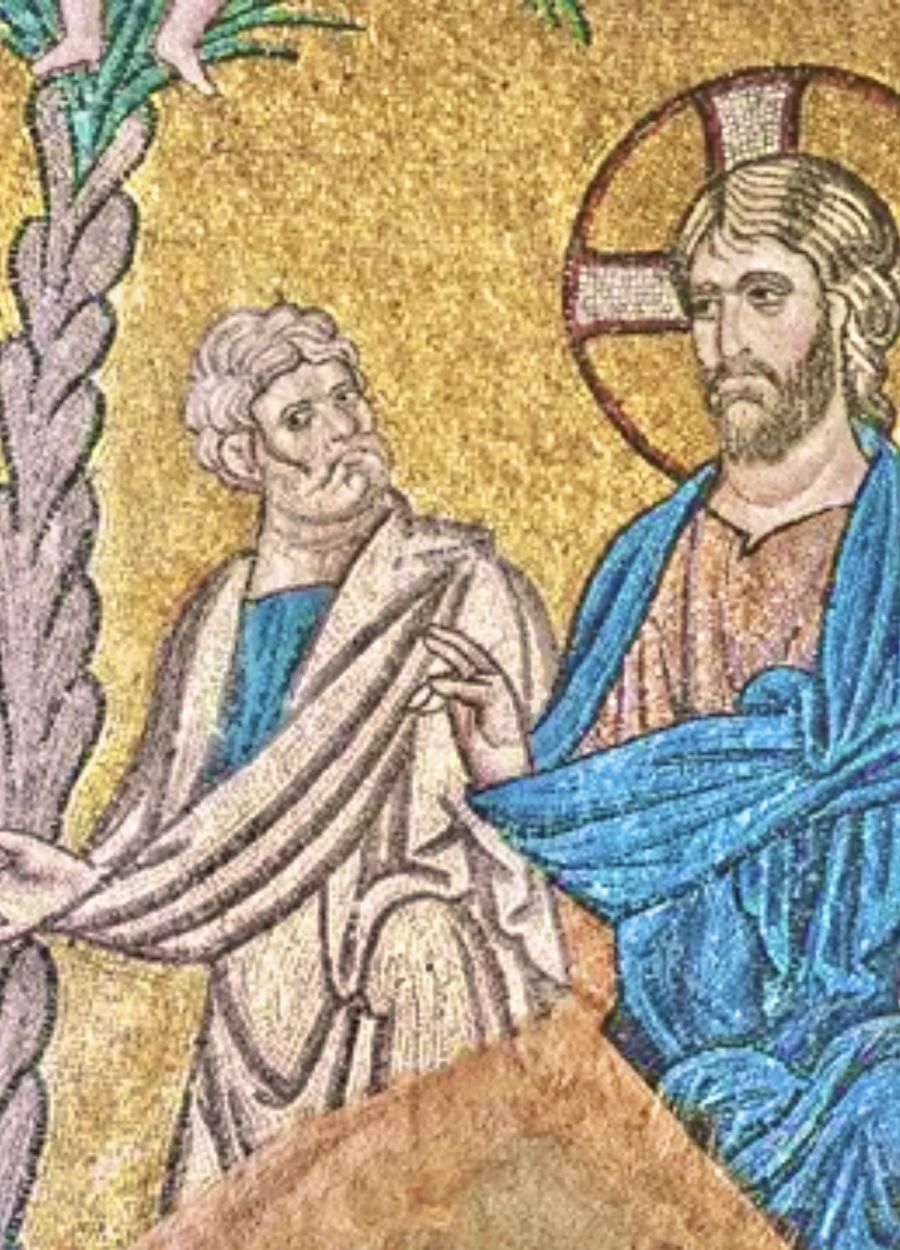
We have reached a decisive moment in the Gospel of Matthew. At Caesarea, Peter recognises Jesus as the Messiah without Jesus having just performed any extraordinary sign: Peter’s faith springs from an inner revelation. For this reason, Jesus says to him: “Blessed are you, Simon, son of Jonah, for neither flesh nor blood has revealed this to you, but my Father in heaven.” True faith does not arise from human intelligence, but is a gift from God. And this is what is new about Peter’s confession: it is not the use of individual titles, but their connection. Jesus asks who the ‘Son of Man’ is, and Peter replies that he is the ‘Son of God’. In this way, he recognises that the glorious figure foretold by Daniel is one and the same as the Messiah sent by God. However, Peter does not yet fully understand the mystery of Jesus. He knows that Jesus is the Messiah, but he has not yet realised that he is the Son of God made man. This understanding will mature after the Resurrection and the gift of the Holy Spirit at Pentecost. Immediately after Peter’s profession of faith, Jesus begins to proclaim openly his Passion, death and Resurrection. The expression ‘from that time on’ indicates that a fundamental milestone in the understanding of his identity has been reached. In Jesus’ time, the expression ‘Son of God’ was essentially equivalent to ‘Messiah’ or ‘King consecrated by God’. The disciples had already used this title after the miracle of walking on water, but at that time they had been struck above all by his power. During his trial before the high priest, Jesus once again combines these two titles, declaring that the Son of Man will come on the clouds of heaven and sit at the right hand of God. Yet it is precisely at that moment that his kingship is revealed, not through force, but through the love with which he entrusts himself into the hands of men. In Caesarea, following his profession of faith, Peter is entrusted with the mission of leading the Church: “You are Peter, and on this rock I will build my Church.” The rock does not refer to a personal quality of Peter—who would repeatedly demonstrate his frailties—but to the faith he received from the Father. The foundation of the Church is therefore faith in Jesus Christ. The Church is the new people of God, the “people of the saints of the Most High” foretold by Daniel, united to Christ as the body is to its head. And Peter receives the power of the keys. Jesus adds: “Whatever you bind on earth shall be bound in heaven, and whatever you loose on earth shall be loosed in heaven.” This is the so-called power of the keys, which recalls the symbol of the authority entrusted in the Old Testament to Eliakim. This does not mean that Peter and his successors are omnipotent, but that God undertakes to accompany their mission. The Church has the task of bringing people into communion with the Father and opening up access to the Kingdom for them. The final message is Jesus’ reassuring word: ‘I will build my Church’. It is not the Church that saves itself, nor is it people who build it by their own strength. It is Christ himself, the Risen One, who sustains and guides her. This is why Jesus can promise that the gates of hell shall not prevail against her. The strength of the Church does not depend on the perfection of her members, but on the faithfulness of Christ, the Son of the living God, who continues to build her throughout history.
+Giovanni D’Ercole
