
20th Sunday in Ordinary Time (year A) [16 August 2026]
First Reading from the Book of the Prophet Isaiah (56:1, 6–7)
This passage, attributed to the so-called ‘Third Isaiah’, dates from after the return from the Babylonian exile, between the end of the 6th and the beginning of the 5th century BC. Upon their return to Jerusalem, the Jews found the city occupied by foreigners, some of whom had begun to take part in religious life. A conflict arose: some advocated the strict preservation of their own identity, whilst others favoured greater openness. The prophet, speaking in the name of God, declares that the sincerely devout foreigner must not be excluded; those who love the Lord and honour his covenant may enter the community. Foreigners are integrated if they observe the Sabbath, honour the covenant, practise justice and live according to the Torah. This marks a step towards accepting the idea that salvation is not reserved for Israel alone because, says the Lord, ‘my house shall be called a house of prayer for all peoples.’ Amidst the tension between identity and openness (exclusion and inclusion), the ongoing challenge lies in safeguarding the demands of fidelity to the Covenant with God without closing oneself off from others; a delicate balance that concerns all religions. With Isaiah, a decisive step is taken in Israel towards a more inclusive faith, with foreigners integrated into the Jewish religion, who are called ‘proselytes’.
Responsorial Psalm (66/67)
The Psalm reflects on God’s blessing, which is a wish for happiness, and on the universal mission of the people of Israel. We are in the midst of a great celebration in the Temple of Jerusalem, whilst the priests bless the people with words taken from the Book of Numbers: ‘May the Lord bless you and keep you; may he make his face shine upon you and grant you peace.’ An important truth emerges here: God does not begin to bless when the priest asks him to, but does so constantly; therefore, when we say ‘May God bless you’, the wish does not concern God, but our own readiness to receive his blessing. God has no other plan than the good of his creatures; therefore, to bless literally means to place his Name upon someone, and since the name denotes the person, to be blessed means to live under God’s protection, to enter into his presence and to allow oneself to be enlightened by his love. The blessing establishes a living relationship with God, to which the faithful always respond ‘Amen’, expressing their consent to receive this divine gift. The blessing is also for all peoples: ‘May the peoples praise you, O God; may all the peoples praise you’; therefore, the chosen and blessed people must become an instrument of God’s blessing for all humanity.
Second Reading from the Letter of Saint Paul the Apostle to the Romans (11:13–15, 29–32)
Saint Paul moves from evangelising the Jews to the Gentiles. Before his conversion on the road to Damascus, Saint Paul divided humanity into two groups: the Jewish people and the Gentiles. After his encounter with the risen Christ, he realised that Israel’s mission was to bring the Messiah to all nations. For this reason, his plan was simple: to proclaim Jesus to the Jews and, through Israel, to bring the Gospel to all nations. In Antioch of Pisidia, Paul and Barnabas began to preach in the synagogue and were listened to with interest. The following week, some Jews accepted the message; others rejected it with hostility; many Gentiles, however, showed interest. Faced with the rejection of the majority of the Jews, Paul declared: ‘Since you reject the Word of God, we turn to the Gentiles.’ This choice would be repeated in other cities during his missionary journeys. According to Paul, this openness towards the Gentiles arose from the fact that many Jews did not recognise Jesus as the Messiah. Paradoxically, it was precisely this rejection that facilitated the spread of the Gospel amongst the nations. Therefore, Christians who have come from a pagan background must not feel superior to the Jews, because their conversion is linked to the history and mission of Israel. Has God, then, abandoned Israel? This is the central question of Paul’s reflection. His answer is clear: no. God does not revoke his promises, for God’s gifts and calling are irrevocable. The Covenant God made with Israel remains valid for ever, and Paul reaches a very bold conclusion: God allows people to experience their own rejection and their own mistakes, and he knows how to transform even negative situations for the sake of salvation. The Gentiles have received God’s mercy, and Israel, too, will one day recognise that same mercy, for God’s ultimate plan concerns everyone. His Covenant with Israel remains valid, and his mercy is intended for both Jews and Gentiles.
From the Gospel according to Matthew (15:21–28)
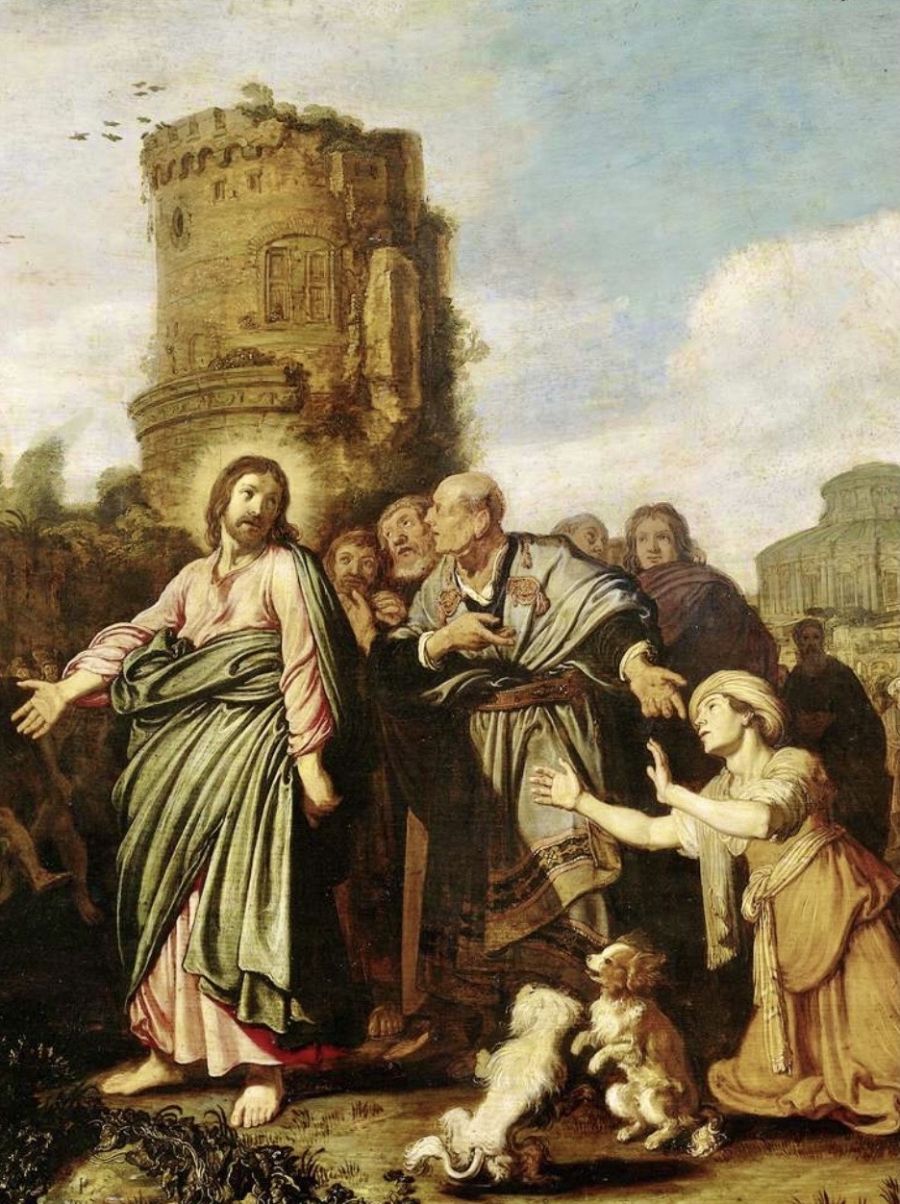
The Gospel account of the Canaanite woman’s persistence comes immediately after a teaching by Jesus on ritual purity. In the Jewish world, purity does not mean the absence of sin, but rather the fitness to draw near to God, and the Pharisees attached great importance to the rules of ritual purity in order to be worthy to pray and enter the Temple. Jesus, on the other hand, says that purity is first and foremost a matter of the heart and of intention, and asserts that it is what comes out of the mouth and originates in the heart that defiles a person. For it is from the heart that evil thoughts come… but eating without washing one’s hands does not defile a person (Mt 15:18–20). Immediately after this controversy, Jesus goes into ‘unclean’ pagan territory because the rules of the Torah are not observed there. It is there that a Canaanite woman asks him to heal her daughter, but Jesus pays her no heed, so much so that the disciples intervene to send her away (Lk 11:5–8). However, as she continues to insist, Jesus replies: ‘I was sent only to the lost sheep of the house of Israel’ (Mt 15:24). In the history of salvation, the first stage concerns Israel, as Jesus also points out to the apostles: do not go amongst the Gentiles and do not enter the towns of the Samaritans; rather, go to the lost sheep of the house of Israel (Mt 10:5–6). And this is precisely what Saint Paul did. He turned first to the Jews, and after failing to reach the majority of them, he devoted himself to the Gentiles, as we read in this Sunday’s second reading. Here too, Jesus proclaims that salvation is now for everyone, Jews and Gentiles alike, and the only condition is faith – a trust like that of the Canaanite woman who persists in trusting him. Is faith not, in fact, precisely believing in Jesus, trusting him completely and entrusting oneself to him? Jesus does not ask the Canaanite woman to practise any aspect of the Jewish religion, but only for faith; and his attitude towards her serves as the model for welcoming the Gentiles. The Canaanite woman, ‘persistent’ in her request, becomes the model of faith for us and our communities.
+Giovanni D’Ercole
