
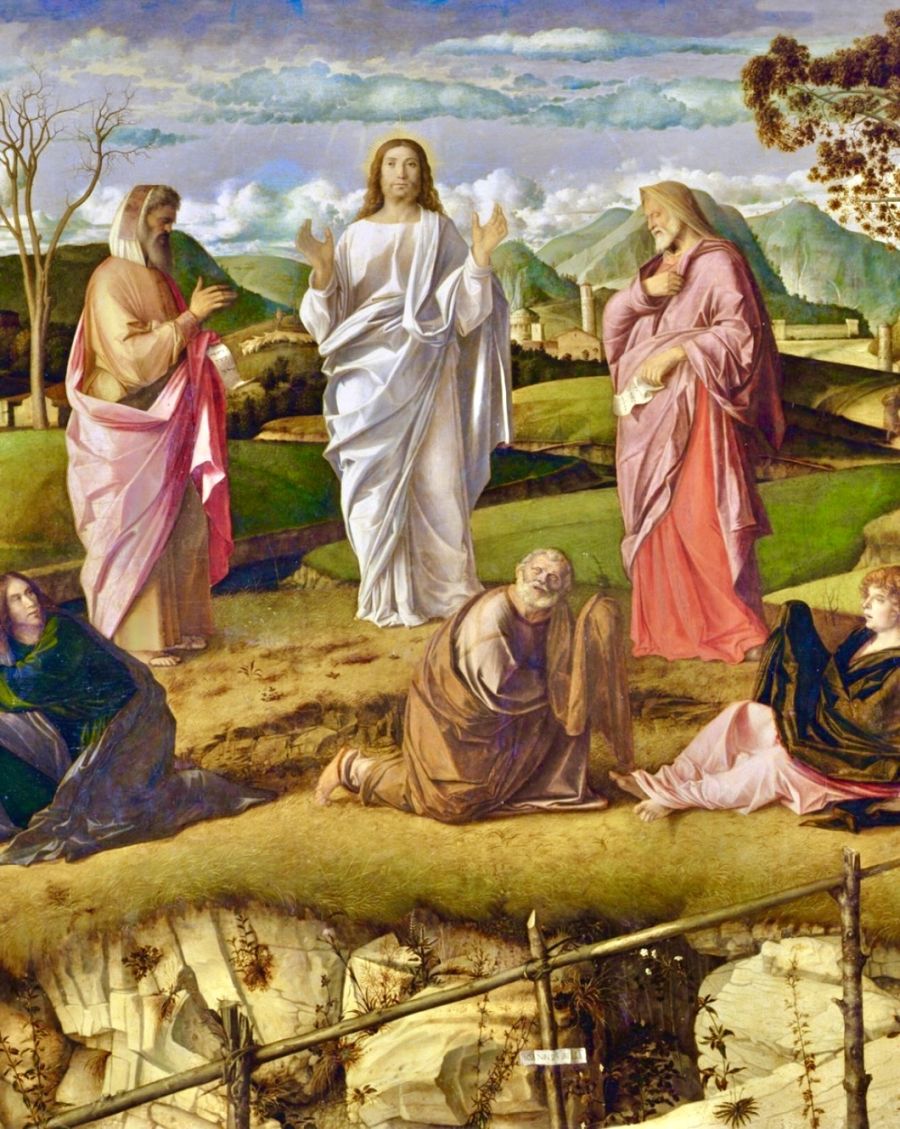
The Transfiguration of the Lord (year A) [6 August 2026]
First Reading from the Book of the Prophet Daniel (7:9–10, 13–14)
The text recounts a vision of the prophet Daniel, written during the persecution of the Jews by Antiochus IV Epiphanes in the 2nd century BC. Its purpose is to encourage and console the suffering people. Daniel first sees God, depicted as an ‘Ancient of Days’ seated on a throne of fire, surrounded by millions of servants. It is an image of justice and victory: God is about to judge the persecutors and bring justice to the faithful. Next, the ‘Son of Man’ appears; he is brought before God on the clouds of heaven and receives power, glory and an eternal kingdom. It resembles a scene of a messianic coronation.
Who is the Son of Man? The explanation given in the text of Daniel itself is surprising: the Son of Man does not initially represent a single person, but the ‘people of the saints of the Most High’, that is, Israel faithful to God, especially that small group which remains faithful during persecution. The message is therefore clear: today you are oppressed, but God will grant you victory and his Kingdom will be eternal. After their deliverance from persecution, many Jews continued to interpret this prophecy as referring to the future. Some began to await not an individual Messiah, but a collective Messiah: the faithful people of Israel, called precisely the ‘Son of Man’. And here is the new insight brought by Jesus. Jesus of Nazareth takes up the title ‘Son of Man’, but gives it a deeper meaning: it does not simply refer to ‘a man’, but to the whole of humanity; Jesus applies it to himself more than eighty times in the Gospels; he unites two aspects that were separate in Daniel: glory and suffering. For Jesus, the Son of Man is not merely the glorious King who receives the Kingdom, but also the one who suffers, is rejected and dies before entering into glory. After the Resurrection, the disciples realise that Jesus is both man and God. He is the head of a new humanity, and all those united to him form one body. Therefore, Daniel’s prophecy is fully fulfilled in Christ and in his people: believers are called to share in his kingship and his glory.
This, then, is the central message: God created humanity to share in his dignity and his Kingdom. Suffering and persecution do not have the final say: the ultimate destiny of the faithful is to share in God’s victory and his eternal kingdom.
Responsorial Psalm (96/97)
A constant struggle against idolatry: this could be the commentary on Psalm 96/97 (‘The Lord reigns’) to highlight a fundamental theme of the Bible: the constant struggle against idolatry and the affirmation that there is only one God.
When the psalm proclaims: ‘The Lord is King; let the earth rejoice’, it affirms that God is the one true sovereign of the universe. The expressions: ‘You reign above all gods; let all gods bow down before him’, do not mean that there are other inferior gods, but that all false deities and idols are nothing in the face of the one God of Israel.
In the Jewish faith, the fundamental principle is: ‘Hear, O Israel: the Lord our God is the one and only Lord.’ Israel always lived in close contact with polytheistic peoples and was often tempted to adopt their cults. For this reason, the prophets denounced the people’s unfaithfulness, comparing it to that of a wife who betrays her husband. However, alongside their rebuke, they always proclaimed God’s forgiveness and mercy. The text recalls that the first chapter of the Book of Genesis was written in contrast to the religious beliefs of Babylon. Whilst Babylonian myths spoke of many gods fighting amongst themselves and of humanity created to be slaves, the Bible affirms that: there is only one God; creation is good; man and woman are created in the image of God; human beings are called to rule over creation and not to be its slaves. Even the sun and the moon are not named, to prevent them from being worshipped as deities: they are simply ‘luminaries’ in the service of life. God, Lord of the universe, and the psalm describes God’s manifestation with majestic imagery: fire, lightning, clouds, earthquakes, mountains melting like wax. These images recall Moses’ theophany on Mount Sinai and serve to demonstrate divine power and majesty. A universal message of joy emerges, and the expression ‘The Lord is King; let the earth rejoice’
means that God’s kingdom concerns not only Israel, but all humanity.
Indeed, the Bible always combines two ideas: the election of Israel and the salvation intended for all peoples. God’s plan is universal and oriented towards joy, justice and peace. Finally, the psalm invites us to believe that God guides history towards a future of peace and happiness for all. Even when the world seems dominated by wars, violence and injustice, the believer is called to maintain hope and to work together so that God’s plan may be realised. The commentary’s final observation is very practical: peace and joy are possible, but we must truly desire them. In other words, it is not enough simply to wait for God to intervene: we must also commit ourselves personally to building a more just and fraternal world.
Second Reading from the Second Letter of Saint Peter the Apostle (1:16–19)
The central theme of this passage could be summarised as follows: ‘Remain steadfast in the faith and beware of false prophets’, which may be regarded as Peter’s spiritual testament. The Second Letter of Peter resembles a farewell address: as he is about to depart, the one who is leaving recalls the fundamental truths that have inspired him and offers guidance for the future to those who have gathered around his testimony. The verses presented here serve as an introduction to the entire letter and summarise its main themes: 1) remain steadfast in your faith in Jesus Christ, the Son of God; 2) beware of false prophets. All this without losing sight of the horizon of faith: the hope of Christ’s return. Above all: remain steadfast in your faith in Jesus, the Son of God. At the time of Jesus’ birth, it would never have occurred to anyone that God could have a Son; the one God was solitary. When John the Baptist heard the voice from heaven designating Jesus as the Son, he certainly interpreted it as ‘Messiah’; for, traditionally, the king of Israel received the title ‘Son of God’ on the day of his coronation, with the words ‘You are my Son; today I have begotten you’ (Ps 2:7). For Jewish believers, to call oneself the Son of God was a lie, a claim to authority, or even blasphemy. It was one of the reasons for Jesus’ condemnation (Mark 14:64). Gradually, much later, as they meditated on the mystery of Christ in the light of the Resurrection, the apostles discovered this unexpected truth: Jesus is truly the Son of God; he is God. The event of the Transfiguration now appears in full light: Christ ‘received honour and glory from God the Father; a voice came to him from the majestic glory: “This is my beloved Son, in whom I am well pleased.”’
Now, throughout the Old Testament, glory is the prerogative of God: for example, ‘Give to the Lord the glory due to his name’ (Ps 28/29:2) . Yet, according to Matthew and Mark, the voice from heaven at the Transfiguration said nothing different from what it said at the Baptism; what changes is precisely the glory that envelops Jesus at the Transfiguration: he is alone on the mountain, surrounded only by the two greatest figures of the Old Testament; at the Baptism he was immersed in the crowd, mingled with the people of sinners. It is the same Jesus whom the disciples have come to know little by little—the Son of Man, certainly, but also the Son of God. Moreover, this faith does not betray their previous faith. For the disciples, this renewed faith is not a betrayal of their past faith: none of them thinks they have changed religion by recognising in Jesus the Messiah so long awaited by his people. On the contrary, by re-reading the Scriptures, they discover that Jesus is precisely the one whom they foretold.
Hence Peter’s words: ‘Thus we have confirmation of the prophetic word’, and his advice to the readers: ‘You would do well to pay close attention to it, as to a lamp shining in a dark place.’ A beautiful image: in the darkness of humanity awaiting its Saviour, the light of the prophets is already shining. From now on, Christians must always remember this Word that foretold Jesus. Another important point: beware of false prophets. If Peter speaks in this way, it is because his fear was not unfounded, and many passages in the New Testament express the same concern. For example,
we read in the Gospel of Matthew: ‘Beware of false prophets, who come to you in sheep’s clothing, but inwardly are ravenous wolves. ‘You will recognise them by their fruits’ (7:15–16). The same issue recurs in John’s letters: ‘Beloved, do not believe every spirit, but test the spirits to see whether they are from God, for many false prophets have gone out into the world’ (1 John 4:1). And Paul also speaks of this: “The Spirit plainly states that in the last days some will fall away from the faith, following deceiving spirits and the teachings of demons” (1 Tim 4:1); “The time will come when people will no longer endure sound teaching, but, having an itch to hear something, they will gather around themselves a multitude of teachers… and turn to myths” (2 Tim 4:3–4). Faced with these false prophets stand the authentic witnesses, those who have known Jesus of Nazareth and who alone have the right to speak. This concern for the authenticity of witness is a constant theme among the first apostles, and in Peter in particular. Hence the conditions for choosing Judas’s replacement (cf. Acts 1:21–22). Hence, too, Peter’s insistence on his presence at the Transfiguration: “We were eyewitnesses of his majesty… We ourselves heard this voice coming from heaven whilst we were with him on the holy mountain”. It is because they were witnesses to the coming of the Son of God amongst men that his apostles can now, with full confidence, await his coming at the end of time ‘until the day dawns and the morning star rises in your hearts’ (2 Peter 1:19).
From the Gospel according to Matthew (17:1–9)
Two essential points emerge from this text: the choice of witnesses and the Mount of the Transfiguration: Jesus took Peter, James and his brother John with him: once again we are faced with the mystery of God’s choices. Shortly before, at Caesarea, Jesus had said to Peter: ‘You are Peter, and on this rock I will build my Church; and the gates of hell shall not prevail against it’ (Mt 16:18). But Peter, entrusted with this crucial mission, is not alone with Jesus: he is accompanied by the two brothers, James and John, the sons of Zebedee. ‘And he led them aside to a high mountain’: on a high mountain, Moses had received the revelation of the God of the Covenant and had been given the tablets of the Law—that law which was to gradually teach the people of the Covenant to live in the love of God and of their brothers and sisters. On that same mountain, Elijah had received the revelation of the God of tenderness in the gentle breeze… Moses and Elijah, the two pillars of the Old Testament. On the high mountain of the Transfiguration, Peter, James and John—the pillars of the Church—receive the revelation of the God of tenderness incarnate in Jesus: ‘This is my beloved Son, in whom I am well pleased.’ And this revelation is given to strengthen their faith before the storm of the Passion. Peter would later write: ‘We did not follow cleverly devised myths when we made known to you the power and coming of our Lord Jesus Christ, but we were eyewitnesses of his majesty’ (2 Peter 1:16–18). ‘Let us make three tents’: this remark by Peter suggests that the episode of the Transfiguration took place during the Feast of Tabernacles, or at least within the atmosphere of the feast celebrated in remembrance of the journey through the desert during the Exodus and of the Covenant made with God. During the feast, many psalms celebrated the messianic promises and implored God to hasten his coming. On the Mount of the Transfiguration, the three apostles suddenly find themselves faced with this revelation of the mystery of Jesus: it is hardly surprising that they are seized by the fear that grips every person in the presence of the holy God. Nor is it surprising that Jesus lifts their spirits and reassures them: the Old Testament had already revealed to the people of the Covenant that the Most Holy God is the God who is very close to humankind, and that there is no cause for fear. But this revelation of the mystery of the Messiah, in all its aspects, is not yet within everyone’s grasp; Jesus commands them not to tell anyone for the time being, until the Son of Man has risen from the dead. By uttering these words, Jesus confirms the revelation the three disciples have just received: he is truly the Messiah whom the prophet Daniel saw in the likeness of a man, coming on the clouds of heaven (cf. Dan 7:13–14). It should be remembered that Daniel himself presents the Son of Man not as a solitary individual, but as a people, whom he calls the people of the saints of the Most High. The fulfilment is even more beautiful than the promise: in Jesus, the God-Man, it is the whole of humanity that will receive this eternal kingship and be eternally transfigured. But Jesus was right to say: ‘Tell no one anything before the Resurrection…’ Only after Jesus’ resurrection will the apostles be able to bear witness to it.
Note: The Greek text begins with ‘Six days later’: this is understood to mean ‘six days after Yom Kippur’, the Day of Atonement. It invites us to imagine a connection with the Feast of Tabernacles, hence Peter’s suggestion: ‘Let us make three tents here.’ Furthermore, why are Moses and Elijah present? The very same two who received the revelation of the Father on Mount Sinai now receive the revelation of the Son here. The mosaic in the Basilica of the Transfiguration at St Catherine’s Monastery in Sinai confirms this interpretation: Moses is depicted barefoot, his sandals untied beside him, as he was before the burning bush (cf. Ex 3).
+Giovanni D’Ercole
