
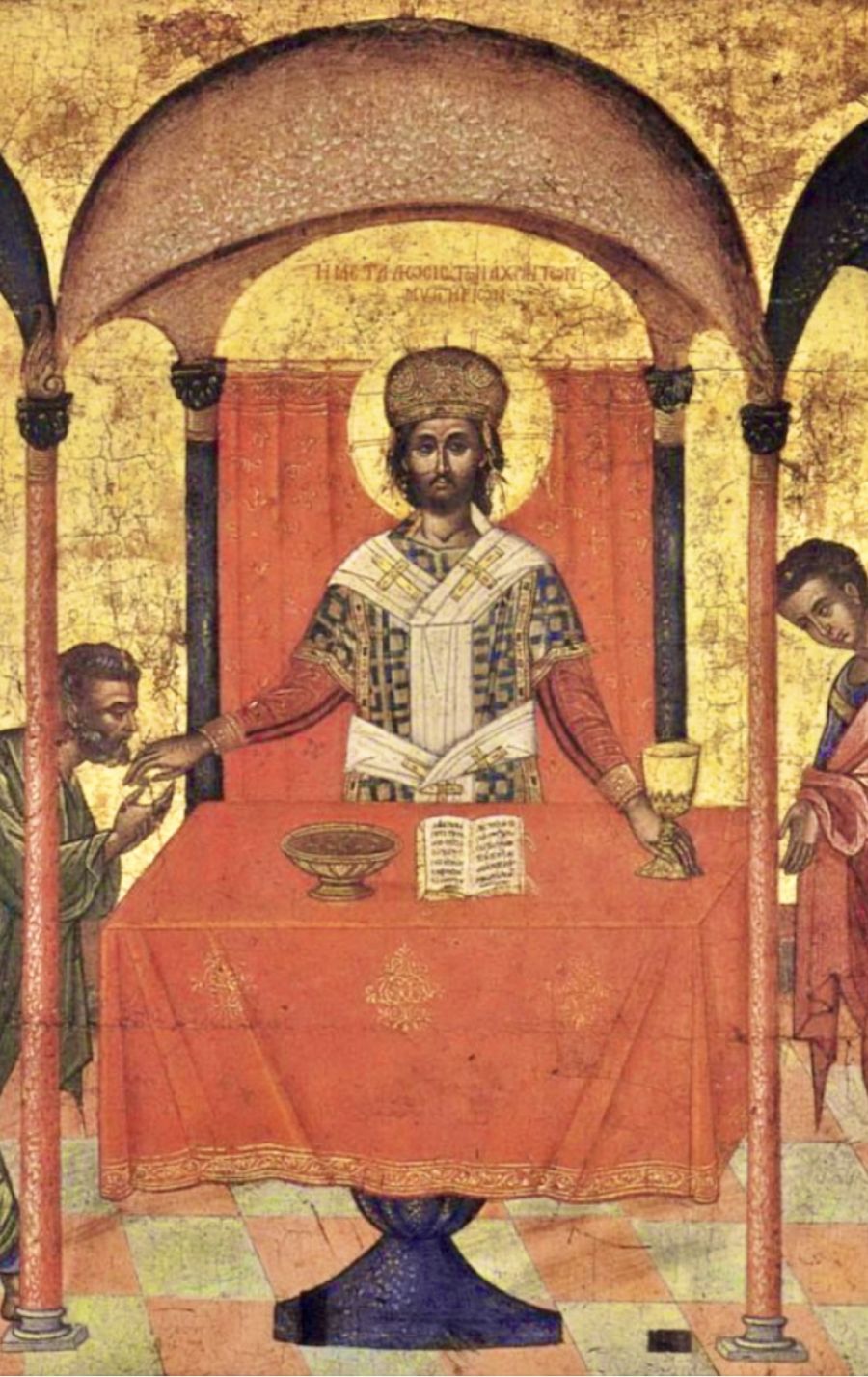
(Jn 16:23-28)
In ancient religions, prayer is performance of the believer, an act owed by creature to divine majesty.
But also a member of an assembly, in the Faith any son of God has full access to the Father in a personal way, like Jesus.
And Dialogue that arises has the character of spontaneity. The language: unrepeatable for each one [as in a love story].
Christ in us is the authentic protagonist of prayer 'in his Name'. But He does not replace the faithful - nor does he assume them, as an intermediary or external intercessor would.
The Lord unites us to Himself, in flesh and blood.
Contact with the Father is «in Jesus of Nazareth»: in the brought, sense and scope of His own desires, words, actions, disappointments, joys, even activities of denouncing false beliefs.
We are connected to His very Person - not to another, more scintillating or tranquil, harmonious and quiet historical occurrence: in the Spirit of Incarnation, totally.
Then the Father has respect for our identity-character in Christ. He grasps the traits and incorporates them, to suggest to us the Way of special fulfilment.
In the richness of the Mystery, the events of the Son and the sons are intertwined. His Name merges with our ‘name’.
In short, His story of persecution and mockery is all about us all. One recognizes it, already at first sight.
Therefore, in the prayers, the Risen One does not act as a "mediator".
He is the inside groove, the intimate track, the path completely our own, not to be lost sight of and to be listened to attentively, both in order to scrutinize the global option of life and to learn from time to time.
We are hearers of the Word, of the signs of the times, of personal events, encounters, experience, heart or advice, character and inclinations - starting from our creaturely Seed.
Just like Jesus with the Father: we remain with Him inside, and (united with Him) in His mystical and everlasting Dialogue with the meaning of events.
In them the Father, the true Subject who expresses Himself, is revealed. And the Eternal shines through in the facts that He offers us in His wise Providence.
So the praying person is the one Listening - in the same way as Jesus related to the Father, to understand his own affairs.
In order to encounter ourselves, our brothers, the world, and insight into meaning of the episodes and our mission, we remain in the Name of Jesus.
The story of the carpenter's son concerns us: so all the more do we demand to be introduced into the adventure and life-wave of Faith.
In this way, the exodus in the Spirit from our deepest strata is not the same as a devout and whatever, ordinary spiritual life.
Thus the prayer that belongs to our Calling has nothing to do with mediocre, subordinate attitudes - not correlative in the first place to a historical fact: the life of the Master.
In the soul of His intimates, He Himself listens, interprets, assimilates. And He turns «with-us» to the Father.
Such friendship and attunement [sometimes crude] allows us to assimilate His authentic Person; not contrived, not sweetened, not smuggled.
Prayer in the Name of Christ contains His radical power, makes sense of hostilities and wounds.
In Him they become ground for sharing and deep correspondence.
Here the Lord dwells us and continues His creative Action.
Prayer in the Name transforms our dust into living awe and splendour of concrete relationship, as equals.
[Saturday 6th wk. in Easter, May 16, 2026]
