
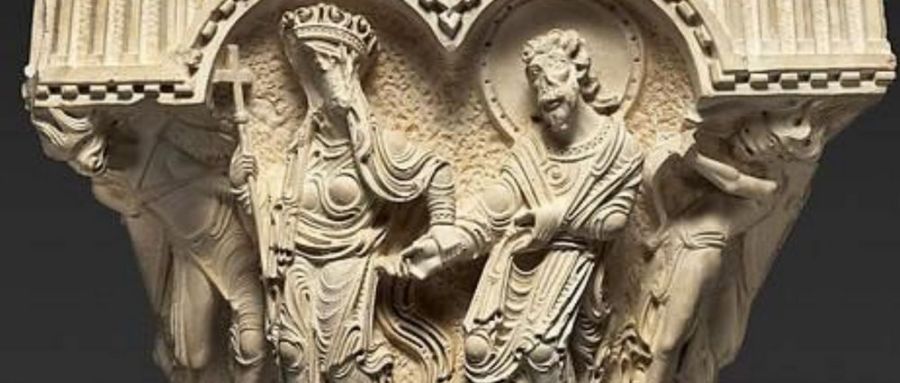
He uncloses our ears, so that we do not remain deaf and stuttering
(Mk 7:31-37)
"But this Gospel also speaks to us: we are often withdrawn and closed in on ourselves, and we create so many inaccessible and inhospitable islands. Even the most basic human relationships sometimes create realities incapable of mutual openness: the closed couple, the closed family, the closed group, the closed parish, the closed homeland... And this is not of God!"
[Pope Francis, Angelus 6 September 2015].
The background of the Gospel passage is the theme of initiation into the Faith, which invests the (inner) "senses" that risk being extinguished.
In fact, every believer also runs the danger of weakening perception, circumscribing vital energy, drastically reducing the relationship with profound reality, and the horizon of his journey.
"Effatà" was a globally expressive liturgical formula employed by the primitive churches in Baptism.
Behind that expression we find a truly living and conscious, albeit popular, ecclesial dimension.
Communities that perceive the language of Faith, welcome and share the thought of the Son; therefore they react to the stasis, they do not have fallen inclinations, nor do they remain mute and blind.
The invitation to open one's whole life wide [Effatà] stems from a missionary afflatus that does not let up. Let us see in what sense.
Jesus' far-fetched itinerary (v.31) suggests almost a reluctance on his part to turn back, staying rather among pagans. Why?
He realises that the "distant ones" seem to be less deaf to the Word of God than the people of Israel: they are awake, they receive, they have a still living conscience.
After the heated dispute about the pure and the impure, here is the Master getting impatient even with the disciples.
They have remained at the same level of spiritual deafness as the people, inert; mutilated of the spirit of Scripture.
Still deaf, they stammer: they have tied a knot in their tongues.
If they speak they do so with difficulty, in a disjointed, incomprehensible manner.
In short, the followers do not expound authentic messages.
They show themselves to be intimate, but despite appearances they still do not know how to listen [we would say: not even faithful to the living Tradition; cf. Dei Verbum 1]!
This is due to the fact that the ears of some of them are only open to cunning: they have to be "stitched up" without too many compliments.
In fact, Jesus' action is violent (v.33 Greek text).
The 'supporters' here seem to oppose in every way the action of Christ in its entirety.
The apostles believed that God's treasure was exclusively for the 'insiders' - not for the people.
He then strikes hard: he wants to meet the 'outsiders' so that they too can turn on their resources.
The Gospel episode is a parable of the condition of any person - even a rambunctious one - who upon meeting the Lord begins to perceive and communicate well, with wisdom.
No longer wavering in their growth trajectories - with the fear of reality, and of themselves.
Religious wisdom or pagan philosophy have sought answers to the enigmas, to life's questions of meaning. And yet, so far, they have only tinkered.
Even the great civilisations have only thought up a few fragments of Truth. It has remained erratic and shaky. It has not expressed itself exactly, or fully.
E.g. (in Plato) Socrates speaks of the immortality of the soul, so he had a vague sense of indestructible Life, but did not receive the Light of Easter.
The problem here is not one of external catechism, but primarily personal and ecclesial.
The authentic Messiah cannot stand our dragging our feet, without comparisons and discussions that re-create us.
The young Rabbi does not want the disciple to resign, to withdraw, to become attached to his own illness.
Even today, we still perhaps sclerotize on positions that do not question the real syndromes, and remain with the usual ailments - totally passive about them.
A scruffy and empty condition of life, from which the 'godfathers' of Baptism would like to emancipate us (v.32a).
They are the true co-workers of Christ, strangers to the circle of the ever-attached to God - those who heed him, but do not follow him.
His "angels" [cf. Mk 1:13] bring him a "deaf" (not mute, but) "stutterer".
This is the only time this term appears in the NT.
In the First Testament "stutterer" (moghilàlos) appears only once, to indicate the deliverance from the exodus of Babylon ["The tongue of the stutterer shall shout for joy", Is 35:6 LXX Greek verse].
Not physical healing, but an image of deliverance - radical - that becomes the motive and driving force of the person.
It is a problem of understanding!
Christ pulls us out, "in the background" (v.33)... even in comparison to the dissent of the "intimates", who like to surround themselves with crowds and adhere to the common thought; compromising and trivial, not breaking closures.
He wants to separate us from the fashionable, conformist way of reasoning; he wants to detach us from the qualunquist and other people's goals.
He wants us to think and say sensible things, dictated by God's thinking and personal vocation; not trendy, à la page, normalised, standard.
Those who remain in the village where everyone chatters in the same way, or reasons in the same way, and chooses in the same way - stunned, dumbed down by impersonal voices - cannot be healed.
In fact, Jesus' 'sigh' (v.34) sounds like that of one who already feels taken hostage by his own, who seem to hold him like a lion in a cage.
It takes a good outpouring of the Spirit from Heaven to stay calm and not slap them around... and commit to starting [again] all over again.
The very intimates continue to prefer the usual booklets of instruction and prohibition: easier - than taking risks and letting themselves be educated.
[Considering themselves privileged, some have taken possession of his Person by transmitting it in bits and pieces, through a teaching that neither amazes nor liberates, nor announces it, but stutters and debases it].
To "sigh" is also to ask: is it worth it? The worst choice would be to circumscribe oneself in distrust.
After the Second Vatican Council, we have just begun to open our ears to the Word, and gradually the preaching is changing - but with the usual biblical timescales. (Today we hope for the synodal path).
In the meantime, an idea of a 'barefoot' Church is spreading here and there, one that knows how to listen to the questions of today's man, instead of shutting them up.
An institution in the province of grand narratives and scarcely incisive, but which perhaps begins to leave out a few catchphrases, and begins not to silence all questions.
At last we realise that it is time for proclamation and new catechesis, for convincing language and discernment - and a very different pastoral. Not for this glamour.
But before acting on the ground, it is appropriate for curials, leaders, captains and consuls to open their eyes and ears - involving themselves in person.
"Open up!" remains the pressing invitation to open up new avenues again: to unblock the dialogue, to be concrete and respectful, to put life back into the picture. Enriching oneself and others.
The only great miracle is to open each person up to perception and communication, intuiting and giving everything of themselves.
Because by seeking the truth in deep and mutual listening, beyond fraternities or cordatas, one no longer stutters.
Even the high-profile hierarchy is beginning to break through the usual external, rubber and stone walls.
In the meantime, ecumenical and cross-cultural confrontation moves us out of the status quo that blocks the most significant achievements.
It is Dialogue that conveys meaning and substance even to Dogmatics.
Only in this way will we succeed in discernment, as well as in prolonging the creative Action of the Son.
In short, the hinge of it all is the knowledge that the Person of Christ communicates wonder and fullness of life; it does not transmit ties.
In Semitic culture, saliva [v.33: "and having spat, he touched his tongue"] was considered condensed breath.
An image of the Spirit that liberates from alienation - of course, not from the outside.
Evangelisation must also be configured in such a concomitance, in solidarity with the realisation, and engaged in the processes: from within.
Thus we will live fluently, and proclaim the Good News in favour of our Happiness. Finding unexpected solutions.
Unfortunately - despite the unleashing of the same Spirit in people, the "narrower" heralds continued to want to preach the "Son of Man" as "the" (that) Messiah they expected (v.36).
But religion prone to spectacle, and the ideology of power, all external exhibitionism - also showy - never had anything to do with Him.
In Baptism, the Lord unplugs our ears to enable us to listen to the 'Word' that becomes an 'event', and loosens our tongues so that we can make what is proclaimed resound to others.
Through this unsealing we have been made believers and prophets. Before, we were babblers.
After hearing, we began to speak correctly, not by our own virtue: only because we received from others the Word that gives life, heals, and does not lie.
However, we often plug our ears and tie our tongues, shrinking soul, spirit, and hands.
But in this way we make God less present and active; we prevent growth, block openness; any development of full life.
The attitude of the son? To open the Exodus to the world, to true knowledge, to the light of the Gospel; where there is no darkness.
And the mission of the authentic Church is not to decide everything, but to make people hear and speak. Without the a-priori of useless references.
To open up remains our decisive Vocation.
