
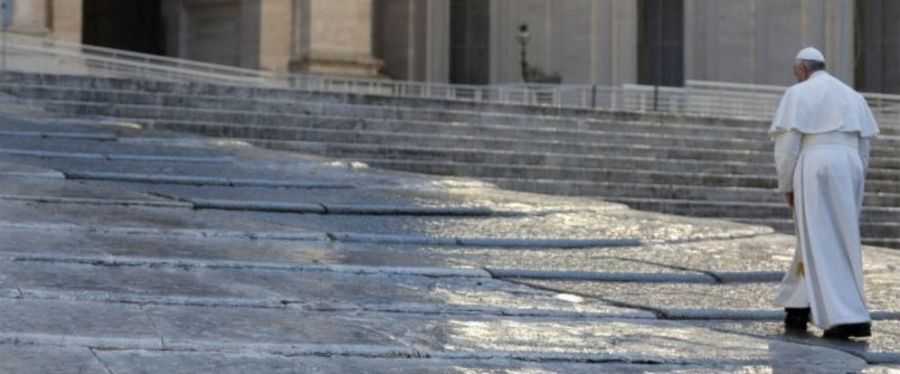
How much harm is done by "inconsistent" Christians and "schizophrenic" pastors who do not bear witness, thus distancing themselves from the Lord's style, from his authentic "authority". The Pope's homily at Mass on Tuesday morning, 14 January, at Casa Santa Marta, addressed to God's people, a "meek" and "wise" people who tolerate but know how to distinguish, revolves around these key words.
"Jesus taught as one having authority". The Gospel of Mark (1:21b-28) tells us of Jesus teaching in the temple and the reaction that his way of acting with "authority", unlike the scribes, arouses among the people. It is from this comparison that the Pope immediately took his cue to explain the difference that exists between "having authority", "inner authority" like Jesus, and "exercising authority without having it, like the scribes", who, despite being specialists in the teaching of the law and heard by the people, were not believed.
"What is the authority that Jesus has?" wondered Francis, and explained: "It is that style of the Lord, that 'lordship' - let us say - with which the Lord moved, taught, healed, listened". He added: "this genteel style - which is something that comes from within - makes one see.... What does this show? Consistency. Jesus had authority because he was consistent between what he taught and what he did, [i.e.] how he lived. That consistency is what gives the expression of a person in authority: 'This one has authority, this one has authority, because he is consistent', that is, he bears witness. Authority shows itself in this: consistency and witness'.
On the contrary, the scribes were not consistent and Jesus - the Pope pointed out - on the one hand admonishes the people to "do what they say but not what they do", on the other hand he does not miss an opportunity to reproach them, because "with this attitude - he remarked - they have fallen into a pastoral schizophrenia: they say one thing and do another". And it happens in several episodes of the Gospel that the Pope mentioned: sometimes Jesus reacts - he said - by cornering them, sometimes by not giving them any answer, and at other times, by 'qualifying them'". And here the Pope paused: 'And the word Jesus uses to qualify this inconsistency, this schizophrenia, is "hypocrisy". It is a rosary of qualifiers!". Then, referring to the twenty-third chapter of Matthew, he recalled when Jesus describes them as "hypocrites" and clarified: "Hypocrisy is the way of acting of those who have responsibility over people - in this case pastoral responsibility - but they are not consistent, they are not lords, they have no authority. And the people of God are meek and tolerate; they tolerate so many hypocritical pastors, so many schizophrenic pastors who say and do not do, without consistency'.
But God's people - Francis added - who tolerate so much, know how to distinguish the power of grace. In this regard, Francis referred to the first reading of the liturgy, in which the elderly Eli "had lost all authority" and "only the grace of anointing remained to him, and with that grace" - he explained - "he blesses and performs the miracle" to Anne, who, grief-stricken, is praying to be a mother. Hence the Pope's final remark on the people of God, on Christians and pastors: 'The people of God,' he said, 'distinguish well between the authority of a person and the grace of anointing. "But you go to confession to that, which is this, and this and this...?" - "But for me that is God. Point. That is Jesus'. And this is the wisdom of our people who tolerate so many times, so many inconsistent pastors, pastors like the scribes, and also Christians? - who go to mass every Sunday and then live like pagans. And people say: 'This is a scandal, an inconsistency'. How much harm is done by inconsistent Christians who do not bear witness and inconsistent, schizophrenic pastors who do not bear witness!".
The occasion that offers this reflection, then, is the prayer that the Pope raised to the Lord, at the conclusion of the homily, that all the baptised may have "authority", "which does not consist in commanding and being heard, but in being consistent, being a witness and for this, being companions on the way of the Lord".
[Pope Francis at St. Martha, Osservatore Romano 15.01.2020]
