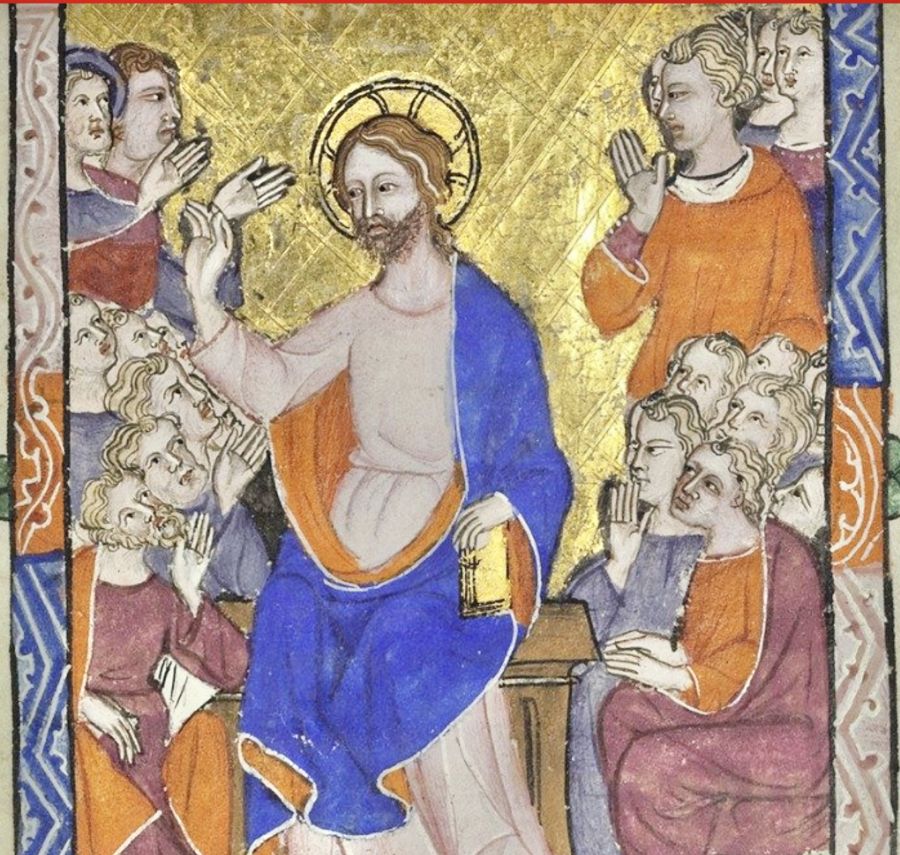
In this Gospel passage, the conditions for following Jesus are summarised in three verbs and thus in three actions: to renounce, to take up the cross, to follow Christ.
Jesus emphasises that life will not come to us through worldly gain, but through the loss of all advantage and esteem, for the sake of the Gospel.
Francis, at the beginning of the Unconfirmed Rule (1221), writes that the friars wished to live by following the example of the Lord Jesus.
He highlights various aspects of the Gospel, emphasising the importance of denying oneself and taking up one’s cross.
The pious Father would often gather his sons around him and, speaking at length about the Kingdom of God, ‘of contempt for the world, and of the need to deny one’s own will’ (FF 1058), he would instruct them:
«Go […] proclaim peace to all people; preach penance for the remission of sins. Be patient in tribulations, vigilant in prayer […]» (FF 1058).
Renouncing oneself to embrace the call in all its fullness, willing to lose one’s life in order to find it again in the Incarnate Word, was the guiding principle of their daily lives.
A passage from the Sources, taken from the Major Legend, is particularly illuminating:
“One day, whilst he was praying, so isolated from the world and wholly absorbed in God, in the height of his fervour, Christ Jesus appeared to him, as though nailed to the cross.
On seeing him, he felt his soul melt away. The memory of Christ’s Passion was so vividly imprinted upon the innermost depths of his heart that, from that moment on, whenever the crucifixion of Christ came to mind, he could scarcely restrain himself, even outwardly, from tears and sighs, as he himself later confided when he was nearing death.
The man of God realised that, through this vision, God was addressing to him that Gospel maxim:
«If you wish to follow me, deny yourself, take up your cross and follow me» (FF 1035).
And again, in the Second Life, Celano emphasises:
‘Francis was already dead to this world, but Christ lived in him. The delights of the world were a cross to him, for he bore the Cross of Christ rooted in his heart” (FF 800).
But Clare too, the first little plant of her blessed father, always strove to deny herself, spurring on her own soul and that of her sisters through assiduous meditation on the Passion of Christ.
“To nourish her soul unceasingly with the ineffable joys of the Crucified One, she meditated very frequently on the prayer of the Five Wounds of the Lord.
She learnt the Office of the Cross, as it had been composed by Saint Francis, the lover of the cross, and was in the habit of reciting it with equal love” (FF 3216).
In her wonderful letter to Ermentrude of Bruges*, Clare expresses herself thus:
«Lift up your eyes to heaven, O most beloved, for it is a call to us, and take up the cross and follow Christ who goes before us. For after many and varied tribulations, it is He who will lead us into his glory.
Love God with all your heart, and Jesus, his Son crucified for us sinners, and may the memory of Him never fade from your mind.
Meditate tirelessly on the mystery of the Cross and the sorrows of the Mother standing at the foot of the Cross» (FF 2915).
Clare, following the example of Francis, lived out the Word of the Gospel whilst secluded in San Damiano, out of love for her Spouse, renouncing all worldly desires.
She was ever mindful that the Spouse, upon his return, will reward each person according to their deeds, according to the life they have led.
During her lifetime, she chose to live in seclusion for the One she loved, and by whom she felt loved.
The dimension of penance and self-denial is no longer so harsh and disconcerting when it is Charity that causes the beauty of the spousal and regenerative experience she underwent—by Grace, as did so many of her sisters—to radiate from within the walls.
* It is to Ermentrude that we owe the spread of the Order of St Clare in Flanders.
Friday of the 18th wk. in Ordinary Time (Mt 16:24–28)