
32nd Sunday in Ordinary Time (year A) [8 November 2026]
*First Reading from the Book of Wisdom (6:12–16)
The Book of Wisdom presents Wisdom not merely as a quality of the intellect, but as a radiant presence that offers itself to humankind and leads it to the truth. It is not enough simply to be intelligent or to accumulate knowledge: one must have a heart willing to seek, to listen and to allow oneself to be transformed. Today’s reading is divided into three sections: Wisdom is luminous and never sets (v. 12), and so it allows itself to be contemplated by those who love it. Wisdom takes the initiative (vv. 13–14) and goes out to meet those who desire her, making herself known to those who seek her. Wisdom, in turn, seeks out humankind (vv. 15–16) and reaches those who rise early to seek her, meeting them with kindness. It is important to note this reciprocity: man seeks Wisdom, and Wisdom, in a sense, seeks man. The spiritual quest is not merely a human endeavour but also a response to a call that precedes it. Wisdom is light that enables one to see things as they are and thus to understand their meaning. Even if one possesses a great deal of information, one may still not know which direction to give to one’s life; one may know the means, but be unaware of the end; one may be skilled in action, but ill-equipped to discern what is truly good. Wisdom, on the other hand, is ‘unfailing’: it does not run out, does not lose its value, and is not rendered obsolete by passing fashions. In the context of the book, written within a Hellenistic Jewish milieu, probably in Alexandria in Egypt between the 1st century BC and the beginning of the 1st century AD, Wisdom is God’s gift that guides humankind in righteousness and faithfulness. It is not knowledge reserved for a select few initiates, but a light capable of providing practical guidance for life because True wisdom does not consist in knowing everything, but in seeing life in the light of God. Those who love the truth are willing to listen even to what challenges their own convictions, and if they seek it sincerely, they are willing to change course when they discover they were mistaken. The verb ‘to contemplate’ does not imply a hurried glance, but an attentiveness capable of pausing and receiving. Wisdom therefore requires a heart free from the presumption of already possessing all the answers. We live in a society where information is accessible at all times, but reflection is often sacrificed to speed; we know how to look for an answer on a screen, but it is harder to find the silence needed to understand whether that answer truly makes us more human. ‘Anticipating those who desire her, she appears to them first’ (v. 13): here one of the deepest insights of this text emerges. Wisdom precedes human seeking because God does not remain passively waiting for humankind to reach him through its own efforts; rather, it is his Wisdom that draws near and reveals itself to those willing to receive it—even though the divine initiative does not eliminate human freedom, but rather stirs it to life and sustains it. It is a fundamental principle of the spiritual life: even before a person seeks God, God has already opened a path for them to encounter him. This perspective frees us from two opposing errors: the presumption of being able to win God over by our own abilities, and the discouragement of those who think that God is too distant or unattainable. How, then, do we encounter Wisdom? In prayer, in the Word of God, in discernment, in a rightly formed conscience, in listening to another person, and even in a trial endured with faith. The problem is not a lack of time, but the way in which we organise our time; and the question this raises is: what place does the search for God occupy in my daily life? Wisdom reaches us in our everyday lives, in our decisions and in our thoughts; it is not a theory separate from existence: it illuminates the way we act, love, govern and relate to others. Finally, for the Christian, Wisdom finds its fulfilment in Christ, whom Saint Paul proclaims to be ‘the power of God and the wisdom of God’ (1 Cor 1:24). In Jesus, divine Wisdom offers more than just a teaching: it draws near to humankind, shares in our human condition and shows us the way of love. We thus see a dynamic at work that runs through the whole of the spiritual life: desiring, seeking, encountering, allowing oneself to be guided. Desire opens the heart; seeking makes it persevering; the encounter enlightens it; and welcoming Wisdom transforms our daily choices. We may conclude with three simple questions: Am I truly seeking God’s Wisdom, or am I primarily seeking confirmation of my own ideas? What concrete space do I set aside each day for silence, prayer and listening? Do the decisions I make demonstrate greater wisdom—that is, greater truth, justice and love? In short: it is not the person who knows many things who is wise, but the one who learns to see their own life in the light of God. If one lives in this way, one does not walk alone and, whilst seeking Wisdom, one realises that Wisdom itself has already come to meet one.
*Responsorial Psalm (62/63)
Psalm 62 in the Catholic liturgical numbering (63 in the Hebrew numbering and in many modern Bibles) is the song of a person who, even in solitude and trial, discovers that God is more necessary than life itself, for He is the source that gives meaning to life. It is therefore not merely the prayer of one in need of help, but the prayer of one who has discovered that no created reality can fully quench the thirst of the human heart. The biblical title links it to David whilst he was in the wilderness of Judah. We cannot identify the historical episode with certainty, but the image of the wilderness is fundamental to understanding its message. The desert is a real place, arid and arduous, but it also becomes a symbol of a spiritual condition: when certainties fade and one experiences the desert of the heart, one is led back to the essential questions. From this perspective, we discern four themes in the psalm: The thirst for God (vv. 2–3): the soul seeks the Lord as parched land seeks water. The soul praises him and remembers him (vv. 4–6): God’s love is worth more than life itself and becomes a source of blessing. Communion in the night (vv. 7–9): the believer remembers God even during the darkest hours and finds refuge in his presence. Trust in divine justice (vv. 10–12): evil will not have the last word, and the Lord will protect those who entrust themselves to him. The focus of the psalm is therefore not the desert, but the presence of God discovered precisely in the desert. The prayer begins with a personal declaration: ‘You are my God’. The psalmist does not speak first and foremost of what God can give him, but of who God is to him, and this reminds us that relationship comes before the request; belonging comes before need. The expression ‘from the dawn’ indicates the intensity of the search, and the believer begins the day by turning to the One who is its very foundation. May God always be the first inner reference point with which we face decisions, relationships and difficulties. A brief prayer upon waking may not necessarily change the events of the day, but it can change the way in which we experience them. ‘My soul thirsts for you; my body longs for you’ (v. 2). Thirst is one of the most powerful biblical images of the longing for God, and the psalmist does not simply say that he thinks of God, but affirms that he thirsts for him. Contemporary society offers many opportunities for immediate gratification: consumption, entertainment, visibility, virtual relationships; yet our longing can remain unfulfilled even when we have many things. Not every desire is a conscious thirst for God, but the deepest longings — to be loved, to find meaning, not to be alone, to hope beyond death — can become a path to recognising this thirst. Just as the earth without water cannot produce life on its own, so the believer recognises that they are not self-sufficient, and biblical prayer reminds us that recognising one’s own thirst is the beginning of wisdom. Those who believe themselves to be self-sufficient risk seeking nothing more; those who recognise their own poverty can open themselves up to relationship, to grace and to the help of others.
*Second Reading from the Letter of Saint Paul the Apostle to the Thessalonians (4:13–18)
Paul writes to a young community, that of Thessalonica, in which some Christians had died before Christ’s glorious return. The believers wonder what will happen to those who have died and whether they will lose their share in final salvation. The Apostle does not respond with a purely theoretical explanation of the afterlife, but proclaims the heart of the Christian faith: death does not have the final say, because Jesus died and rose again. The hope of Christians springs from Christ’s Resurrection, and Paul wishes that Christians should not be in the dark about the fate of the departed. In the Greek text, he uses the expression hoi koimōmenoi, that is, ‘those who have fallen asleep’, and the imagery of sleep is a metaphor which, in the light of the Resurrection, expresses the temporary nature of death: just as sleep awaits awakening, so the believer awaits the Resurrection. In ancient culture, death was often experienced as a definitive separation and a cause for despair. Paul does not deny the pain of separation, but he wishes to spare Christians from despair. Even today, death can be repressed, hidden away in hospitals or regarded as a failure to be avoided at all costs; or it can become a reality that paralyses those left behind. Faith does not ask us not to weep: it teaches us to weep without losing hope. Indeed, Paul does not set Christians in opposition to those who suffer, as if faith made them insensitive. Jesus himself wept at Lazarus’s tomb (John 11:35). The difference does not lie in the absence of sadness, but in the presence of a hope that transcends the pain. Hope does not simply mean a wish that things will turn out well, but a trust grounded in God’s work. A Christian may suffer deeply at the loss of a loved one. Their faith does not erase the void left by that person’s absence, but enables them to live with that void within a greater relationship: communion in Christ, which death cannot destroy. Jesus died and rose again: this is the foundation of the entire passage. The Christian faith is not based primarily on the idea that the soul is immortal, nor on a vague belief that something exists after death. Its centre is an event: God raised Jesus from the dead. The verb ‘will gather’ evokes God’s saving action: He does not abandon His children to the dispersion of death, but leads them into communion with Christ; and His resurrection is the guarantee of our hope: what God has accomplished in Him foreshadows the destiny of those who belong to Him. The fundamental question is not merely: ‘What lies beyond death?’, but rather: ‘Who awaits us beyond death?’ For the Christian, the ultimate future is neither nothingness nor an impersonal force: it is Christ, the Lord who died and rose again, who calls us into communion with himself. The Christians of Thessalonica were eagerly awaiting Christ’s return, his parousia, his glorious coming, and some feared that those who had died before that event might be at a disadvantage. Paul makes it clear that this will not be the case. The dead will not be forgotten or excluded. The destiny of Christians does not depend on whether they are alive or dead at the time of the Lord’s coming. It is important to note that Paul speaks within the context of the Christian expectation of the end times, but he does not give a precise date nor does he authorise anyone to determine when Christ’s return will take place. God does not judge human life by its success, its duration or the possibility of being present at a particular historical event. Even those who die seemingly too soon remain in the Lord’s hands. This truth is particularly comforting in the face of the death of children, young people and those who seemed to have so much left to achieve. Paul also describes the Lord’s coming using apocalyptic imagery: a solemn command, the voice of the archangel, the divine trumpet. We need not necessarily interpret these elements as a foretold account of material events. Apocalyptic language uses powerful imagery to proclaim a theological certainty: history is not abandoned to chaos; the Lord will come to fulfil his work of salvation. In the Old Testament, the trumpet was used to summon the people, announce a divine manifestation or accompany a decisive event. ‘And so we shall always be with the Lord’ (v. 17): this is the culminating phrase of the passage. All the preceding images lead to this promise. The ultimate goal of salvation is not simply to continue to exist, nor to know the secrets of the afterlife: it is to be with the Lord for ever. Eternal life is full communion with Christ, the fulfilment of the relationship begun in faith, nourished by the Word and the sacraments, and lived out in charity. And Christian hope is not merely a desire to reach a place called paradise: it is a longing to live eternally with the One we have learnt to love. ‘Therefore comfort one another with these words’ (v. 18). Paul concludes with a communal imperative: ‘comfort one another’. The hope of the resurrection is not a truth to be treasured solely as an individual: it is a gift to be shared. The Christian community is called to support those who are grieving, to accompany the dying, and to remember the departed in prayer. Christian consolation does not consist in uttering facile phrases in the face of grief, but in bearing witness to a hope that springs from Christ. When faced with someone who has lost a loved one, it is sometimes better not to seek immediate explanations; first and foremost, we must simply be there, listen, share in the silence, and pray. Hope becomes credible when it is expressed through concrete acts of closeness.
*From the Gospel according to Matthew (25:1–3)
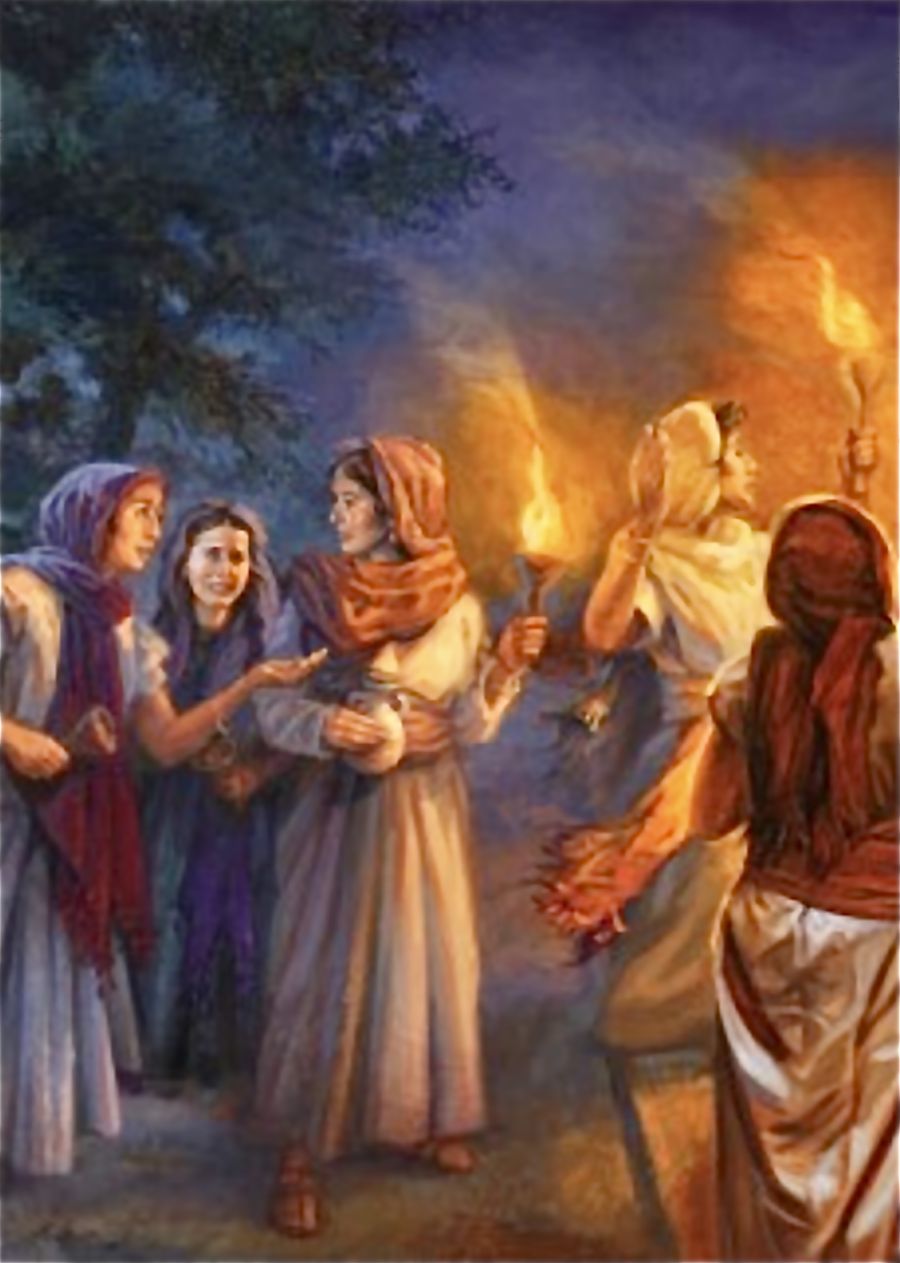
This passage forms part of Jesus’ great eschatological discourse (Mt 24–25) and is one of the parables on Christian vigilance and the expectation of the Lord. Jesus invites his disciples to live not simply by waiting for the end, but by keeping their hearts ready for the encounter with him. The ten virgins are young women attending a wedding feast and, according to custom, they accompanied the bride or waited for the bridegroom to join the wedding procession and accompany him to the feast. The figure of the bridegroom evokes an important biblical symbolism: God is the Bridegroom of his people. In Hosea, God promises: ‘I will make you my bride for ever’ (2:21–22); in Isaiah: ‘As the bridegroom rejoices over the bride, so shall your God rejoice over you’ (62:5). Jesus himself presents himself as the Bridegroom (Mt 9:15). Therefore, in the parable, the bridegroom is Christ and the wedding feast represents the definitive communion with him. The Christian life is not merely a matter of observing precepts: it is a waiting for a person, Christ, who comes to meet us. Of the ten virgins, five are wise and five are foolish. The Greek text uses two very significant words: Phrónimoi (φρόνιμοι): wise, prudent, capable of discernment; mōraí (μωραί): foolish, senseless, lacking in discernment. This is not an intellectual difference, but a spiritual one. The ten virgins all share certain characteristics: they have all received the invitation to the feast; they all possess a lamp; they all go out to meet the bridegroom; they all fall asleep when the bridegroom is delayed. The difference, therefore, does not lie in the invitation received, the lamp possessed or the ability to stay awake. The difference lies in their preparation. The wise ones also bring oil with them, whilst the foolish ones take only their lamps, and here we find the first fundamental lesson: it is not enough to have a lamp; one must have oil to keep it burning. The lamp may represent the faith received, the Christian vocation, or the outwardly religious life, whilst the oil represents what nourishes faith from within: charity, perseverance, prayer, daily fidelity and a living communion with God. It is important to note that the text does not explicitly identify the oil with a single reality. Christian spiritual tradition has seen in it, above all, charity and the inner life nourished by grace. Furthermore, the bridegroom’s delay is a test of time: ‘Since the bridegroom was delayed, they all dozed off and fell asleep’. This is one of the most human expressions in the parable because even the wise virgins fall asleep, and Jesus makes no distinction between those who know no weariness and those who do. If everyone experiences human frailty, the problem is not falling asleep, but being unprepared when the moment of the encounter arrives. The bridegroom’s delay evokes the course of history, in which the Lord sometimes seems absent or distant; it is a time of trial, of perseverance, of faith that does not immediately see results. How often do we too ask ourselves: Why is God slow to intervene? Why does my prayer seem to go unheard? Why does goodness seem to be losing ground? Why does the Lord seem to remain silent? The parable teaches that God’s apparent delay must not become a reason for abandoning the faith, and that true wisdom lies in preparing oneself for even a long wait, without allowing the lamp to go out. ‘At midnight there was a cry: “Here is the bridegroom! Go out to meet him!”’ Midnight is the darkest hour of the night. Symbolically, it may represent the moment when we least expect the Lord’s arrival, and a sudden cry interrupts our sleep and confronts us all with the decisive reality: the bridegroom has arrived. It is interesting to note that the Greek text reads: “Idou ho nymphíos! (Ἰδοὺ ὁ νυμφίος!) ‘Behold, the bridegroom!’”, not ‘behold the judge’, or the master, or indeed the one who comes to call us to account. The bridegroom is coming! The coming of Christ is, first and foremost, an encounter with the One who loves us and desires to unite us to himself. However, this encounter has a decisive dimension: one cannot improvise one’s relationship with God at the last moment. Oil cannot be lent out, and when the foolish virgins plead with the wise ones, the reply may seem harsh: ‘No, lest we and you run out.’ This is not a matter of selfishness, nor is it that Jesus wishes to teach us not to share; for the meaning is spiritually much deeper. There are things we can share and things that no one can experience in our place. No one can believe in our place; love God in our place; be converted in our place; live out their own faithfulness in our place; or build a personal relationship with Christ in our place. A priest can accompany a soul, a parent can bring up a child, a friend can support another friend, but no one can take the place of the personal response that each of us must give to God. Faith can be passed on, but the personal relationship with Christ must be lived out by each individual. The foolish virgins therefore return when the door is already shut and cry out: ‘Lord, Lord, open to us!’; the bridegroom replies: ‘Truly I tell you, I do not know you.’ It is one of the most powerful expressions in the Gospel. The Greek verb is oida (οἶδα), ‘to know’. And in the Bible, ‘to know’ does not simply mean possessing information about someone, but entering into a personal relationship; it is not enough to know Jesus intellectually, to speak of Him, to carry out a ministry or to take part in celebrations. One must belong to Him, live with Him and allow oneself to be transformed by His love. Jesus had said: ‘Not everyone who says to me, “Lord, Lord”, will enter the kingdom of heaven. The greatest danger is having an outward religiosity without true inner communion with Christ, and the closed door invites us to reflect on life’s ultimate encounter with God. The time of preparation belongs to this present life: ‘Keep watch, therefore, for you know neither the day nor the hour.’ In the conclusion lies the fundamental message of the parable. The Greek verb grēgoreîte (γρηγορεῖτε) means: stay awake, keep watch, remain alert; and this Gospel-inspired vigilance is neither fear of death nor anxiety about the future, but living each day with our sights set on Christ. We do not know when he will come, but we know how we must live whilst we await him. This parable teaches us that the Christian life cannot be improvised; it is not enough to have been baptised, to know the Gospel, to belong to the Church or to carry out a ministry, for we must nurture our relationship with Christ every day. The lamp is what is visible; the oil is what nourishes it and is the hidden life. The lamp may be admired by people, but the oil is known above all – and sometimes only – by God. We must not concern ourselves merely with having a lamp to show, but with possessing a heart that burns with love for Christ. Ultimately, the parable tells us that Christian wisdom consists in living each day in such a way as to be ready to welcome the Lord. Unfortunately, the tragedy is not that the night is long, but that, whilst we wait for the Bridegroom, we may allow the oil of love to run out.
+Giovanni D’Ercole
