
28th Sunday in Ordinary Time (year A) [11 October 2026]
First Reading from the Book of the Prophet Isaiah (25:6–10a)
To describe the fulfilment of God’s plan, the prophet Isaiah chose the image of a banquet. This plan is a humanity finally at peace: sitting at the same table, sharing the same meal, celebrating together – a true image of peace. ‘The Lord of hosts will prepare for all peoples, on his mountain, a feast of rich food and choice wines, a feast of succulent meat and refined wines.’ It is a poetic and symbolic evocation: Isaiah is not seeking to give a realistic description of what will actually happen. He means that wars, suffering and injustices will come to an end, and all peoples will be celebrating. If this passage dates, as many believe, from during or after the Babylonian Exile, it is understandable why the dream of celebration is expressed through images of abundance. If the prophet considers it worthwhile to proclaim: “On that day it will be said: “Behold, this is our God; we have hoped in him, and he has saved us”, he probably does so to try to lift the spirits of his compatriots. And so we might translate it as: Take heart, my brothers and sisters; tell yourselves that in time you will not regret having placed your trust in him… and I will tell you how the story will end: we are walking slowly but surely towards the day of definitive peace. The only truly good reason to believe in this is that it is a promise from God: ‘The Lord has spoken’, says Isaiah. Here is the central phrase of the text that justifies the prophet’s unshakeable optimism – he who knows and has experienced God’s ceaseless work to liberate his people. One cannot be a prophet (or simply a witness to the faith) unless, in one way or another, one has a personal or collective experience of God’s work; and Israel takes care to continually nourish its faith through the remembrance of God’s work. And it is precisely because it never forgets this that it is able to endure times of trial. Just as God delivered his people from the bonds of Egypt, so he continues, down through the centuries, to deliver them; and mankind’s worst bonds are the inability to live in peace, to practise justice, and to remain in the Covenant with God. If God brings his work to fulfilment (and Isaiah has no doubt that he will), the day will come when all peoples will live in peace and in faithfulness to the Covenant. For it is he, the Lord, who has promised it.
There is, however, one phrase that remains difficult: ‘He will swallow up death for ever’. When we read this phrase today, we are tempted to interpret it in the light of our present Christian faith and thus to attribute to the prophet thoughts that were not his own. Only God knows, of course, what Isaiah had in mind, but it is highly unlikely that this passage constitutes an affirmation of the Resurrection in the Christian sense of the term; the people of Israel gradually came to discover, even before Christ, a belief in the resurrection of the body, but this was long after the Book of Isaiah had been definitively committed to writing. It is a truth that has become increasingly established over the centuries.
Responsorial Psalm (22/23)
This psalm, known as the Psalm of the Good Shepherd, may seem like a simple pastoral image, but in reality it speaks of the fundamental themes of life: life and death, fear of enemies, and faith in God, which is stronger than any threat. It speaks of life within the Covenant with God: for the believer, only this relationship with God truly deserves the name ‘Life’, whilst a break with God represents ‘Death’. The ‘House of the Lord’ is the Temple in Jerusalem. Those who could truly say, ‘I shall dwell in the House of the Lord all the days of my life’, were the Levites, descendants of Levi. The tribe of Levi did not receive a territory like the other tribes of Israel, because it was consecrated to the service of worship. The Levites lived in the towns of the other tribes, received tithes and travelled to Jerusalem to take their turn in serving in the Temple, which they guarded day and night. The psalm therefore expresses the joy of a life completely consecrated to God: ‘Goodness and mercy shall follow me all the days of my life; I shall dwell in the house of the Lord for ever’. However, the Levite also becomes a symbol of the experience of the whole people of Israel. Just as the Levite has a special place amongst the people of Israel, so Israel has a special role amongst the nations. God freely chose this people and offered them a Covenant. Israel acknowledges this choice with wonder and continually remembers what God did to deliver them from Egypt. Being the chosen people does not, however, mean selfishly enjoying God’s closeness. Israel is called to pave the way for other peoples, so that all humanity too may enter into intimacy with God. This ties in with Isaiah’s message: the banquet prepared by God on his mountain is intended for all peoples. In short, this Psalm teaches that God is the shepherd who accompanies and protects his people. Israel was chosen to live within the Covenant and to bear witness to God’s love before other nations. Ultimately, however, salvation and communion with God are intended for all humanity.
Second Reading from the Letter of Saint Paul the Apostle to the Philippians (4:12–14, 19–20)
Paul writes to the Christians in Philippi whilst he is probably in prison in Ephesus, in the 50s AD. He thanks them for the financial aid they sent him via Epaphroditus. Paul explains that he has learnt to live in both poverty and abundance: he knows how to be full or hungry, to live in plenty or in want. His freedom from material possessions stems from his faith: ‘I can do all things through him who strengthens me’, that is, Christ. Paul is not ashamed to speak of money or to accept help when he needs it. True freedom does not mean pretending not to need material possessions, especially when so many people live in poverty. But are riches an opportunity or a risk? In this regard, the Bible presents three fundamental ideas: First of all, riches are a positive possibility: they are not evil in themselves and can be regarded as a gift from God when they enable one to live and enjoy one’s work. However, riches can become a risk: when they are accumulated for their own sake, they can turn into a form of slavery. An excessive desire to possess leads to a loss of freedom. Finally, the accumulation of wealth can create poverty: when some accumulate too much, others may be deprived of the necessary resources. This is why prophets, such as Amos and Isaiah, strongly criticise injustice and the hoarding of wealth. We must never forget that we are not owners, but stewards of the goods we have, both for ourselves and for others. During the Eucharist, the bread and wine represent all the riches of the earth and the work of humankind. In offering them, we are not simply giving something to God: we acknowledge that everything already belongs to Him and has been entrusted to us. In short: money and wealth are not evil in themselves. They become a problem when they enslave us, when they are hoarded selfishly, or when they lead to poverty and injustice. Christians are called to use them freely and responsibly, remembering that they are merely stewards of these things.
From the Gospel according to Matthew (22:1–14)
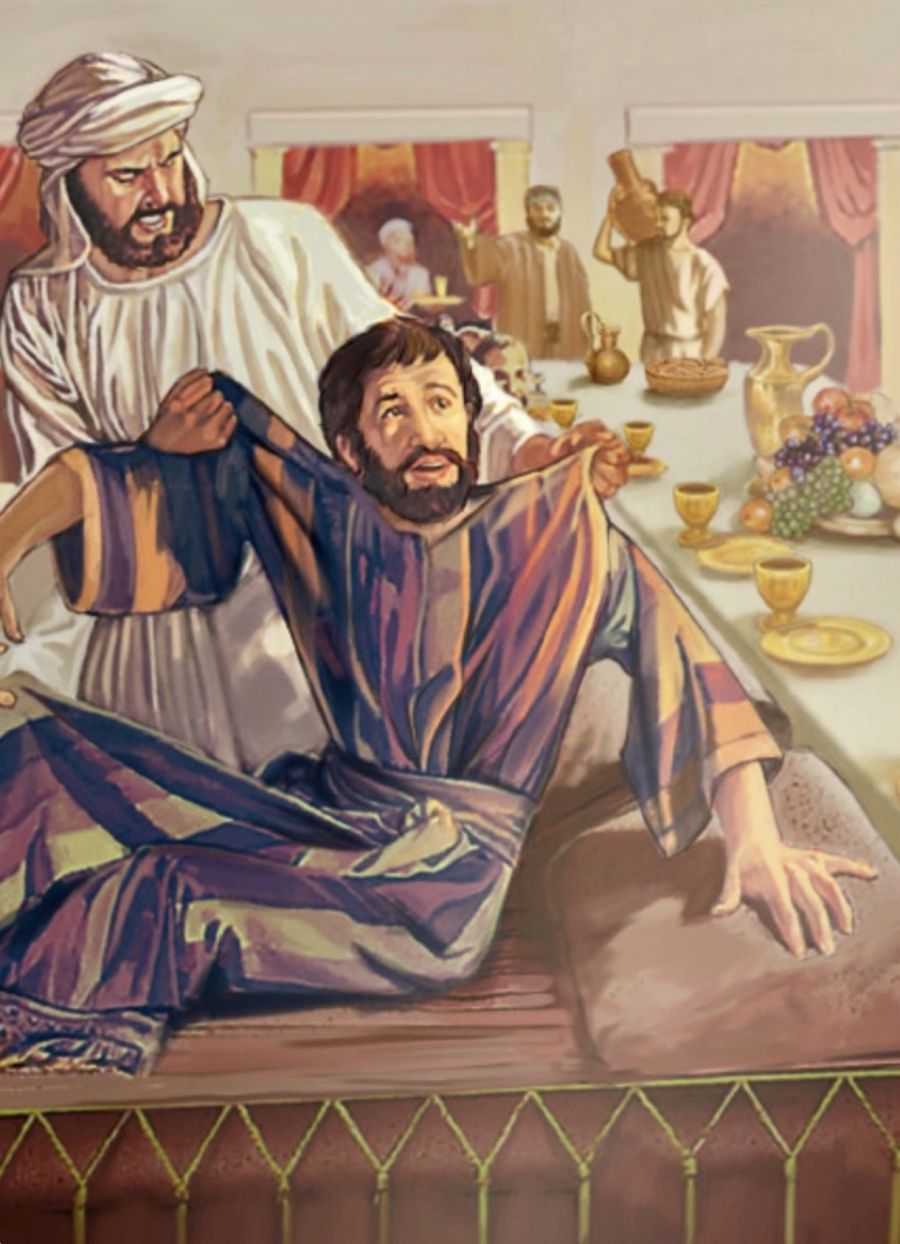
These two parables follow one another and, at first glance, do not seem to have much in common: the parable of the invitation to the wedding feast and that of the man turned away because he was not wearing wedding clothes. Some believe that, originally, these two parables were not connected: it would indeed seem contradictory to demand formal attire from someone who had been picked up off the street. But if Matthew deliberately placed them side by side, it means that we can draw a lesson from this connection. Let us examine them one by one. ‘A king was celebrating his son’s wedding.’ And this is not just any king, for right from the start we are told that we are speaking of the ‘Kingdom of Heaven’: this expression alone immediately suggests to us that it concerns the Covenant between God and humanity, a Covenant fulfilled in Jesus Christ; in the Gospels, he presents himself as the bridegroom. Moreover, the word ‘wedding’ occurs seven times in this parable. This wedding symbolism is not very common in our Christian language today; yet it is precisely in these terms that the later texts of the Bible describe God’s plan for humanity. From the final prophecies of Isaiah right through to the Book of Revelation, via the Song of Songs and the Wisdom Literature, to name but a few, God’s love for humanity is described in terms of conjugal love. And it is precisely for this reason that Saint Paul says that marriage is ‘the best image of God’s relationship with humanity’.
In the Old Testament, it was clear that the proclamation and fulfilment of the universal salvation of humanity were to come through Israel. The chosen people had a mission for the whole of humanity. It is in this sense that we have learnt to interpret God’s words to Abraham: ‘All the families of the earth shall be blessed through you’ (Gen 12:3). Returning to the wedding analogy, we might say that the Jews were the first to be invited to the wedding; the host was counting on them to then extend the invitation and bring in, in their wake, the whole of humanity. But we know how it turned out: the vast majority of Jews refused to recognise Jesus as the Messiah. In the parable, they are represented by the guests who refuse to come to the wedding and even go so far as to mistreat the servants who had gone to summon them. What will happen? In the parable, the servants fill the banquet hall with guests summoned at the last moment. In the Letter to the Romans, Paul comments that this rejection by Israel will not only fail to prevent the wedding, but will actually facilitate the entry of all peoples into the banquet hall. ‘The servants went out into the streets, gathered everyone they found, both good and bad, and the wedding hall was filled with guests’. Let us move on to the second parable: a man, invited at the last moment, enters without a wedding garment. He is utterly unable to answer the question: ‘Friend, how did you get in here without a wedding garment?’ He is then thrown out. This certainly does not mean that he had to meet a particular behavioural requirement, nor that the wedding garment symbolises any kind of merit. As soon as we speak of ‘merit’, we risk distorting the meaning of God’s grace, which by definition is free! With God, there are no conditions to fulfil. The first parable clearly states that everyone was allowed to enter, both the good and the bad. So, what might this second parable mean? Let us look at the crowd entering the wedding banquet hall. Whether good or bad, everyone was invited; everyone accepted and put on the wedding garment: they were able to welcome the unexpected invitation and prepare themselves.
Only one person did not deem it necessary to do so: he failed to appreciate the good fortune of this unhoped-for offer and to accept it with gratitude. When asked, ‘How did you manage to get in here without the wedding garment?’, he does not know what to say. A word of apology or repentance would have sufficed, but he remains silent. Failing to prepare for a banquet means attaching no importance to the invitation and showing contempt for the one who invites us. Ultimately, just like the first guests, he has sinned through indifference or presumption. In conclusion: the first virtue required of us is humility.
Commentary: The first guests refused the invitation and others took their place. Historically, this is precisely what happened. In the Acts of the Apostles we see the same scenario repeated several times: whenever Paul arrives in a new city, he first goes to the synagogue and proclaims to the Jews that Jesus is the long-awaited Messiah. Some believe him and become Christians. However, when Paul’s preaching goes beyond the confines of the synagogue and even the pagans begin to become Christians, the Jews who have not been persuaded become frightened and drive Paul out. This is what happened in Antioch of Pisidia: ‘It was necessary to proclaim the word of God to you first. But since you reject it and do not consider yourselves worthy of eternal life, we turn to the pagan nations.’ The same thing subsequently happened in Iconium and Thessalonica. Precisely because the apostles were driven out from one city to another, the Gospel spread from one city to another. One of the lessons of the first parable is therefore that Israel’s rejection cannot permanently halt God’s plan. Just as prostitutes and tax collectors took the place of the religious authorities in Jesus’ time, so, a few years later, when Matthew was writing his Gospel, pagans entered the Church in great numbers precisely because of the rejection by some Jews.
God always manages to bring good out of evil. There is also another interpretation of the wedding garment. In New Testament language, the wedding garment is that of the baptised. We know, in fact, that what we today call the ‘baptismal garment’ is in reality a ‘wedding garment’. The second parable would therefore concern the baptised: it is they who have entered the wedding hall. But we know that you cannot judge a book by its cover. Here, Jesus would be reminding us of the demands that stem from our Baptism. As he himself says: ‘Not everyone who says to me, “Lord, Lord,” will enter the Kingdom of Heaven, but only the one who does the will of my Father in heaven’ (Mt 7:21).
+Giovanni D’Ercole
