
17th Sunday in Ordinary Time (year A) [26 July 2026]
First Reading from the First Book of Kings (3:5, 7–12)
This passage from the First Book of Kings recounts the first great celebration of the reign of Solomon, David’s successor on the throne of Jerusalem. After his coronation, Solomon went to the sanctuary at Gibeon to offer a great sacrifice and there uttered a prayer that would become a model for all Israel.
However, the historical context shows that Solomon was not a perfect man. His accession to the throne was marked by dynastic struggles, political intrigues and violence. Although he was one of David’s youngest sons, he managed to secure power thanks to the rivalries among his elder brothers and the decisive intervention of his mother, Bathsheba. After his coronation, he swiftly eliminated his opponents. Therefore, his renowned wisdom was not an innate quality, but a gift received from God. True wisdom thus emerges as the most precious of all goods. Once in power, Solomon realised the difficulty of governing. This realisation represents the first sign of his wisdom. He recognised that the most precious good is not wealth or power, but wisdom, and that it comes only from God. In his prayer, he presents himself with humility: ‘I am a young and inexperienced man; grant your servant a discerning heart to govern your people and to distinguish between good and evil.’ His request recalls the hidden treasure and the precious pearl of which Jesus will speak in the Gospel (Mt 13:44–46): wisdom is worth more than any other good. Here is a lesson for all those who govern. The second lesson concerns not only kings, but anyone who exercises authority. Solomon does not ask for personal advantages, a long life, riches or victory over his enemies. He asks only for what is necessary to serve the people entrusted to him. In this, he shows that he has understood the ideal of the monarchy of Israel: the ruler must not seek his own interests, but the good and safety of the people. The prophets, beginning with Nathan, constantly reminded the kings of Israel of this mission. God’s response is generous: He appreciates the selflessness of the request and responds by granting Solomon a wise and discerning heart, superior to that of all other kings; by giving him the ability to discern and govern justly; and, furthermore, by granting him what he had not asked for: wealth, glory and prestige. This reveals God’s generosity: those who seek His will above all else also receive other gifts in addition. The theme echoes Jesus’ teaching: ‘Seek first the Kingdom of God, and all these things will be given to you as well’ (Mt 6:33).
Responsorial Psalm (118/119)
In the First Reading, Solomon, at the beginning of his reign, had grasped the essential truth: true wisdom is the most precious treasure and can come only from God.
He continues in the psalm: ‘The law from your mouth is more precious to me than thousands of pieces of gold and silver.’ And the psalmist adds: ‘How wonderful are your commandments; that is why I keep them!’ For the believer, faithfulness to the commandments is a delight, not a burden. This psalm is a litany of love for the Law; today’s verses are just a short stanza from a very long psalm: 176 verses = 22 stanzas of 8 verses each. Why 22 stanzas? Because there are 22 letters in the Hebrew alphabet. Each stanza is an ‘acrostic’: all 8 verses begin with the same letter, and the stanzas follow the alphabetical order from Alef to Tav. This is not literary virtuosity. It is a true profession of faith: a poem in honour of the Law, a meditation on the gift of God that is the commandments. Rather than a ‘psalm’, it is a litany in honour of the Law. It may sound strange to us, but that is how it is. In the Bible, to love the Law is to love the Father’s gift; this is why the biblical believer truly loves the Law. The commandments are not endured as God’s dominion over us, but as advice—the only valid advice for living happily. When the biblical person says this, they mean it with all their heart. And the Law is not endured as dominion; it is received as a gift that God gives to his people to warn them against all false paths. It is said that God ‘gives’ his Law, and it is indeed regarded as a ‘gift’. God did not merely free Israel from slavery in Egypt. By giving his Law, God has, in a sense, provided the ‘user’s manual’ for freedom. The Torah is an expression of God’s love for his people. If God is Love, his Law leads to love. We did not have to wait for the New Testament to discover that God is Love and that the Law has but one purpose: to lead us along the path of love. The entire Bible is the story of the chosen people’s learning, in the school of brotherly love, from Deuteronomy (Dt 6:4) to Leviticus (Lv 19:18). The famous Rabbi Hillel, who lived from 70 BC to 10 AD, said: ‘Do not do to your neighbour what you would hate for yourself: this is the whole of the Torah; the rest is commentary. Go and study.’ He also said: ‘Do not judge your neighbour until you have been in his place.’ Jesus takes the same line: the two commandments of love for God and for one’s neighbour sum up the whole Law. And the Golden Rule echoes this as follows: ‘Do to others whatever you would have them do to you: for this is the Law and the Prophets’ (Mt 7:12). Finally, this psalm resembles a litany: after the first three verses, which affirm the happiness of those faithful to the Law, the remaining 173 verses address God directly, at times in a contemplative tone, at others in supplication: ‘Open my eyes, that I may see the wonders of your Law’ (v. 18), and the litany continues, almost always repeating the same phrases. In Hebrew, eight identical words recur throughout all the stanzas to describe the Law: Law, Word, Precepts, Statutes, Commandments, Judgements, Promises, Ways. Only lovers repeat themselves like this without ever tiring. Nor is the number 8 coincidental: in the Bible, it is the number of the new creation. God created the first Creation in seven days; therefore, the eighth day will be that of the renewed Creation, of the ‘new heavens and new earth’. This will finally come to pass when all humanity lives according to God’s Law—that is, in love—because they are one and the same.
Second Reading from the Letter of Saint Paul the Apostle to the Romans (8:28–30)
For weeks now we have been reading chapter eight of the Letter to the Romans: Paul contemplates the whole of human history as a long journey towards a magnificent future. One day we shall be like Jesus Christ, in his image, and we shall be one with him. This is God’s plan: ‘God calls those he loves according to his plan’ (Rom 8:28), with the best commentary: ‘God chose you from the very beginning for salvation, through the Holy Spirit who sanctifies and through faith in the truth. For this is what he has called you to through our Gospel, so that you may share in the glory of our Lord Jesus Christ’ (2 Thessalonians 2:13–14). This plan, which culminates in union with Christ, is the work of the Spirit, made possible by our free participation. Paul puts it even more simply: ‘God calls you to his Kingdom and to his glory’ (1 Thessalonians 2:12). We are on a journey towards the transformation of our whole being, a ‘shaping’ that will mould us in the image of Christ. Earlier, Paul had compared this transformation to a birth: ‘The whole creation groans and suffers the pains of childbirth’ (Rom 8:22). Here we see the image of entering into a great family: God has ‘predestined us to be conformed to the image of his Son, so that he might be the firstborn among many brothers’ (Rom 8:29). Shortly before, he had called us “children of God” and had continued: “If we are children, then we are also heirs: heirs of God and co-heirs with Christ” (Rom 8:17). To God’s invitation to take part in this great plan, we respond with faith and trust. It is often said: “Man proposes, God disposes”, but here Paul says the opposite: ‘God proposes, man disposes’. God does not impose his plan on us; he proposes it to us. From the very beginnings of Revelation, we hear God calling humankind and proposing his Covenant to us, as if God were tirelessly repeating: ‘Love me, trust me, for I love you’. And this plan of God depends on our freedom. In today’s passage, the freedom to accept or refuse is expressed as follows: ‘Moreover, we know that all things work together for good for those who love God, for those who are called according to his purpose’ (Rom 8:2). The verb ‘to love’ indicates man’s free response to God’s proposal. It is not a feeling, it is an impulse, it is the adherence of ‘faith’ . Yet we remain free not to love God. In Paul’s vocabulary, we are all ‘known, called, justified, and brought into his glory’, provided we accept him. And he describes the journey of those who wish to enter into this plan of salvation. First, God sent his Son (Col 1:18). Thus, those who respond to God’s love resemble that Son who fulfilled the Father’s will for salvation: predestined, called, justified, glorified—that is, brought into perfect harmony with God, made partakers of his divine nature, already welcomed into his glory. It is no surprise that Paul concludes immediately afterwards: ‘What more can be said?’ Rom 8:31.
From the Gospel according to Matthew (13:44–52)
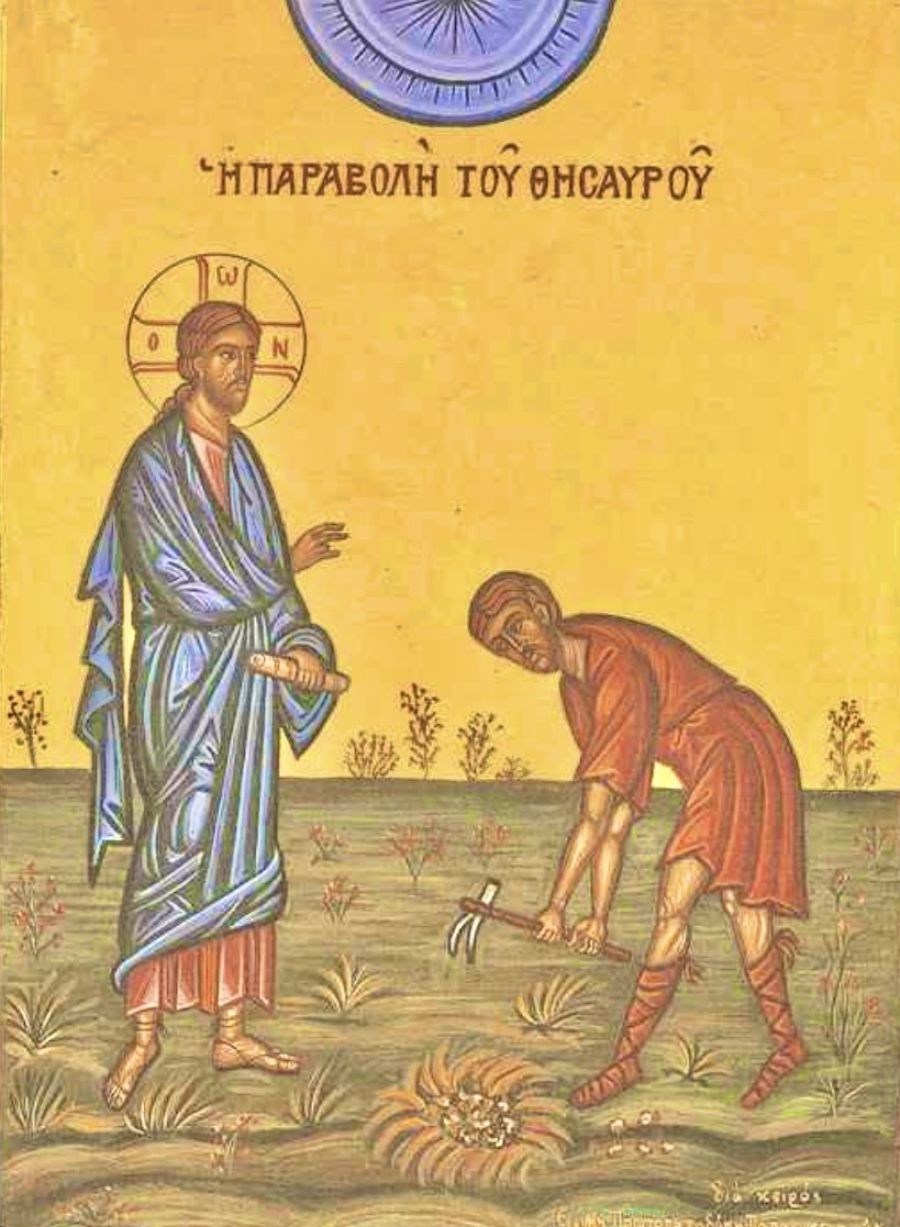
In this passage from the Gospel of Matthew, Jesus presents four brief parables to explain the meaning of the Kingdom of Heaven: the hidden treasure, the pearl of great price, the net cast into the sea, and the householder who brings out of his treasure things both new and old. The treasure and the pearl: the absolute value of the Kingdom. The first two parables convey the same message: a man discovers a treasure hidden in a field; a merchant finds a pearl of exceptional value. In both cases, the protagonists sell everything they own to acquire that unique treasure. This act of renunciation is not experienced as a loss, but as a joy, because the value of the treasure infinitely surpasses that of everything else. Jesus teaches that the Kingdom of God is the greatest good that exists. Those who discover it realise that it is worth more than any earthly wealth, security or success. The net and the final judgement. The third parable describes a bountiful catch. Once the net has been hauled ashore, the fishermen separate the good fish from the bad. Jesus applies this image to the Last Judgement: at the end of time, there will be a definitive distinction between what belongs to the Kingdom and what opposes it. As in the parable of the wheat and the tares, however, it is not simply a matter of dividing people into two rigid categories. Good and evil coexist within every person’s heart. The parable highlights the gravity of human choices: one cannot serve both God and other ‘masters’ at the same time. This is why Jesus continually calls for conversion: ‘Repent, for the Kingdom of Heaven is near.’ The same teaching emerges in his encounter with the rich young man: called to leave everything to follow Christ and gain a treasure in heaven, he is unable to give up his securities and goes away sad. These parables show that following Christ requires concrete decisions. There are no half-measures: every choice must be assessed in the light of the Kingdom of God. To welcome the Kingdom means being willing to let go of whatever prevents one from fully adhering to God’s will, just as one who sells everything to acquire the treasure or the pearl—a treasure both ancient and new. After asking his disciples whether they had understood his teaching, Jesus adds a fourth parable: ‘Every scribe who has become a disciple of the Kingdom of Heaven is like a householder who brings out of his treasure things both new and old.’ The scribes had a profound knowledge of the Old Testament Scriptures. However, in order to welcome the Kingdom proclaimed by Jesus, they had to open themselves to the newness of his revelation without losing the heritage they had received. The true disciple cherishes both: the treasure of the Old Covenant and the newness brought by Jesus Christ. This is why Jesus affirms: ‘I have not come to abolish the Law and the Prophets, but to bring them to fulfilment.’ The Old and New Testaments are not opposed to one another: the former prepares and announces, the latter realises and brings to fulfilment. Knowing both constitutes the true treasure of the Christian faith. The life of Paul of Tarsus represents a living synthesis of these parables. Having enjoyed prestige as a Jew and a Pharisee, he regards all that as a loss compared with the knowledge of Christ. In his letter to the Philippians, he states that every human privilege pales in comparison with the gift of Christ, for which he was willing to lose everything. Ultimately, the four parables converge on a single teaching: the Kingdom of God is the supreme treasure; it is worth giving up everything to obtain it; our choices have decisive consequences; the disciple must embrace both the richness of the Old Covenant and the newness of Christ; true wisdom lies in recognising that nothing is of greater value than communion with God. The ‘treasure hunt’ of which Jesus speaks is not the pursuit of material goods, but the discovery of the Kingdom, a treasure so great that it renders everything else secondary.
+Giovanni D’Ercole
