
Third Lent Sunday (year A) [8 March 2026]
May God bless us and the Virgin Mary protect us! Have a good Lenten journey as we pause today with Jesus at the well, a place of life-changing encounters.
*First Reading from the Book of Exodus (17:3-7)
Looking at a map of the Sinai desert, Massa and Meriba are nowhere to be found: they are not specific geographical locations, but symbolic names. Massa means 'challenge', Meriba means 'accusation'. These names recall an episode of challenge, of protest, almost of mutiny against God. The episode takes place in Rephidim, in the middle of the desert, between Egypt and the Promised Land. The people of Israel, led by Moses, advanced from stage to stage, from one water source to another. But at Rephidim, the water ran out. In the desert, under the scorching sun, thirst quickly becomes a matter of life and death: fear grows, panic takes over. The only right response would have been trust: 'God wanted us to be free, he proved it, so he will not abandon us'. Instead, the people give in to fear and react as we often react ourselves: they look for someone to blame. And the culprit seems to be Moses, the 'government' of the time. What is the point, they say, of leaving Egypt only to die of thirst in the desert? Better to be slaves but alive than free but dead. And, as always happens, the past is idealised: they remember the full pots and abundant water of Egypt, forgetting the slavery. In reality, behind the accusation against Moses, there is a deeper accusation: against God himself. What kind of God is this, they ask themselves, who frees a people only to let them die in the desert? The protest: Why did you bring us out of Egypt? To let us, our children and our livestock die of thirst? It becomes increasingly harsh, until it turns into a real trial against God: as if God had freed the people only to get rid of them. Moses then cries out to the Lord: What shall I do with this people? A little more and they will stone me!
And God replies: he orders him to take the staff with which he had struck the Nile, to go to Mount Horeb and to strike the rock. Water gushes forth, the people drink, and their lives are saved (cf. Exodus 17). That water is not only physical relief: it is a sign that God is truly present among his people, that he has not abandoned them and that he continues to guide them on the path to freedom. For this reason, that place will no longer be called simply Rephidim, but Massah and Meribah, 'Testing and Accusation', because there Israel tested God, asking themselves: Is the Lord among us or not? In modern language: 'Is God for us or against us?' This temptation is also ours. Every trial, every suffering, reopens the same original question: can we really trust God? It is the same temptation recounted in the Garden of Eden (Genesis): the suspicion that God does not really want our good poisons human life. This is why Jesus Christ, teaching the Our Father, educates his disciples in filial trust. Do not abandon us to temptation could be translated as: "Do not let our Refidim become Massa, do not let our places of trial become places of doubt." Continuing to call God "Father," even in difficult times, means proclaiming that God is always with us, even when water seems to be lacking.
*Responsorial Psalm (94/95),
In the Bible, the original text of the psalm reads as follows: "Today, if you hear his voice,
do not harden your hearts as at Massah and Meribah, as on the day of Massah in the desert, where your fathers tested me even though they had seen my works." This psalm is deeply marked by the experience of Massah and Meribah. This is why the liturgy proposes it on the third Sunday of Lent, in harmony with the story of the Exodus: it is a direct reference to the great question of trust. In a few lines, the psalm summarises the whole adventure of faith, both personal and communal. The question is always the same: can we trust God?
For Israel in the desert, this question arose at every difficulty: ' Is the Lord really among us or not?' In other words: can we rely on Him? Will He really support us? Faith, in the Bible, is first and foremost trust. It is not an abstract idea, but the act of 'relying' on God. It is no coincidence that the word 'Amen' means 'solid', 'stable': it means 'I trust, I have faith' . This is why the Bible insists so much on the verb 'to listen': when you trust, you listen. It is the heart of Israel's prayer, the Shema Israel: Hear, O Israel: the Lord is our God... You shall love Him, that is, you shall trust Him. 'To listen' means to have an open ear. The psalm says: 'You have opened my ear' (Ps 40), and the prophet Isaiah writes: The Lord God has opened my ear. Even 'obeying' in the Bible means this: listening with trust. This trust is based on experience. Israel has seen the 'work of God': liberation from Egypt. If God has broken the chains of slavery, He cannot want His people to die in the desert. This is why Israel calls him 'the Rock': it is not poetry, it is a profession of faith. At Massah and Meribah, the people doubted, but God brought water out of the rock: since then, God has been the Rock of Israel. Even the story of the Garden of Eden (Genesis) can be understood in the light of this experience: every limitation, every command, every trial can become a question of trust. Faith is believing that, even when we do not understand, God wants us to be free, alive and happy, and that from our situations of failure he can bring forth new life. Sometimes this trust resembles a 'leap of faith' when we cannot find answers. Then we can say with Simon Peter in Capernaum: 'Lord, to whom shall we go? You have the words of eternal life'. When Paul of Tarsus writes: ' Be reconciled to God', it is like saying: stop suspecting God, as at Massah and Meribah. And when the Gospel of Mark says, 'Repent and believe in the Gospel', it means: believe that the Good News is truly good, that God loves you. Finally, the psalm says, 'Today'. It is a liberating word: every day can be a new beginning. Every day we can relearn to listen and to trust. This is why Psalm 94/95 opens the Liturgy of the Hours every morning and Israel recites the Shema twice a day. And the psalm speaks in the plural: faith is always a journey of a people. 'We are the people He guides'. This is not poetry: it is experience. The Bible knows a people who, together, come to meet their God: "Come, let us acclaim the Lord, let us acclaim the rock of our salvation." It is faith that comes from trust, renewed today, day after day.
*Second Reading from the Letter of St Paul to the Romans (5:1-2, 5-8)
Chapter 5 of the Letter to the Romans marks a decisive turning point. Up to this point, Paul of Tarsus had spoken of humanity's past, of pagans and believers; now he looks to the future, a future transfigured for those who believe, thanks to the life, death and resurrection of Jesus Christ. To understand Paul's thinking clearly, we can summarise it in three fundamental statements. 1. Christ died for us while we were sinners. Paul affirms that Christ died 'for us'. This expression does not mean 'in our place', as if Jesus had simply replaced those who were condemned, but 'on our behalf'. When humanity was incapable of saving itself, marked by violence, injustice, greed for power and money, Christ took this reality upon himself and fought it to the point of giving his life.
Humanity, created for love, peace and sharing, had lost its way. Jesus comes to say, with his life and death: "I will show you to the very end what it means to love and forgive. Follow me, even if it costs me my life."
2. The Holy Spirit has been given to us: God's love dwells in us. The second great affirmation is this: the Holy Spirit has been given to us, and with him, God's own love has been poured into our hearts. It is no coincidence that Paul speaks of the Spirit for the first time when he speaks of the cross. For him, passion, cross and gift of the Spirit are inseparable. Here Paul is in complete harmony with the evangelist John. In his Gospel, during the Feast of Tabernacles, Jesus promises "living water," explaining that he was speaking of the Spirit (cf. Gospel of John (7:37-39). And at the moment of the cross, John writes: Bowing his head, Jesus gave up his spirit (Jn 19:30). The promise is fulfilled: from the cross comes the gift of the Spirit. 3. Our 'boast' is the hope of God's glory. Paul also speaks of 'pride', but he makes it clear: we cannot boast about ourselves, because everything is a gift from God; but we can boast about God's gifts, about the wonderful destiny to which we are called. The Spirit already dwells in us, and we know that one day this same Spirit will transform our bodies and hearts into the image of the risen Christ.
The account of the Transfiguration has given us a foretaste of this glory.
From Massah and Meribah to glory. What an immense journey compared to Massah and Meribah, where the people doubted God! Now, thanks to our faith in Christ, we can say with Paul: "Through him we also have access by faith into this grace in which we stand, and we rejoice in hope of the glory of God" (5:2). In conclusion, the Spirit that Jesus has given us is the very love of God. This certainty should overcome all fear. If God's love has been poured into our hearts, then the forces of division will not have the last word.
For believers, and for all humanity, hope is well-founded, because "the love of God has been poured into our hearts through the Holy Spirit who has been given to us" (5:5).
*From the Gospel according to John (4:5-42)
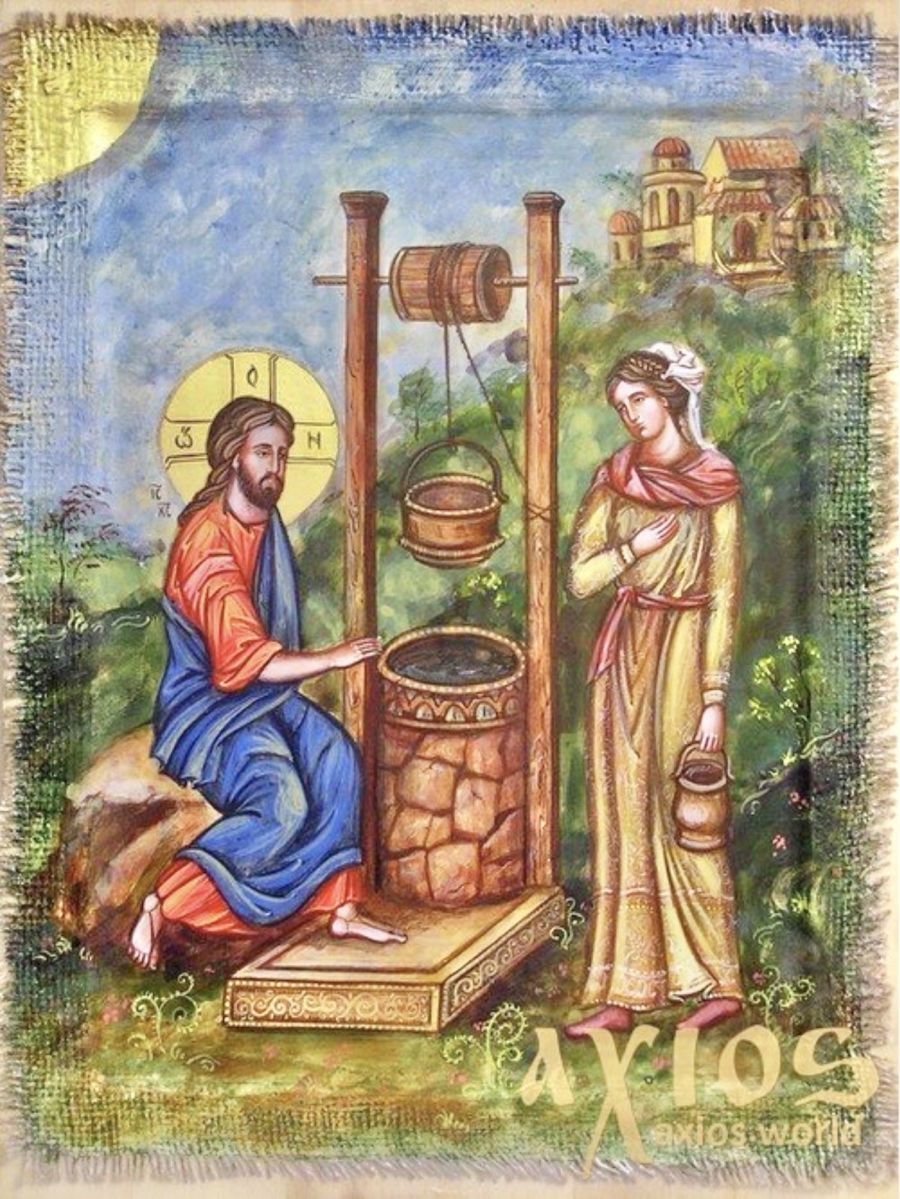
Jesus meets us today at the well. And this detail is not secondary. In the Bible, the well is never just a place where water is drawn: it is a place of decisive encounters, where life changes direction. At a well, Abraham's servant meets Rebecca, who will become Isaac's wife; at a well, Jacob falls in love with Rachel. At the well, relationships, alliances and the future are born. When John places Jesus at a well, he is telling us that something decisive is about to happen. Jesus arrives at Jacob's well in Samaria. It is midday. Jesus is tired and sits down. The Gospel immediately shows us a God who stops, who accepts fatigue, who enters our life as it is. Salvation begins with a pause, not with a spectacular gesture. At that hour, a woman arrives. She is alone. Jesus says to her, 'Give me a drink'. It is a surprising request. Jesus, a Jew, speaks to a Samaritan woman; a man speaks to a woman; a righteous man speaks to a person whose life has been wounded. God does not enter our lives by imposing himself, but by asking. He becomes a beggar for our hearts. From that simple request, a dialogue arises that goes ever deeper. Jesus leads the woman from the external well to her inner thirst: "If you knew the gift of God..." The water that Jesus promises is not water to be drawn every day, but a spring that gushes within, a life that does not run dry. It does not eliminate daily life, but transfigures it from within. Then Jesus touches on the truth of the woman's life. He does not judge her, he does not humiliate her. In the Gospel, truth does not serve to crush, but to liberate. Only those who accept to be known can receive the gift. The woman then asks a religious question: where should God be worshipped? On the mountain or in the temple? Jesus responds by shifting the focus: no longer where, but how. 'In Spirit and truth'. God is no longer encountered in one place as opposed to another, but in a living relationship. The true temple is the heart that allows itself to be inhabited. When the woman speaks of the Messiah, Jesus makes one of the most powerful revelations in the entire Gospel: 'I am he, the one who is speaking to you'. The Messiah does not manifest himself in the temple, but in a personal dialogue, at a well, to a woman considered unclean. As in the ancient stories of wells, here too the encounter opens up a promise: but now the Bridegroom is Jesus Christ and the covenant is new. The woman leaves her jug behind. It is a simple but decisive gesture. The jug represents old certainties, repeated attempts to quench a thirst that never goes away. Those who have encountered Christ no longer live to draw water, but to bear witness. The woman runs into town and says, 'Come and see'. She does not give a lesson, she recounts an encounter. And many believe, to the point of saying, 'Now we no longer believe because of what you said, but because we ourselves have heard'. Today's Gospel tells us this: Christ does not take us away from the well of life, but transforms the well into a place of salvation. Our thirst becomes an encounter, the encounter becomes a gift, the gift becomes a source for others. This is Lent: allowing ourselves to be encountered by Christ and becoming, in turn, living water for those who are thirsty.
+Giovanni D'Ercole
