
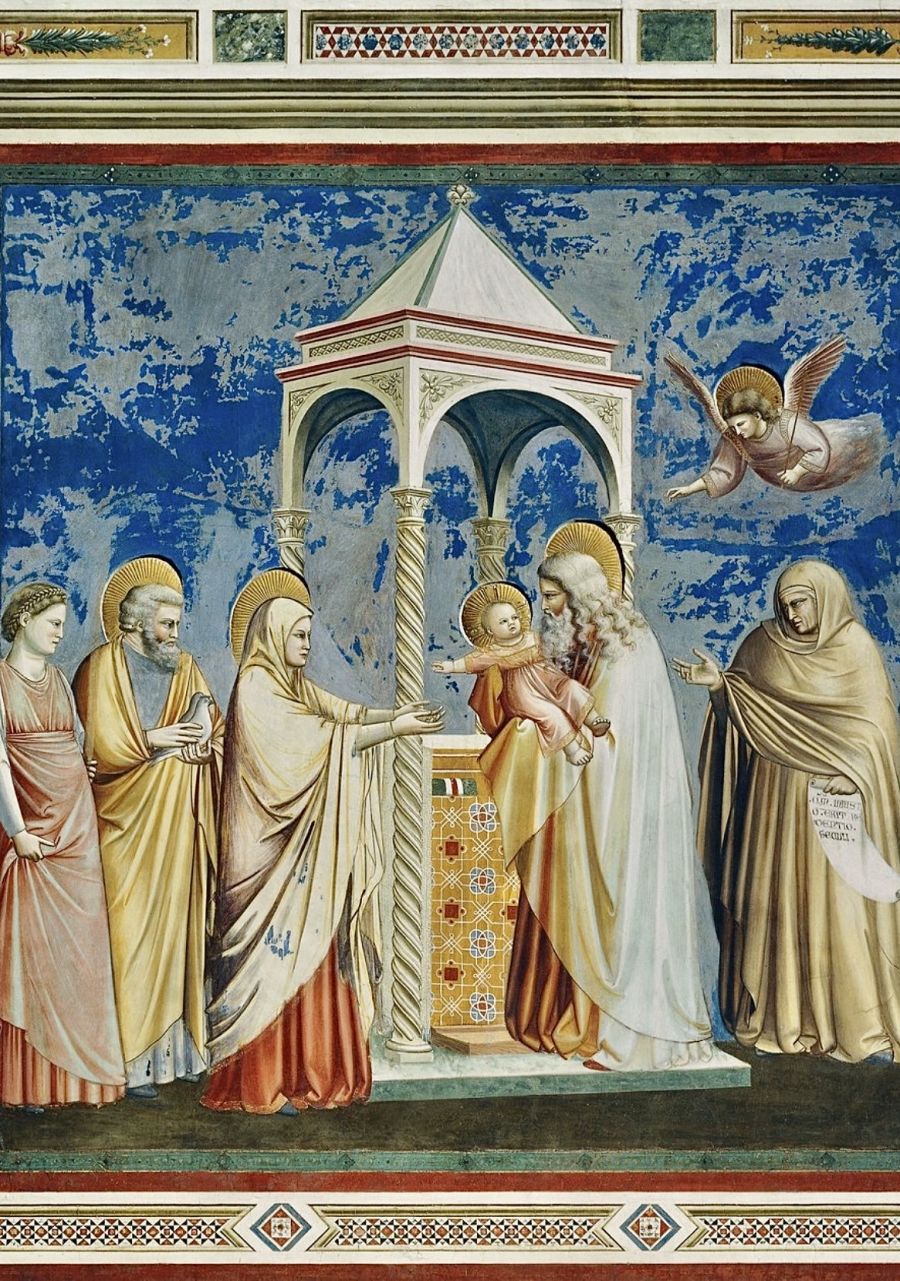
Presentation of Jesus at the Temple [2 February 2026]
May God bless us and may the Virgin protect us! Here is also a brief commentary on the texts of the liturgy for the feast of the Presentation of Jesus at the Temple.
*First Reading from the Book of the Prophet Malachi (3:1-4)
Malachi's text was written in a context of crisis: there was no longer a Davidic king, the people were subjugated by the Persians, and authority was in the hands of the priests. For this reason, the prophet insists on the covenant with the Levites, recalling its divine origin and denouncing its present corruption. The central announcement is the imminent coming of the Lord to his temple, also called the Angel of the Covenant: not a simple messenger, but God himself who comes to re-establish the Covenant. This coming is both desired and feared, because it is a coming of judgement that purifies: it does not destroy man, but eliminates the evil that is in him. Before this coming, God sends a messenger who prepares the way by calling for conversion. The New Testament will recognise John the Baptist as this precursor and Jesus himself as the Angel of the Covenant announced by Malachi. The message remains relevant today: God enters his temple to renew the Covenant, purify worship and lead his people back to fidelity of heart.
*Responsorial Psalm (23/24, 7, 8, 9, 10)
The poetic expression "Lift up your heads, O gates" (v. 9) is a hyperbole that celebrates the majesty of the "King of Glory," that is, God himself, who solemnly enters the Temple of Jerusalem. The gates do not simply open: they are lifted up, as if the building itself had to become larger to accommodate the divine presence. The psalm refers to the solemn dedication of the first Temple by Solomon (around 950 BC), when the Ark of the Covenant was carried in procession to the Holy City, accompanied by singing, music and sacrifices. The Ark, placed in the Holy of Holies under the wings of the cherubim, represented the invisible throne of God in the midst of his people. The cherubim, far from the imagery of little angels, were majestic and symbolic figures, a sign of divine sovereignty. The psalm seems to be structured as a liturgical dialogue between two choirs: one invites the gates to open, the other proclaims the identity of the king of glory as the strong and victorious Lord. The warrior titles remind us that God accompanied Israel in its struggles for freedom and survival: the Ark was the sign of his presence in the people's battles. Even after the disappearance of the Ark, especially after the Babylonian Exile, this psalm continued to be sung in the Temple. It was precisely the absence of the Ark that increased its spiritual value: Israel learned that God's presence is not tied to an object, however sacred and laden with memory. Over the centuries, the psalm took on a messianic meaning: the invocation 'let the King of glory enter' became an expression of the expectation of the Messiah, the definitive king who would defeat evil and inaugurate a renewed humanity. The 'Lord of hosts' came to be understood progressively as the God of the universe, no longer just the God of Israel but the Lord of all humanity. This is why the Christian liturgy sings this psalm on the feast of the Presentation of Jesus in the Temple: it is a profession of faith that recognises in that child the true king of glory, God himself who enters his Temple and comes to meet his people.
*Second Reading from the Letter to the Hebrews (2:14-18)
The Letter to the Hebrews was written in a climate of controversy: Christians of Jewish origin were accused of following a Messiah who could not be a priest according to the Law. The author responds by showing that Jesus fulfils the priesthood in a new and definitive way. Although he does not belong to the tribe of Levi, Jesus is a priest according to the order of Melchizedek, that is, in a more ancient and universal form. He does not reproduce the priesthood of the Old Testament, but brings it to fulfilment, realising its profound purpose. Jesus is a true priest because: he is fully in solidarity with humanity, sharing its weakness, suffering and death; he is in full communion with God, as his resurrection demonstrates; he re-establishes the Covenant, freeing humanity from fear and the slavery of death. Salvation is offered to all, but it concerns in particular the 'children of Abraham', that is, those who live in faith as trust. The Covenant is a free gift from God, but it requires a free response: to accept or reject it remains the responsibility of man.
*From the Gospel according to Saint Luke (2:22-40)
The account of the Presentation of Jesus in the Temple is constructed with great care and highlights two fundamental elements: the Law and the Spirit. In the first verses, Luke repeatedly emphasises the Law of Israel, not as a simple set of prescriptions, but as an expression of the faith and expectation of the people. Jesus' life begins within the faith of Israel: Mary and Joseph devoutly perform the prescribed gestures, placing the child within the history and hope of their people. Luke's first message is clear: the salvation of humanity is born within the Law of Israel. It is in this context that the Word of God became incarnate and that God's plan of love for humanity took shape. Immediately afterwards, Simeon enters the scene, guided by the Holy Spirit, who is also mentioned several times. It is the Spirit who reveals the identity of the child to him: Jesus is the Saviour prepared by God before all peoples. Simeon's words summarise the entire Old Testament as a long preparation for the fulfilment of salvation, which concerns not only Israel but all humanity. Israel is the 'glory' because it has been chosen as the instrument of universal salvation. The event takes place in the Temple of Jerusalem, a decisive place for Luke: here Malachi's prophecy about the Lord's sudden entry into his Temple is fulfilled. Jesus is recognised as the Angel of the Covenant, the Lord himself who comes to visit his people. The images of light and glory used by Simeon fit perfectly into this perspective. The story also recalls the Psalm of the 'king of glory': the long-awaited royal Messiah enters the Temple, not with outward power, but in the poverty of a newborn baby. Nevertheless, the scene is solemn and full of glory, because in that child is present all the expectation of Israel, represented by Simeon and Anna, figures of faithful hope. Simeon's canticle affirms that Jesus is the Messiah and the glory of God: with him, divine glory enters the Sanctuary. This means that Jesus not only brings the glory of God, but is the glory of God, is God himself present among his people. With his coming, the time of the Law reaches its fulfilment: the Angel of the Covenant has entered the Temple to give the Spirit, enlighten the nations and inaugurate the new time of universal salvation.
+Giovanni D'Ercole
