1. “Well done, good and faithful servant; you have been faithful with a few things; I will put you in charge of many things. Come and share your master’s joy” (Mt 25:23).
As the end of the liturgical year draws near, the Church invites us to listen to the Lord’s words, which urge us to keep watch whilst awaiting the Second Coming. We must prepare for this with a simple yet resolute response to the call to conversion that Jesus addresses to us, calling us to live the Gospel as a source of striving, hope and anticipation.
Today, in the liturgy, the Saviour speaks to us through the parable of the talents, to show us how those who adhere to him in faith and live actively whilst awaiting his return are likened to the ‘good and faithful servant’, who, with wisdom, diligence and fruitfulness, manages the affairs of his master whilst he is away.
What does ‘talent’ mean? Literally, it refers to a coin of great value used in Jesus’ time. Figuratively, it means ‘gifts’, which are bestowed upon every individual: the totality of qualities with which a person, in their psychophysical wholeness, is endowed ‘by nature’.
However, the parable highlights that these abilities are at the same time a ‘gift’ from the Creator, bestowed upon every person.
These ‘gifts’ are diverse and multifaceted. This is confirmed by observing human life, in which we see the variety and richness of the talents found in people.
Jesus’ parable firmly emphasises that every ‘talent’ is a calling and an obligation to undertake a specific task, understood in the dual sense of working on oneself and working for others. It affirms, in other words, the need for personal self-discipline combined with active service to one’s neighbour.
4. Often the gifts that God places within us are difficult talents, but they must not be squandered—neither out of self-doubt, nor out of disobedience, nor, least of all, because they are arduous. For Christ, the cross was not a reason to object to the Father’s will, but the very condition—the supreme talent—by which ‘by dying he destroyed death and, by rising again, restored life to us’ (Easter Preface). I therefore ask all of you, and in particular the sick, the suffering and those with disabilities, to bring to fruition, through prayer and self-offering, the difficult and demanding gift you have received.
Always bear in mind that your invocations, your prayers and your willing acceptance of life’s hardships and sufferings enable you to reach out to all people and to contribute to the salvation of the whole world.
5. This work on oneself, which bears fruit for all people, has its roots in Baptism, which gave rise to new life within each of you through the supernatural gift of grace and liberation from original sin. Through this sacrament, which has made you children of God, you have received those ‘gifts’ which constitute a true inner wealth of life in Christ.
Incorporated into Jesus and conformed to him, you are called, as living members, to contribute with all your strength and talents to the growth of your parish, which is the gateway to the Roman-Universal Church.
The talents received at Baptism are also a call to cooperate with grace, which entails a dynamism inherent in the Christian life and a gradual and constant growth towards that maturity which is shaped by faith, hope, charity and the gifts of the Holy Spirit.
This collaboration is realised above all in that centre of communion which is the parish, a community of men and women who place their various abilities at the service of their own personal growth and that of their brothers and sisters, both near and far.
The parish is the Church: a community of people who must develop within themselves ‘the gifts of Baptism’. Its entire structure, by fostering and ensuring a communal apostolate—above all through the liturgy, catechesis and charity—unites the many human differences found within it and enables everyone, according to their own abilities, to make a fraternal contribution to every missionary initiative of their ecclesial family (cf. Apostolicam Actuositatem, 10).
6. Today’s Gospel parable also speaks of a talent ‘buried in the ground’, left unused.
‘The one who had received a single talent said: “Lord, I know that you are a hard man, reaping where you have not sown and gathering where you have not scattered seed; out of fear I went and hid your talent in the ground; here is your talent”’ (Mt 25:24–25). This last servant, who received only one talent, illustrates how a person behaves when they do not live out an active fidelity to God. Fear, self-importance and the assertion of selfishness prevail, as he seeks to justify his behaviour by citing the master’s unjust demand—that he reaps where he has not sown.
This attitude warrants punishment from the Lord, for that man has failed in the responsibility entrusted to him and, in so doing, has not fulfilled what God’s will required, with the consequence that he has neither realised his own potential nor been of any use to anyone.
On the other hand, working on oneself and for the world is something that must concretely engage the true disciple of Christ. In the various and specific situations in which the Christian finds himself, he must be able to discern what God wants of him and carry it out with that joy which Jesus then makes full and eternal.
7. Dearest brothers and sisters, I urge you to unite yourselves with all your spirit to the sacrifice of Christ, to the Eucharistic liturgy, which each time represents the presence of the Saviour in your community.
Persevere in being, and in becoming ever more, one heart and one soul, so that you may welcome Christ amongst you every day. May he enter into you, and remain in you, to bring you his fullness.
May the Mother of God, Saint Mary of the People, bring Jesus into your community and help it to remain with her Son, so that it may bear much fruit.
Here is the essence of the teaching contained in the parable of the talents, which we have listened to and meditated upon together: to have the fullness of life and bear fruit, we must, with passionate vigilance, fulfil God’s will and remain in Christ, through supplicatory and adoring prayer.
Let us remain in him! Let us remain in Jesus Christ!
Let us remain through all the talents of our soul and our body!
Through the talents of sanctifying and active grace!
Through all the talents that come from participating in the Word of God and the sacraments, especially in the Eucharist!
Let us remain!
Let us remain so that we may bear much fruit!
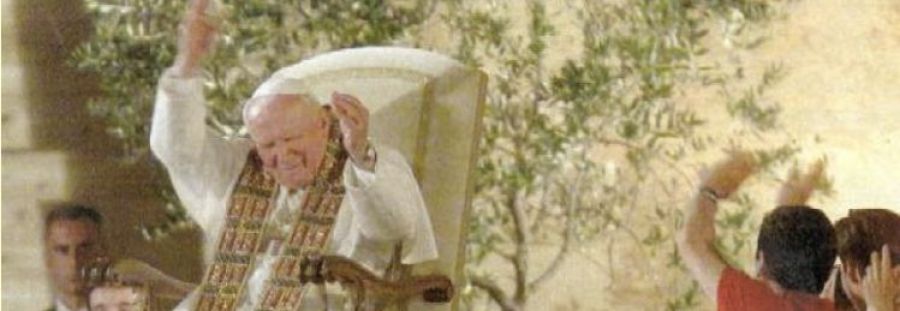
[Pope John Paul II, homily, 18 November 1984]
Nov 7, 2026
Written by
don Giuseppe Nespeca
-
font size
decrease font size
 increase font size
Virtues and Gifts

don Giuseppe Nespeca
Giuseppe Nespeca è architetto e sacerdote. Cultore della Sacra scrittura è autore della raccolta "Due Fuochi due Vie - Religione e Fede, Vangeli e Tao"; coautore del libro "Dialogo e Solstizio".
Email This email address is being protected from spambots. You need JavaScript enabled to view it.