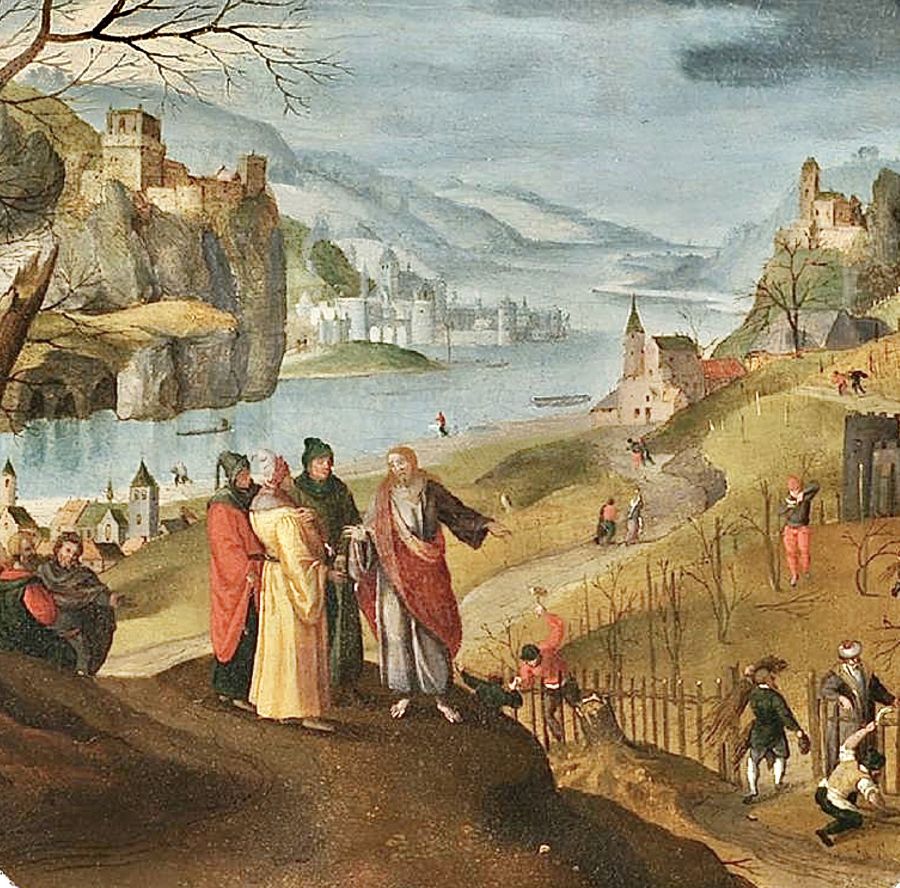
Jesus tells the parable of the murderous farmers. Only at the end do the priests and Pharisees realise that it was directed at them, and they try to arrest him, though they fear the crowd, who regarded him as a prophet.
Francis knew full well that Jesus is the Cornerstone, rejected by the builders, yet precious and as firm as granite in the sight of God.
He knew and repeated in his heart the Psalm (118) which captures all this:
«Jesus said to them, “Have you never read in the Scriptures: ‘The stone which the builders rejected has become the cornerstone […]’» (Mt 21:42).
In the Sources, indeed, we find the Poverello’s great respect for the stones that reminded him of the Cornerstone: Christ.
Celano, in the Second Life, emphasises:
“He walked reverently upon the stones, out of respect for the One who is called the Stone. And when he had to recite the verse which says, ‘Upon the rock you have set me’, he altered the words out of greater reverence: «Beneath the feet of the Rock you have set me»” (FF 750).
Following Christ’s example and through the work of the Holy Spirit, Francis became a stone in the edifice of the Church.
The Major Legend attests to this:
“During the two years following the appearance of the stigmata, he, like a stone intended for the edifice of the heavenly Jerusalem, had been hewn by the blows of trial through his many and tormenting infirmities, and, like malleable material, had been brought to the highest perfection under the hammer of numerous tribulations” (FF 1239).
Alongside Francis, Clare too was transformed into a cornerstone for the Order of the Poor Ladies.
We read: “The first work Francis undertook […] was to rebuild a temple to the Lord. He did not set out to build a new one, but restored an ancient and dilapidated church; he did not undermine the foundations, but built upon them, thus—without realising it—leaving primacy to Christ. For no one could lay any foundation other than the one already laid: Jesus Christ.
Having therefore returned to the place where, as has been said, the church of San Damiano had once stood, with the grace of the Most High he repaired it with great diligence in a short space of time” (FF 350).
“This is the blessed and holy place where, through the work of Francis himself, the glorious Order of the «Poor Ladies» and holy virgins had its happy beginning, almost six years after his conversion.
It was there that Sister Clare, also a native of Assisi, a most precious and strong stone, became the cornerstone for all the other stones of this religious family” (FF 351).
Upon the Cornerstone of Christ—He whom the murderous vineyard-keepers persecuted and killed—stones brought to life by Him were laid (finding there their place and meaning) to build the Kingdom of God through the power of the Spirit.
27th Sunday in Ordinary Time, year A (Mt 21:33–43)