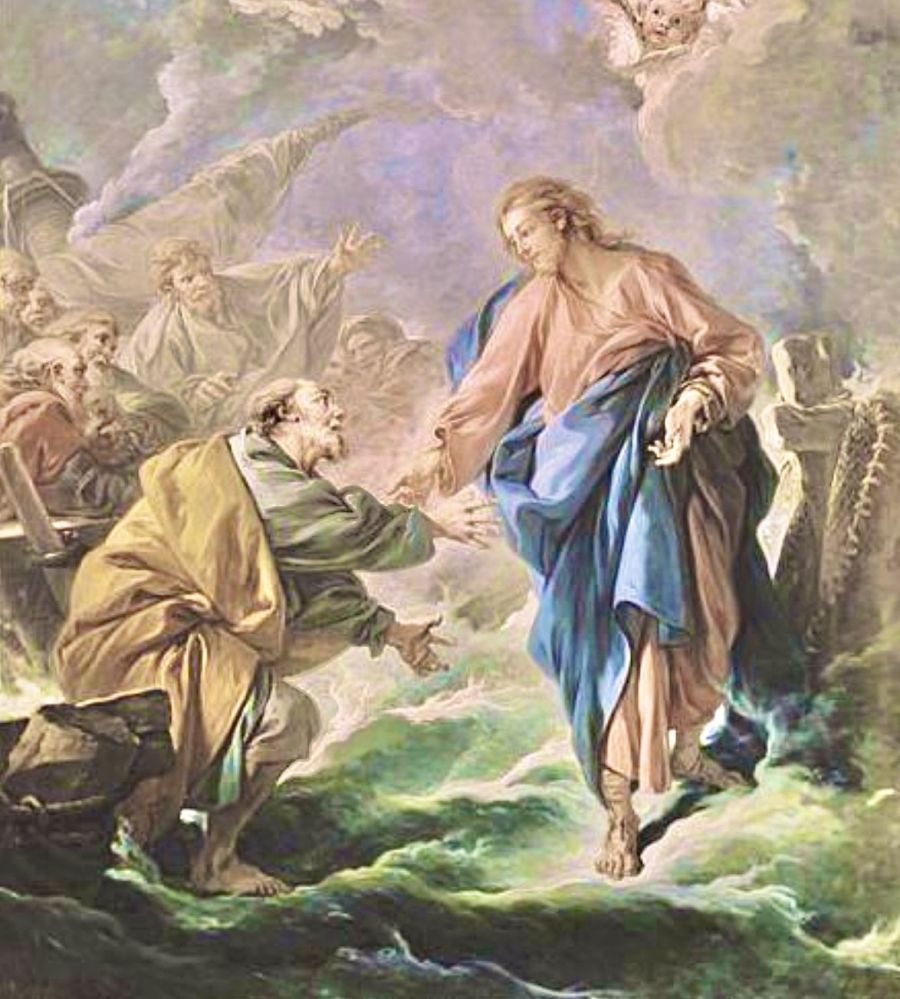
The Gospel passage from Matthew presents Jesus who, after praying in seclusion, approaches his disciples in the boat at the end of the night, walking on the water.
After the crossing, the people gathered round Him to seek healing of body and soul.
The Poor Man of Assisi, too, sought a solitary relationship with the Father before meeting the crowd, who sought healing of body and soul, perhaps by touching his rough habit.
The crowd flocked to him devoutly, for they longed to ‘be’ with God.
Francis, a servant of Christ, was a simple man yet eager to ‘dwell’ with the Lord, so that he might conform himself to the Gospel and help his brothers to flourish and grow in the path of unwavering faith.
For this reason, as soon as he was free, he would withdraw into solitude to pray, seeking enlightenment and a deeper commitment to the divine plan, without fear.
The Sources portray Francis as an ‘Alter Christus’, in whose image he was even in his solitude ‘on the Mount’ to enter into the intimacy of the Father.
Indeed, we read:
“Desiring to devote himself solely to God and to purify his spirit from the dust of the world, which might have defiled him whilst living amongst men, the blessed and venerable Father Francis one day withdrew to a place of contemplation and silence [La Verna], leaving behind the crowds who flocked devoutly to him every day to hear and see him.
He was in the habit of dividing and allocating the time granted to him for the acquisition of graces, as he deemed most appropriate: one part for the good of his neighbour, the other reserved for solitary contemplation. He therefore took with him a very small number of companions, among the closest and most intimately involved in his life, so that they might shield him from visits and the disturbance of others and serve as loving and faithful guardians of his peace.
He remained in that solitude for a certain period, and having attained, through intimate prayer and frequent contemplation, an extraordinary intimacy with God, he longed to know what about him and within him might be most pleasing to the eternal King” (FF 479).
He knew, in fact, that he would help to develop the disciples’ fearful faith only through a trusting surrender to God, who does not cause one to falter or drown in dangers.
In the face of adverse winds, the stability of the existential ‘boat’ in God’s hands brings salvation.
«And having sent the crowds away, he went up the mountain by himself to pray» (Mt 14:23)
Tuesday of the 18th wk. in Ordinary Time (Mt 14:22–36)